Advertisements
Advertisements
प्रश्न
Cellulose-rich food substances are good source of roughage in human beings because ______.
विकल्प
human beings do not have cellulose-digesting enzymes.
cellulose gets absorbed in the human blood and converts into fibres.
the cellulose-digesting bacteria convert cellulose into fibres.
cellulose breaks down into smaller components which are egested as roughage.
Advertisements
उत्तर
Cellulose-rich food substances are good source of roughage in human beings because human beings do not have cellulose-digesting enzymes.
Explanation:
Human beings do not have cellulose-digesting enzymes in their bodies and are therefore unable to digest cellulose. Since it is not digested, it passes down the entire digestive tract from mouth to anus. It acts as roughage, adds bulk to the food and helps the body to easily get rid of undigested food.
APPEARS IN
संबंधित प्रश्न
Draw neat labelled diagram of the pancreas with their associated structures
What is the role of saliva in the digestion of food?
The stomach releases hydrochloric acid and ______ juices which act on food.
Carbohydrates are bodybuilding nutrients.
Name the enzyme present in human saliva. What type of food material is digested by this enzyme?
Which of the organs performs the function in humans?
Absorption of food
Mention two ways in which the ileum of the mammal is adapted for the absorption of digested food.
The stomach secretes gastric juice, which contains hydrochloric acid. What is its function?
Write four sequential steps of the procedure of the experiment "Preparing a temporary mount of a leaf peel to show stomata".
Fill in the blank.
Molars are meant for _____ the food.
State whether the following statement is True or False.
The ducts from the salivary glands open into the duodenum.
What is dental plaque?
Describe the human alimentary canal.
Describe the following: Coagulation of milk in the digestive system.
The question has four options. Choose the correct answer:
Common passage for swallowing food and breathing is
State whether true or false. If false, correct the statement.
During digestion, proteins are broken down into amino acids.
Which option represents the CORRECT sequence of digestive organs between the mouth and the anus?
All are functions of the liver, EXCEPT
The digestive glands associated with the alimentary canal are ______.
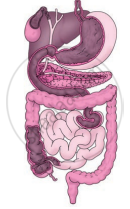
Label the following parts in Figure and name them.
- The largest gland in our body.
- The organ where protein digestion starts.
- The organ that releases digestive juice into the small intestine.
- The organ where bile juice gets stored.
