Advertisements
Chapters
▶ 2: Nutrition in Animals
3: Fibre to Fabric
4: Heat
5: Acids, Bases and Salts
6: Physical and Chemical Changes
7: Weather, Climate and Adaptation of Animals to Climate
8: Wind, Storm and Cyclone
9: Soil
10: Respiration in Organisms
11: Transportation in Animals and Plants
12: Reproduction in Plants
13: Motion and Time
14: Electric Current and Its Effects
15: Light
16: Water : A Precious Resource
17: Forests : Our Lifeline
18: Wastewater Story
![NCERT Exemplar solutions for साइंस इग्ज़ेम्प्लार [अंग्रेजी] कक्षा ७ chapter 2 - Nutrition in Animals - Shaalaa.com](/images/science-english-class-7_6:fca739400fac4d1398a2ed15ae18baa6.jpg "NCERT Exemplar solutions for साइंस इग्ज़ेम्प्लार [अंग्रेजी] कक्षा ७ chapter 2 - Nutrition in Animals")
Advertisements
Solutions for Chapter 2: Nutrition in Animals
Below listed, you can find solutions for Chapter 2 of CBSE NCERT Exemplar for साइंस इग्ज़ेम्प्लार [अंग्रेजी] कक्षा ७.
NCERT Exemplar solutions for साइंस इग्ज़ेम्प्लार [अंग्रेजी] कक्षा ७ 2 Nutrition in Animals MULTIPLE CHOICE QUESTIONS [Pages 6 - 8]
Given below from (i) to (iv) are some food items.
- Boiled and mashed potato
- Glucose solution
- A slice of bread
- Mustard oil
Which of the above will give a blue-black colour when tested with iodine?
(i) and (ii)
(i) and (iii)
(ii) and (iii)
(iii) and (iv)
Which of the following pair of teeth differ in structure but are similar in function?
canines and incisors
molars and premolars
incisors and molars
premolars and canines
Read carefully the terms given below. Which of the following set is the correct combination of organs that do not carry out any digestive functions?
Oesophagus, Large Intestine, Rectum
Buccal cavity, Oesophagus, Rectum
Buccal cavity, Oesophagus, Large Intestine
Small Intestine, Large Intestine, Rectum
The swallowed food moves downwards in the alimentary canal because of ______.
force provided by the muscular tongue.
the flow of water taken with the food.
gravitational pull.
the contraction of muscles in the wall of food pipe.
The acid present in the stomach ______.
kills the harmful bacteria that may enter along with the food.
protects the stomach lining from harmful substances.
digests starch into simpler sugars.
makes the medium alkaline.
The finger-like outgrowths of Amoeba helps to ingest food. However, the finger-like outgrowths of human intestine helps to ______.
digest the fatty food substances.
make the food soluble.
absorb the digested food.
absorb the undigested food.
Read the following statements with reference to the villi of small intestine.
- They have very thin walls.
- They have a network of thin and small blood vessels close to the surface.
- They have small pores through which food can easily pass.
- They are finger-like projections
Identify those statements which enable the villi to absorb digested food.
(i), (ii) and (iv)
(ii), (iii) and (iv)
(iii) and (iv)
(i) and (iv)
The false feet of Amoeba are used for ______.
movement only.
capture of food only.
capture of food and movement.
exchange of gases only.
The enzymes present in the saliva convert ______.
fats into fatty acids and glycerol.
starch into simple sugars.
proteins into amino acids.
complex sugars into simple sugars.
Cud is the name given to the food of ruminants which is ______.
swallowed and undigested.
swallowed and partially digested.
properly chewed and partially digested.
properly chewed and completely digested.
Choose the correct order of terms that describes the process of nutrition in ruminants.
swallowing → partial digestion → chewing of cud → complete digestion
chewing of cud → swallowing → partial digestion → complete digestion
chewing of cud → swallowing → mixing with digestive juices → digestion
swallowing → chewing and mixing → partial digestion → complete digestion
Cellulose-rich food substances are good source of roughage in human beings because ______.
human beings do not have cellulose-digesting enzymes.
cellulose gets absorbed in the human blood and converts into fibres.
the cellulose-digesting bacteria convert cellulose into fibres.
cellulose breaks down into smaller components which are egested as roughage.
NCERT Exemplar solutions for साइंस इग्ज़ेम्प्लार [अंग्रेजी] कक्षा ७ 2 Nutrition in Animals VERY SHORT ANSWER QUESTIONS [Pages 8 - 9]
Name the parts of the alimentary canal where water gets absorbed from undigested food.
Name the parts of the alimentary canal where digested food gets absorbed.
Name the parts of the alimentary canal where taste of the food is perceived.
Name the parts of the alimentary canal where bile juice is produced.
Mark the following statement as True or False. If false, write the correct statement.
Tongue is attached to the roof of the mouth cavity at the back.
True
False
Mark the following statement as True or False. If false, write the correct statement.
The large intestine is longer and wider than the small intestine of the human alimentary canal.
True
False
Mark the following statement as True or False. If false, write the correct statement.
Mucus protects the stomach lining from damage.
True
False
Mark the following statement as True or False. If false, write the correct statement.
All heterotrophs have a similar basic process of nutrition.
True
False
Choose the odd one out from the group and give a reason.
liver, salivary gland, starch, gall bladder
Choose the odd one out from the group and give reason.
Stomach
Liver
Pancreas
Salivary gland
Choose the odd one out from the group and give reason.
Tongue
Absorption
Taste
Swallow
Choose the odd one out from the group and give reason.
Oesophagus
Small intestine
Large intestine
Rectum
You were blindfolded and asked to identify the drinks provided in two different glasses. You could identify drink A as lime juice and B as bitter gourd juice. How could you do it in spite of being blindfolded?
Fill in the blanks with suitable words:
The alimentary canal stretches from ______ to ______.
Teeth are rooted in separate ______ in between the ______.
Digestion of food starts in ______ and gets completed in ______.
______ is the largest gland in the human body.
Following statements describe animal nutrition. Read the statement and give one word for the statement. Write the terms that describe process.
Transportation of absorbed food to different parts of body and their utilisation
Following statements describe animal nutrition. Read the statement and give one word for the statement. Write the terms that describe process.
Breaking of complex food substances into simpler and soluble substances.
Following statements describe animal nutrition. Read the statement and give one word for the statement. Write the terms that describe process.
Removal of undigested and unabsorbed solid residues of food from the body.
Following statements describe animal nutrition. Read the statement and give one word for the statement. Write the terms that describe process.
Taking food into the body.
Following statements describe animal nutrition. Read the statement and give one word for the statement. Write the terms that describe process.
Transport of digested and soluble food from the intestine to blood vessels.
NCERT Exemplar solutions for साइंस इग्ज़ेम्प्लार [अंग्रेजी] कक्षा ७ 2 Nutrition in Animals SHORT ANSWER QUESTIONS [Pages 10 - 11]
Match the animals in Column I with their mode of feeding listed in Column II
| Column I | Column II | ||
| Animals | Mode of Feeding | ||
| (a) | House fly | (i) | Biting and chewing |
| (b) | Cockroach | (ii) | Suckling |
| (c) | Mosquito | (iii) | Sponging |
| (d) | Infants | (iv) | Sucking |
Boojho took some grains of boiled rice in test tube ‘A’ and Paheli took boiled and chewed rice in test tube ‘B’. Both of them poured 1-2 drops of iodine solution into the test tube and observed the colour change. What colour change would they have observed? Give reasons for your answer.
A’ got her gall bladder removed surgically as she was diagnosed with stones in her gall bladder. After the surgery, she faced problems in digestion of certain food items when consumed in bulk. Can you tell which kind of food items would they be and why?
Match the organs in Column I with the words listed in Column II.
| Column I | Column II | ||
| (a) | Rectum | (i) | Mucus |
| (b) | Gall bladder | (ii) | Villi |
| (c) | Stomach | (iii) | Taste buds |
| (d) | Tongue | (iv) | Faeces |
| (e) | Small intestine | (v) | Bile juice |
Ruminants such as cows and buffaloes swallow their food hurriedly and then sit restfully and chew their food. Can you reason why?
Boojho and Paheli were eating their food hurriedly so that they could go out and play during recess. Suddenly, Boojho started coughing violently. Think of the reasons why he was coughing and discuss them with your friends.
NCERT Exemplar solutions for साइंस इग्ज़ेम्प्लार [अंग्रेजी] कक्षा ७ 2 Nutrition in Animals LONG ANSWER QUESTIONS [Pages 11 - 13]
Fill in the blanks using the words listed below.
| water, front, intestinal, salts, pseudopodia, back, vacuole |
- The digestion of all food components is completed by the ______ juice.
- Large intestine absorbs ______ and some ______ from the undigested food.
- Tongue is attached at the ______ to the floor of the mouth cavity and is free at the ______.
- Amoeba pushes out ______ around the food and traps it in a food ______.
Label the below given Figure as directed below in (i) to (iv) and give the name of each type of teeth.
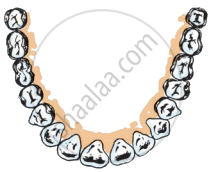
- The cutting and biting teeth as ‘A’
- The piercing and tearing teeth as ‘B’
- The grinding and chewing teeth as ‘C’
- The grinding teeth are present only in adults as ‘D’
Read the following passage carefully and answer the questions that follow it.
| Bile juice is stored in a sac called, gall bladder, located near its organ of secretion, liver. The gall bladder releases the bile juice into the small intestine whenever food reaches there. Though bile juice is devoid of any digestive enzymes, it is required for the digestion of fats. The fats cannot be digested easily because they are insoluble in water and are present as large globules. Bile juice breaks down big fat droplets into smaller droplets. These are then easily digested by the enzymes released from the pancreas. |
- Which organ secretes the bile juice?
- Why is digestion of fats difficult as compared to that of other nutrients?
- How does bile juice help in the digestion of fat?
- Where is the digestion of fat completed?
- Does bile juice digest fat completely?
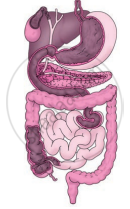
Label the following parts in Figure and name them.
- The largest gland in our body.
- The organ where protein digestion starts.
- The organ that releases digestive juice into the small intestine.
- The organ where bile juice gets stored.
Open your mouth, look into a mirror and try to count the different types of teeth in your mouth. Compare them with Figure on page 13 of your NCERT textbook.
Record your observations in the table below:
| Type of teeth | Number of teeth | |
| In my mouth | In the figure | |
| Incisors | ||
| Canines | ||
| Premolars | ||
| Molars | ||
- Did you observe any difference in the number of teeth? If yes, could you identify which type of teeth showed the difference?
- Compare the number and type of teeth in an adult (say your parents or cousins who have reached the age of 25-30 or more). Note your observation.
Solve the crossword given as Figure.

| Across | Down | ||
| 1. | Cream-coloured digestive gland | 2. | Feeds with the help of pseudopodia |
| 3. | Undigested excretory solid residues | 6. | Total number of molars in one jaw of an adult |
| 4. | Organ that mixes saliva with the food | 8. | Largest gland |
| 5. | Point of defecation | 9. | Watery secretion in the mouth |
| 7. | Stored in gall bladder | 11. | A ruminant |
| 10. | Finger-like outgrowth in the small intestine | 12. | Form of food chewed by ruminants |
| 13. | Kind of taste buds | ||
| 14. | Kills bacteria in the stomach | ||
Solutions for 2: Nutrition in Animals
NCERT Exemplar solutions for साइंस इग्ज़ेम्प्लार [अंग्रेजी] कक्षा ७ chapter 2 - Nutrition in Animals
Shaalaa.com has the CBSE Mathematics साइंस इग्ज़ेम्प्लार [अंग्रेजी] कक्षा ७ CBSE solutions in a manner that help students grasp basic concepts better and faster. The detailed, step-by-step solutions will help you understand the concepts better and clarify any confusion. NCERT Exemplar solutions for Mathematics साइंस इग्ज़ेम्प्लार [अंग्रेजी] कक्षा ७ CBSE 2 (Nutrition in Animals) include all questions with answers and detailed explanations. This will clear students' doubts about questions and improve their application skills while preparing for board exams.
Further, we at Shaalaa.com provide such solutions so students can prepare for written exams. NCERT Exemplar textbook solutions can be a core help for self-study and provide excellent self-help guidance for students.
Concepts covered in साइंस इग्ज़ेम्प्लार [अंग्रेजी] कक्षा ७ chapter 2 Nutrition in Animals are Different Ways of Taking Food, The Mouth and Buccal Cavity, The Teeth and Its Structure, The Salivary Glands, The Food Pipe/Oesophagus, The Stomach, The Small Intestine, Absorption of Food, The Large Intestine, Assimilation of Food, Digestion in Grass-eating Animal, Feeding and Digestion in Amoeba, Human Digestive System, Human Digestive System.
Using NCERT Exemplar साइंस इग्ज़ेम्प्लार [अंग्रेजी] कक्षा ७ solutions Nutrition in Animals exercise by students is an easy way to prepare for the exams, as they involve solutions arranged chapter-wise and also page-wise. The questions involved in NCERT Exemplar Solutions are essential questions that can be asked in the final exam. Maximum CBSE साइंस इग्ज़ेम्प्लार [अंग्रेजी] कक्षा ७ students prefer NCERT Exemplar Textbook Solutions to score more in exams.
Get the free view of Chapter 2, Nutrition in Animals साइंस इग्ज़ेम्प्लार [अंग्रेजी] कक्षा ७ additional questions for Mathematics साइंस इग्ज़ेम्प्लार [अंग्रेजी] कक्षा ७ CBSE, and you can use Shaalaa.com to keep it handy for your exam preparation.
