Advertisements
Advertisements
प्रश्न
Answer of these question in a short paragraph (about 30 words).
Santosh Yadav got into the record books both times she scaled Mt Everest. What were the reasons for this?
Advertisements
उत्तर
When Santosh Yadav first scaled Mt Everest, she became the youngest woman in the world to achieve the feat. When she scaled the Everest the second time, she became the only woman to have scaled it twice.
संबंधित प्रश्न
Thinking about the Poem
What are the things the wind does in the first stanza?
Answer following question in short.
How did kangaroos react to duck’s request?
Pick out word from the text that mean the same as the following word or expression. (Look in the paragraph indicated.)
took to be true without proof : _________
Read the lines given in the boxes on the next page. They are in random order.
Now listen to the recording of the poem carefully. As you listen, number the
stanzas given in the boxes sequentially.
I am beautiful pearls, plucked from the
Crown of Ishtar by the daughter of Dawn
To embellish the gardens
I emerge from the heart of the Sea and
Soar with the breeze. When I see a field in
Need, I descend and embrace the flowers and
The trees in a million little ways
The voice of thunder declares my arrival :
The rainbow announces my departure.
I am like earthly life, which begins at
The feet of the mad elements and ends
Under the upraised wings of death
I am dotted silver threads dropped from heaven
By the gods. Nature then takes me to adorn
Her fields and valleys.
I touch gently at the windows with my
Soft fingers and my announcement is a
Welcome song. All can hear but only
The sensitive can understand
The field and the cloud are lovers
And between them I am a messenger of mercy.
I quench the thirst of the one,
I cure the ailment of the other.
I am the sigh of the sea, the laughter of the field;
The tears of heaven.
When I cry the hills laugh;
When I humble myself the flowers rejoice;
When I bow, all things are elated
So, with love-
Sighs from the deep sea of affection; Laughter
from the colourful field of the spirit; Tears from
the endless heaven of memories.
Read the following statement and imagine you are Jack.
“I can’t afford to, after what Jack’s done to his teeth.” What is it, you think, you can not afford to do and why? Write a diary entry of not less than 125 words.
The athletes had come from all over the country
To run for the gold, for the silver and bronze
Many weeks and months of training
All coming down to these games.
The spectators gathered around the old field
To cheer on all the young women and men
The final event of the day was approaching
Excitement grew high to begin.
Read the lines given above and answer the following question:
What do the words ‘gold’, ‘silver’ and ‘bronze’ stand for in the poem?
Of the seven hundred villages dotting the map of India, in which the majority of India’s five hundred million live, flourish and die, Kritam was probably the tiniest, indicated on the district survey map by a microscopic dot, the map being meant more for the revenue official out to collect tax than for the guidance of the motorist, who in any case could not hope to reach it since it sprawled far from the highway at the end of a rough track furrowed up by the iron-hooped wheels of bullock carts. But its size did not prevent its giving itself the grandiose name Kritam, which meant in Tamil coronet or crown on the brow of the subcontinent. The village consisted of fewer than thirty houses, only one of them built from brick and cement and painted a brilliant yellow and blue all over with
gorgeous carvings of gods and gargoyles on its balustrade, it was known as the Big House. The other houses, distributed in four streets, were generally of bamboo thatch, straw, mud and other unspecified material. Muni’s was the last house in the fourth street, beyond which stretched the fields. In his prosperous days Muni had owned a flock of sheep and goats and sallied forth every morning driving the flock to the highway a couple of miles away.
Read the extract given below and answer the question that follow.
Describe the other houses.
How was Nishad spending his unexpected holiday?
Which was the toughest part of the bicycle that the author’s friend found the toughest to fix?
How do the desert plants fulfill their need for water?
What happened to the reptiles in the forest once?
Replace the italicised portion of the sentence below with a suitable phrase from the box. Make necessary changes, wherever required.
I was in a difficult situation till my friends came to my rescue.
Complete the following sentences from memory choosing a phrase from those given in brackets.
Uncle told me that the shopkeeper had made ____________
Look at the following picture. One asks a question, the other answers it. Then the answer is noted in a form as shown below.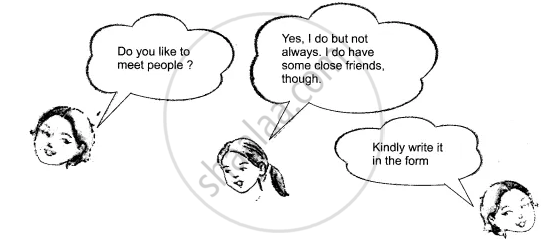
| Questions | Yes/No | Additional Response |
|
1. Do you like to meet people? |
Yes I do, but not always | I do have some close friends, though. |
|
2. Do you like the area you live in? |
No, I Don't | But I have no choice |
Your partner and you may now be able to answer the question.
From the way the child envies the hawker, the gardener, and the watchman, we can guess that there are many things the child has to do, or must not do. Make a list of the do’s and don’ts that the child doesn’t like. The first line is done for you.
| The child must come home at a fixed time. | The child must not get his clothes dirty in the dust. |
|
|
|
Now add to the list your own complaints about the things you have to do, or must not do.
What is the job of a watchman?
What is being compared to a gray overcoat?
Read the following conversation.
Ravi: What are you doing?
Mridu: I’m reading a book.
Ravi: Who wrote it?
Mridu: Ruskin Bond.
Ravi: Where did you find it?
Mridu: In the library.
Notice that ‘what’, ‘who’, ‘where’, are question words. Questions that require information begin with question words. Some other question words are ‘when’, ‘why’, ‘where’, ‘which’ and ‘how’.
Remember that
- What asks about acting, things etc.
- Who asks about people.
- Which asks about people or things.
- Where asks about place.
- When asks about time.
- Why asks about reason or purpose.
- How asks about means, manner or degree.
- Whose asks about possessions.
Read the following paragraph and frame questions on the italicised phrases.
Anil is in school. I am in school too. Anil is sitting in the left row. He is reading a book. Anil’s friend is sitting in the second row. He is sharpening his pencil. The teacher is writing on the blackboard. Children are writing in their copybooks. Some children are looking out of the window.
Study the following phrases and their meanings. Use them appropriately to complete the sentences that follow.
The police are …………… the matter thoroughly.
Discuss the absence of human characters in the story, There Will Come Soft Rains. How does this absence contribute to the overall tone and message of the narrative? Answer in 200-250 words.
