Advertisements
Advertisements
प्रश्न
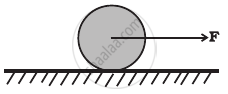
A uniform disc of radius R, is resting on a table on its rim.The coefficient of friction between disc and table is µ (Figure). Now the disc is pulled with a force F as shown in the figure. What is the maximum value of F for which the disc rolls without slipping?
Advertisements
उत्तर
Let the acceleration of the centre of mass of the disc be ‘a’, then
`Ma = F - f` ......(1)
The angular acceleration of the disc is `α = a/R`. (if there is no sliding).
Then `(1/2 MR^2)α = Rf` ......(2)

⇒ `Ma = 2f`
Thus, `f = F/3`. Since there is no sliding,
⇒ `f ≤ µmg`
⇒ `F ≤ 3µMg`.
APPEARS IN
संबंधित प्रश्न
A solid sphere rolls down two different inclined planes of the same heights but different angles of inclination. (a) Will it reach the bottom with the same speed in each case? (b) Will it take longer to roll down one plane than the other? (c) If so, which one and why?
Prove the result that the velocity v of translation of a rolling body (like a ring, disc, cylinder or sphere) at the bottom of an inclined plane of a height h is given by `v^2 = (2gh)/((1+k^2"/"R^2))`.
Using dynamical consideration (i.e. by consideration of forces and torques). Note k is the radius of gyration of the body about its symmetry axis, and R is the radius of the body. The body starts from rest at the top of the plane.
Read each statement below carefully, and state, with reasons, if it is true or false;
A wheel moving down a perfectly frictionless inclined plane will undergo slipping (not rolling) motion
A solid sphere of mass 1 kg rolls on a table with linear speed 2 m/s, find its total kinetic energy.
If a rigid body of radius ‘R’ starts from rest and rolls down an inclined plane of inclination
‘θ’ then linear acceleration of body rolling down the plane is _______.
A hollow sphere and a solid sphere having same mss and same radii are rolled down a rough inclined plane.
A sphere cannot roll on
Discuss the interlink between translational, rotational and total kinetic energies of a rigid object rolls without slipping.
Answer in Brief:
A rigid object is rolling down an inclined plane derive the expression for the acceleration along the track and the speed after falling through a certain vertical distance.
Discuss rolling on an inclined plane and arrive at the expression for acceleration.
A solid sphere rolls down from top of inclined plane, 7m high, without slipping. Its linear speed at the foot of plane is ______. (g = 10 m/s2)
The power (P) is supplied to rotating body having moment of inertia 'I' and angular acceleration 'α'. Its instantaneous angular velocity is ______.
A ring and a disc roll on horizontal surface without slipping with same linear velocity. If both have same mass and total kinetic energy of the ring is 4 J then total kinetic energy of the disc is ______.
A circular disc reaches from top to bottom of an inclined plane of length 'L'. When it slips down the plane, it takes time ' t1'. when it rolls down the plane, it takes time t2. The value of `t_2/t_1` is `sqrt(3/x)`. The value of x will be ______.
The least coefficient of friction for an inclined plane inclined at angle α with horizontal in order that a solid cylinder will roll down without slipping is ______.
When a sphere rolls without slipping, the ratio of its kinetic energy of translation to its total kinetic energy is ______.
A disc of mass 4 kg rolls on a horizontal surface. If its linear speed is 3 m/ s, what is its total kinetic energy?
