Advertisements
Advertisements
प्रश्न
A disc of the moment of inertia Ia is rotating in a horizontal plane about its symmetry axis with a constant angular speed ω. Another disc initially at rest of moment of inertia Ib is dropped coaxially onto the rotating disc. Then, both the discs rotate with the same constant angular speed. The loss of kinetic energy due to friction in this process is, ______
विकल्प
`1/2(I_b^2)/((I_a + I_b))ω^2`
`(I_b^2)/((I_a + I_b))ω^2`
`(I_b - I_a)^2/((I_a + I_b))ω^2`
`1/2(I_bI_b)/((I_a + I_b))ω^2`
Advertisements
उत्तर
A disc of the moment of inertia Ia is rotating in a horizontal plane about its symmetry axis with a constant angular speed ω. Another disc initially at rest of moment of inertia Ib is dropped coaxially onto the rotating disc. Then, both the discs rotate with the same constant angular speed. The loss of kinetic energy due to friction in this process is, `underline(1/2(I_bI_b)/((I_a + I_b))ω^2)`.
APPEARS IN
संबंधित प्रश्न
Read each statement below carefully, and state, with reasons, if it is true or false;
For perfect rolling motion, work done against friction is zero.
Can an object be in pure translation as well as in pure rotation?
Two uniform solid spheres having unequal masses and unequal radii are released from rest from the same height on a rough incline. If the spheres roll without slipping, ___________ .
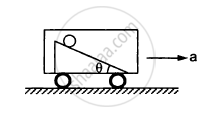
The following figure shows a smooth inclined plane fixed in a car accelerating on a horizontal road. The angle of incline θ is related to the acceleration a of the car as a = g tanθ. If the sphere is set in pure rolling on the incline, _____________.
A cylinder rolls on a horizontal place surface. If the speed of the centre is 25 m/s, what is the speed of the highest point?
What is the difference between sliding and slipping?
The angular velocity of minute hand of a clock in degree per second is ______.
A 1000 kg car has four 10 kg wheels. When the car is moving, fraction of total K.E. of the car due to rotation of the wheels about their axles is nearly (Assume wheels be uniform disc)
An object is rolling without slipping on a horizontal surface and its rotational kinetic energy is two-thirds of translational kinetic energy. The body is ______.
Solid spherical ball is rolling on a frictionless horizontal plane surface about is axis of symmetry. The ratio of rotational kinetic energy of the ball to its total kinetic energy is ______.
