Advertisements
Advertisements
Question
A disc of the moment of inertia Ia is rotating in a horizontal plane about its symmetry axis with a constant angular speed ω. Another disc initially at rest of moment of inertia Ib is dropped coaxially onto the rotating disc. Then, both the discs rotate with the same constant angular speed. The loss of kinetic energy due to friction in this process is, ______
Options
`1/2(I_b^2)/((I_a + I_b))ω^2`
`(I_b^2)/((I_a + I_b))ω^2`
`(I_b - I_a)^2/((I_a + I_b))ω^2`
`1/2(I_bI_b)/((I_a + I_b))ω^2`
Advertisements
Solution
A disc of the moment of inertia Ia is rotating in a horizontal plane about its symmetry axis with a constant angular speed ω. Another disc initially at rest of moment of inertia Ib is dropped coaxially onto the rotating disc. Then, both the discs rotate with the same constant angular speed. The loss of kinetic energy due to friction in this process is, `underline(1/2(I_bI_b)/((I_a + I_b))ω^2)`.
APPEARS IN
RELATED QUESTIONS
Read each statement below carefully, and state, with reasons, if it is true or false;
The instantaneous speed of the point of contact during rolling is zero.
Read each statement below carefully, and state, with reasons, if it is true or false;
For perfect rolling motion, work done against friction is zero.
A stone of mass 2 kg is whirled in a horizontal circle attached at the end of 1.5m long string. If the string makes an angle of 30° with vertical, compute its period. (g = 9.8 m/s2)
A solid sphere of mass 0⋅50 kg is kept on a horizontal surface. The coefficient of static friction between the surfaces in contact is 2/7. What maximum force can be applied at the highest point in the horizontal direction so that the sphere does not slip on the surface?
A pendulum consisting of a massless string of length 20 cm and a tiny bob of mass 100 g is set up as a conical pendulum. Its bob now performs 75 rpm. Calculate kinetic energy and increase in the gravitational potential energy of the bob. (Use π2 = 10)
What is the difference between sliding and slipping?
A solid sphere is rolling on a frictionless surface with translational velocity 'V'. It climbs the inclined plane from 'A' to 'B' and then moves away from Bon the smooth horizontal surface. The value of 'V' should be ______.

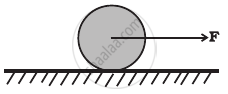
A uniform disc of radius R, is resting on a table on its rim.The coefficient of friction between disc and table is µ (Figure). Now the disc is pulled with a force F as shown in the figure. What is the maximum value of F for which the disc rolls without slipping?
Solid spherical ball is rolling on a frictionless horizontal plane surface about is axis of symmetry. The ratio of rotational kinetic energy of the ball to its total kinetic energy is ______.
The least coefficient of friction for an inclined plane inclined at angle α with horizontal in order that a solid cylinder will roll down without slipping is ______.
