Advertisements
Advertisements
प्रश्न
A filter transmits only the radiation of wavelength greater than 440 nm. Radiation from a hydrogen-discharge tube goes through such a filter and is incident on a metal of work function 2.0 eV. Find the stopping potential which can stop the photoelectrons.
Advertisements
उत्तर
Wavelength of radiation coming from filter, λ = 440 nm
Work function of metal, ϕ = 2 eV
Charge of the electron, e = 1.6 × 10⁻⁹ C
Let V0 be the stopping potential.
From Einstein's photoelectric equation,
`(hc)/lamda - ø=eV_0`
Here,
h =Planck constant
c = Speed of light
λ = Wavelength of radiation
`(4.14 xx 10^-15xx3xx10^8)/(440xx10^-9)- 2eV = eV_0`
⇒ `eV_0 = ((1242)/440 - 2)eV = 0.823`
⇒ `V_0 = 0.823` Volts
APPEARS IN
संबंधित प्रश्न
(i) State Bohr's quantization condition for defining stationary orbits. How does the de Broglie hypothesis explain the stationary orbits?
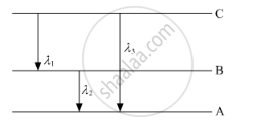
(ii) Find the relation between three wavelengths λ1, λ2 and λ3 from the energy-level diagram shown below.
How many electrons in an atom may have the following quantum numbers?
n = 3, l = 0
- Using the Bohr’s model, calculate the speed of the electron in a hydrogen atom in the n = 1, 2 and 3 levels.
- Calculate the orbital period in each of these levels.
In a laser tube, all the photons
A beam of monochromatic light of wavelength λ ejects photoelectrons from a cesium surface (Φ = 1.9 eV). These photoelectrons are made to collide with hydrogen atoms in ground state. Find the maximum value of λ for which (a) hydrogen atoms may be ionized, (b) hydrogen atoms may get excited from the ground state to the first excited state and (c) the excited hydrogen atoms may emit visible light.
What is the energy in joules released when an electron moves from n = 2 to n = 1 level in a hydrogen atom?
For an electron in the second orbit of hydrogen, what is the moment of momentum as per the Bohr's model?
Derive an expression for the frequency of radiation emitted when a hydrogen atom de-excites from level n to level (n – 1). Also show that for large values of n, this frequency equals to classical frequency of revolution of an electron.
The energy of an electron in hth orbit of hydrogen atom is –13.6/n2ev energy required to excite the electron from the first orbit to the third orbit is
Consider aiming a beam of free electrons towards free protons. When they scatter, an electron and a proton cannot combine to produce a H-atom ______.
- because of energy conservation.
- without simultaneously releasing energy in the from of radiation.
- because of momentum conservation.
- because of angular momentum conservation.
A hydrogen atom in its first excited state absorbs a photon of energy x × 10-2 eV and exited to a higher energy state where the potential energy of electron is -1.08 eV. The value of x is ______.
If 13.6 eV energy is required to ionize the hydrogen atom, then the energy required to remove an electron from n = 2 is ______.
In Bohr's theory of hydrogen atom, the electron jumps from higher orbit n to lower orbit p. The wavelength will be minimum for the transition ______.
What is the energy of an electron in stationary state corresponding to n = 2?
Oxygen is 16 times heavier than hydrogen. Equal volumes of hydrogen and oxygen are mixed. The ratio of speed of sound in the mixture to that in hydrogen is ______.
Specify the transition of an electron in the wavelength of the line in the Bohr model of the hydrogen atom which gives rise to the spectral line of the highest wavelength ______.
On the basis of Bohr's theory, derive an expression for the radius of the nth orbit of an electron of hydrogen atom.
What is the velocity of an electron in the 3rd orbit of hydrogen atom if its velocity in the 1st orbit is v0?
Calculate the shortest wavenumber in hydrogen spectrum of Lyman series. (RH = 109677 cm−1)
