Advertisements
Advertisements
प्रश्न
What is meant by ionisation energy?
Advertisements
उत्तर
The energy needed to transfer an electron from its ground state energy level to its free state is known as the ionisation energy of an atom. The ionisation energy measures an element’s ability to participate in chemical processes that call for the creation of ions or the donation of electrons.
APPEARS IN
संबंधित प्रश्न
(i) State Bohr's quantization condition for defining stationary orbits. How does the de Broglie hypothesis explain the stationary orbits?
(ii) Find the relation between three wavelengths λ1, λ2 and λ3 from the energy-level diagram shown below.
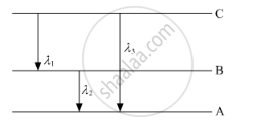
State Bohr’s postulate of hydrogen atom which successfully explains the emission lines in the spectrum of hydrogen atom. Use Rydberg formula to determine the wavelength of Hα line. [Given: Rydberg constant R = 1.03 × 10⁷ m−1]
If the photon of the wavelength 150 pm strikes an atom and one of its inner bound electrons is ejected out with a velocity of 1.5 × 10⁷ ms–1, calculate the energy with which it is bound to the nucleus.
The radius of the innermost electron orbit of a hydrogen atom is 5.3 × 10⁻¹¹ m. What are the radii of the n = 2 and n = 3 orbits?
In accordance with the Bohr’s model, find the quantum number that characterises the earth’s revolution around the sun in an orbit of radius 1.5 × 10¹¹ m with orbital speed 3 × 10⁴ m/s. (Mass of earth = 6.0 × 1024 kg)
On the basis of Bohr's theory, derive an expression for the radius of the nth orbit of an electron of the hydrogen atom.
State Bohr postulate of hydrogen atom that gives the relationship for the frequency of emitted photon in a transition.
Using Bohr's postulates, derive the expression for the total energy of the electron in the stationary states of the hydrogen atom ?
Using Bohr’s postulates, derive the expression for the frequency of radiation emitted when electron in hydrogen atom undergoes transition from higher energy state (quantum number ni) to the lower state, (nf).
When electron in hydrogen atom jumps from energy state ni = 4 to nf = 3, 2, 1, identify the spectral series to which the emission lines belong.
The numerical value of ionization energy in eV equals the ionization potential in volts. Does the equality hold if these quantities are measured in some other units?
When a photon stimulates the emission of another photon, the two photons have
(a) same energy
(b) same direction
(c) same phase
(d) same wavelength
The Bohr radius is given by `a_0 = (∈_0h^2)/{pime^2}`. Verify that the RHS has dimensions of length.
A filter transmits only the radiation of wavelength greater than 440 nm. Radiation from a hydrogen-discharge tube goes through such a filter and is incident on a metal of work function 2.0 eV. Find the stopping potential which can stop the photoelectrons.
According to Bohr, 'Angular momentum of an orbiting electron is quantized'. What is meant by this statement?
If l3 and l2 represent angular momenta of an orbiting electron in III and II Bohr orbits respectively, then l3: l2 is :
According to Bohr's theory, an electron can move only in those orbits for which its angular momentum is integral multiple of ____________.
The radius of the third Bohr orbit for hydrogen atom is ____________.
For an electron in the second orbit of hydrogen, what is the moment of momentum as per the Bohr's model?
The energy of an electron in hth orbit of hydrogen atom is –13.6/n2ev energy required to excite the electron from the first orbit to the third orbit is
For the ground state, the electron in the H-atom has an angular momentum = h, according to the simple Bohr model. Angular momentum is a vector and hence there will be infinitely many orbits with the vector pointing in all possible directions. In actuality, this is not true ______.
An ionised H-molecule consists of an electron and two protons. The protons are separated by a small distance of the order of angstrom. In the ground state ______.
- the electron would not move in circular orbits.
- the energy would be (2)4 times that of a H-atom.
- the electrons, orbit would go around the protons.
- the molecule will soon decay in a proton and a H-atom.
Consider aiming a beam of free electrons towards free protons. When they scatter, an electron and a proton cannot combine to produce a H-atom ______.
- because of energy conservation.
- without simultaneously releasing energy in the from of radiation.
- because of momentum conservation.
- because of angular momentum conservation.
Use Bohr's postulate to prove that the radius of nth orbit in a hydrogen atom is proportional to n2.
How will the energy of a hydrogen atom change if n increases from 1 to ∞?
The value of angular momentum for He+ ion in the first Bohr orbit is ______.
The wavelength in Å of the photon that is emitted when an electron in Bohr orbit with n = 2 returns to orbit with n = 1 in H atom is ______ Å. The ionisation potential of the ground state of the H-atom is 2.17 × 10⁻¹¹ erg.
Find the ratio of energies of photons produced due to transition of an election of hydrogen atom from its (i) second permitted energy level to the first level. and (ii) the highest permitted energy level to the first permitted level.
What is the energy associated with first orbit of Li2+ (RH = 2.18 × 10⁻¹⁸)?
The total energy of an electron in the nth orbit of the hydrogen atom is proportional to ______.
Specify the transition of an electron in the wavelength of the line in the Bohr model of the hydrogen atom which gives rise to the spectral line of the highest wavelength ______.
How much is the angular momentum of an electron when it is orbiting in the second Bohr orbit of hydrogen atom?
On the basis of Bohr's theory, derive an expression for the radius of the nth orbit of an electron of hydrogen atom.
State the Bohr's postulate of angular momentum of an electron.
For the reaction \[\ce{2NO2 (g) ⇌ N2O4(g)}\], when ΔS = −176.0 JK−1 and ΔH = −57.8 kj mol−1, the magnitude of ΔG at 298 K for the reaction is ______ kJ mol−1. (Nearest integer)
Which expression gives the orbital frequency used to calculate the initial frequency of light emitted under classical electromagnetic theory?
For an orbit radius of \[5.3\times10^{-11}\,\mathrm{m}\] and an electron velocity of \[2.2\times10^6\,\mathrm{m\,s^{-1}}\], what is the approximate initial frequency of emitted light according to classical electromagnetic theory?
