Advertisements
Advertisements
प्रश्न
A 1.000 mL sample of acetone, a common solvent used as a paint remover, was placed in a small bottle whose mass was known to be 38.0015 g.
The following values were obtained when the acetone-filled bottle was weighed: 38.7798 g, 38.7795 g and 38.7801 g. How would you characterise the precision and accuracy of these measurements if the actual mass of the acetone was 0.7791 g?
Advertisements
उत्तर
Given:
Mass of bottle = 38.0015 g
Actual mass of acetone = 0.7791 g
| Bottle + Acetone | Mass of acetone | Average |
| 38.7798 g | 0.7783 |
= `(0.7783 + 0.7730 + 0.7786)/3` = 0.7780 |
| 38.7795 g | 0.7780 | |
| 38.7801 g | 0.7786 |
Precision = `("highest value" - "lowest value" xx 100)/"lowest value"`
= `(0.7786 - 0.7780)/0.7780 xx 100`
= 0.0007712 × 100
= 0.07712 %
% Accuracy = `("True value" - "observed value")/"True value" xx 100`
= `(0.7791 - 0.7783)/0.7791 xx 100`
= 0.10268
= 0.1027 %
APPEARS IN
संबंधित प्रश्न
To make a saturated solution, 36 g of sodium chloride is dissolved in 100 g of water at 293 K. Find its concentration at this temperature.
Explain the term mole fraction.
Explain the term molality
Why does the molarity of a solution depend upon temperature?
Solve the following problem:
Find out the molar mass of the following compounds:
Sodium carbonate, decahydrate (Na2CO3.10H2O)
(At. mass: Cu = 63.5; S = 32; O = 16; H = 1; Na = 23; C = 12; Fe = 56; N = 14)
Solve the following problem:
Find out the molar mass of the following compounds:
Mohr’s salt [FeSO4(NH4)2SO4.6H2O]
(At. mass: Cu = 63.5; S = 32; O = 16; H = 1; Na = 23; C = 12; Fe = 56; N = 14)
Solve the following problem:
Write the following number in ordinary decimal form:
3.49 × 10⁻¹¹
Solve the following problem:
Write the following number in ordinary decimal form:
5.16 × 10⁴
Solve the following problem:
Write the following number in ordinary decimal form:
43.71 × 10⁻⁴
Solve the following problem:
Write the following number in ordinary decimal form:
5.00858585
Solve the following problem:
Perform the following calculation. Round off your answer to two digits.
`((4xx10^-3)(9.9xx10^-7))/((789)(1.002xx10^-10)(0.3xx10^2))`
Perform the following calculation. Round off your answer to three digits.
(8.39 107) (4.53 109)
Solve the following problem:
Perform the following calculation. Round off your answer to three digits.
`((9.28xx10^9)(9.9xx10^-7))/((511)(2.98xx10^-6))`
Solve the following problem:
Your laboratory partner was given the task of measuring the length of a box (approx 5 in) as accurately as possible, using a metre stick graduated in milimeters. He supplied you with the following measurements:
12.65 cm, 12.6 cm, 12.65 cm, 12.655 cm, 126.55 mm, 12 cm.
Give your reason for rejecting each of the others.
When light is passed through water containing a few drops of milk, it shows a bluish tinge. This is due to the ______ of light by milk and the phenomenon is called ______. This indicates that milk is a ______ solution.
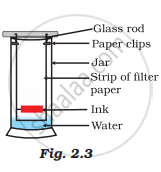
A child wanted to separate the mixture of dyes constituting a sample of ink. He marked a line by the ink on the filter paper and placed the filter paper in a glass containing water as shown in Fig.2.3. The filter paper was removed when the water moved near the top of the filter paper.
(i) What would you expect to see, if the ink contains three different coloured components?
(ii) Name the technique used by the child.
(iii) Suggest one more application of this technique.
Calculate the mass of sodium sulphate required to prepare its 20% (mass percent) solution in 100g of water?
What will be the molality of the solution containing 18.25 g of \[\ce{HCl}\] gas in 500 g of water?
Sulphuric acid reacts with sodium hydroxide as follows:
\[\ce{H2SO4 + 2NaOH -> Na2SO4 + 2H2O}\]
When 1 L of 0.1 M sulphuric acid solution is allowed to react with 1 L of 0.1 M sodium hydroxide solution, the amount of sodium sulphate formed and its molarity in the solution obtained is:
(i) 0.1 mol L–1
(ii) 7.10 g
(iii) 0.025 mol L–1
(iv) 3.55 g
If 4 g of \[\ce{NaOH}\] dissolves in 36 g of \[\ce{H2O}\], calculate the mole fraction of each component in the solution. Also, determine the molarity of solution (specific gravity of solution is 1g mL–1).
The molarity of pure water is ______.
With increase of temperature, which of these changes?
What quantity (in mL) of a 45% acid solution of a monoprotic strong acid must be mixed with a 20% solution of the same acid to produce 800 mL of a 29.875% acid solution?
The molality of solution containing 15.20 g of urea, (molar mass = 60) dissolved in 150 g or water is ______.
Molarity is ______.
Find the molality of solution if boiling point increases by 1.75 K and molal elevation constant of solvent is 5K kg mol-1.
