Topics
Similarity
- Properties of Ratios of Areas of Two Triangles
- Basic Proportionality Theorem
- Property of an Angle Bisector of a Triangle
- Property of Three Parallel Lines and Their Transversals
- Similarity of Triangles (Corresponding Sides & Angles)
- Relation Between the Areas of Two Triangles
- Criteria for Similarity of Triangles
- Overview of Similarity
Pythagoras Theorem
- Pythagoras Theorem
- Pythagorean Triplet
- Property of 30°- 60°- 90° Triangle Theorem
- Property of 45°- 45°- 90° Triangle Theorem
- Similarity in Right Angled Triangles
- Theorem of Geometric Mean
- Right-angled Triangles and Pythagoras Property
- Converse of Pythagoras Theorem
- Application of Pythagoras Theorem in Acute Angle and Obtuse Angle
- Apollonius Theorem
- Overview of Pythagoras Theorem
Circle
- Circles Passing Through One, Two, Three Points
- Tangent and Secant Properties
- Secant and Tangent
- Inscribed Angle Theorem
- Intersecting Chords and Tangents
- Corollaries of Inscribed Angle Theorem
- Angle Subtended by the Arc to the Point on the Circle
- Angle Subtended by the Arc to the Centre
- Overview of Circle
Geometric Constructions
Co-ordinate Geometry
Trigonometry
- Trigonometric Ratios in Terms of Coordinates of Point
- Angles in Standard Position
- Trigonometric Ratios
- Trigonometry Ratio of Zero Degree and Negative Angles
- Trigonometric Table
- Trigonometric Identities (Square Relations)
- Angles of Elevation and Depression
- Relation Among Trigonometric Ratios
- Trigonometric Ratios of Specific Angles
Mensuration
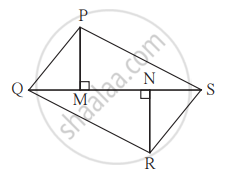
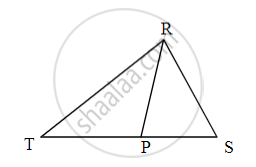
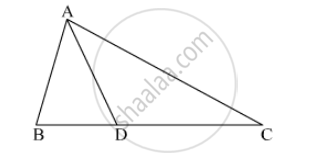
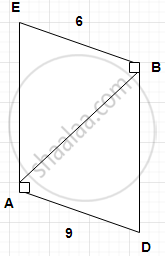
- Ratio of areas of two triangles is equal to the ratio of the products of their bases and corresponding heights.
- Areas of triangles with equal heights are proportional to their corresponding bases.
- Areas of triangles with equal bases are proportional to their corresponding heights.
Notes
We have studied Ratio and Proportion. The statement, "the numbers a and b are in the ratio m/n " is also written as, "the numbers a and b are in proportion m:n". For this concept we consider positive real numbers. We know that the lengths of line segments and area of any figure are positive real numbers. We know the formula of area of a triangle.
Area of a triangle =1/2 Base × Height
Let’s find the ratio of areas of any two triangles.
Ex. In D ABC, AD is the height and BC is the base. In D PQR, PS is the height and QR is the base.
`A(triangle ABC)/A(trianglePQR)=(1/2xxBCxxAD)/(1/2xxQRxxPS)`

`A(triangle ABC)/A(triangle PQR)=(BCxxAD)/(QRxxPS)`
Hence the ratio of the areas of two triangles is equal to the ratio of the products of their bases and corrosponding heights. Base of a triangle is b1 and height is h1. Base of another triangle is b2 and height is h2 .
Then the ratio of their areas =`(b_1xxh_1)/(b_2xxh_2)`
Suppose some conditions are imposed on these two triangles,
Condition 1: If the heights of both triangles are equal then :
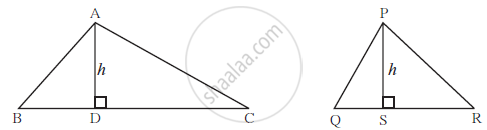
`A(triangle ABC)/A(triangle PQR)=(BCxxh)/(QRxxh)="BC"/QR"`
`A(triangle ABC)/A(triangle PQR)=b_1/b_2`
Property: The ratio of the areas of two triangles with equal heights is equal to the ratio of their corresponding bases.
Condition 2: If the bases of both triangles are equal then -
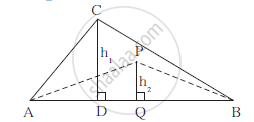
`A(triangle ABC)/A(triangle APB)=(ABxxh_1)/(ABxxh_2)`
`A(triangle ABC)/A(triangle APB)=h_1/h_2`
Property: The ratio of the areas of two triangles with equal bases is equal to the ratio of their corresponding heights.