Topics
Similarity
- Ratios of Areas of Two Triangles
- Basic Proportionality Theorem
- Property of an Angle Bisector of a Triangle
- Property of Three Parallel Lines and Their Transversals
- Similarity of Triangles (Corresponding Sides & Angles)
- Theorem of Areas of Similar Triangles
- Overview of Similarity
Pythagoras Theorem
- Pythagorean Triplet
- Property of 30°- 60°- 90° Triangle Theorem
- Property of 45°- 45°- 90° Triangle Theorem
- Theorem of Similarity in Right Angled Triangle
- Theorem of Geometric Mean
- Pythagoras Theorem
- Application of Pythagoras Theorem
- Apollonius Theorem
- Overview of Pythagoras Theorem
Circle
- Properties of Chords of a Circle
- Circles Passing Through One, Two, Three Points
- Secant and Tangent
- Tangent Theorem
- Tangent Segment Theorem
- Touching Circles
- Arc of the Circle
- Central Angle and the Measure of an Arc
- Congruence of Arcs
- Property of Sum of Measures of Arcs
- Inscribed Angle & Intercepted Arc
- Cyclic Quadrilateral
- Overview of Circle
- Theorem of Angle between Tangent and Secant
- Theorem of Internal Division of Chords
- Theorem of External Division of Chords
- Tangent Secant Segments Theorem
Geometric Constructions
- Construction of Similar Triangle
- Construction of a Tangent to a Circle at a Point on the Circle
- Construction of a Tangent to a Circle from a Point Outside the Circle
- Overview of Geometric Constructions
Co-ordinate Geometry
Trigonometry
Mensuration
- Introduction
- Types of Sectors
- The Quadrant
- Key Points Summary
Introduction
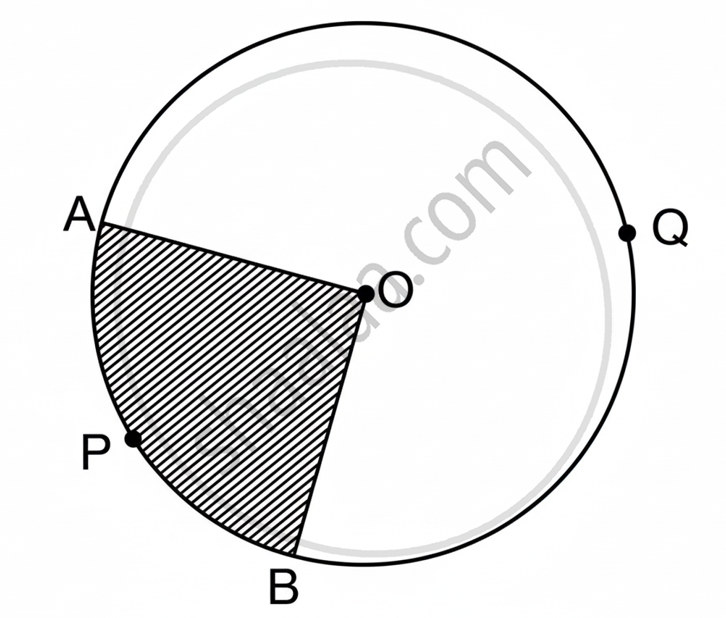
Have you ever cut a pizza or a pie? The piece you hold is shaped like a slice of a circle.”. In math, this specific slice of a circle has a special name: a Sector.
Understanding sectors is important because they help us calculate areas for everything from designing round clocks to graphing data using pie charts.
Types of Sectors
Minor Sector (Smaller one):
-
The smaller piece of the circle
-
The central angle is less than 180°
Major Sector (Larger one):
-
The larger piece of the circle
-
The central angle is more than 180°
The Quadrant
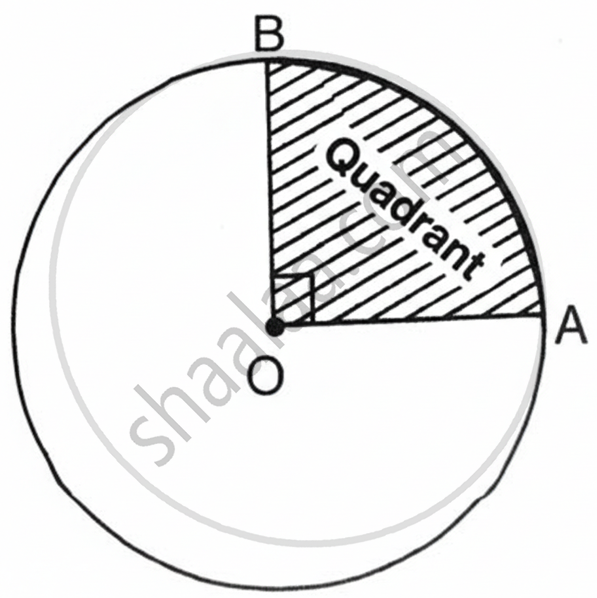
When the two radii are perpendicular to each other (forming a right angle of 90°), the sector formed is called a quadrant.
-
A circle has four quadrants in total.
-
Each quadrant is one-fourth (¼) of the entire circle.
Key Points Summary
-
Sector is a pie-slice region bounded by two radii and an arc
- Minor sector = smaller piece (angle < 180°)
-
Major sector = larger piece (angle > 180°)
- A quadrant is a special sector where the two radii are perpendicular (90° angle)
