Topics
Electrostatics
Electric Charges and Fields
- Electric Charge
- Positive and Negative Charges
- Electron Theory of Electrification
- Conductors and Insulators
- Electrostatic Induction
- Important Properties of Electric Charge
- Scalar Form of Coulomb’s Law
- Coulomb's Law in Vector Form
- Principle of Superposition
- Equilibrium of Charge and System of Charges
- Electric Field
- Electric Field Intensity Due to a Point-Charge
- Intensity of Electric Field due to a Continuous Charge Distribution
- Electric Lines of Force
- Electric Dipole
- Electric Field due to an Electric Dipole
- Torque on a Dipole in a Uniform Electric Field
Current Electricity
Gauss' Theorem
- Gauss’s Law
- Electric Flux
- Gauss' Theorem
- Applications of Gauss' Theorem
- Overview: Gauss' Theorem
Magnetic Effects of Current and Magnetism
Electric Potential
- Electric Potential
- Potential and Potential Difference
- Potential Gradient
- Equipotential Surfaces
- Potential Due to an Electric Dipole
- Electric Potential Energy of an Electric Dipole in an Electrostatic Field
- Overview: Electric Potential
Capacitors and Dielectrics
- Conductors and Insulators
- Capacitance of a Conductor
- Capacitors
- Capacitance of a Capacitor
- Combination of Capacitors
- Energy Stored in a Charged Capacitor
- Dielectrics
- Electric Polarisation of Matter
- Effect of Introducing a Dielectric between the Plates of a Charged Capacitor
- Overview: Capacitors and Dielectrics
Electromagnetic Induction and Alternating Currents
Electric Resistance and Ohm's Law
- Electric Current
- Current Density
- Mechanism of Flow of Charge in Metals
- Transport Properties of Free Electrons
- Mobility of Electrons
- Relation between Drift Velocity of Free Electrons and Electric Current
- Electric Resistance
- Ohm's Law
- Experimental Verification of Ohm’s Law
- Ohmic and Non-ohmic Resistors
- Exceptions to Ohm's Law
- Dynamic Resistance
- Derivation of Ohm's Law
- Specific Resistance or Electrical Resistivity
- Ohm's law in Vector Form
- Resistance and Conductor Dimensions
- Effect of Temperature on Resistivity
- Colour Code of Carbon Resistors
- Combinations of Resistances
- Derivation Using Series and Parallel Connections
- Electric Energy and Power
- Commercial Units of Electricity Consumption
- Overview: Electric Resistance and Ohm's Law
Electromagnetic Waves
DC Circuits and Measurements
- Electric cell
- Electromotive Force (emf)
- Terminal Potential Difference
- Internal Resistance of a Cell
- Relation between E, V, and r
- Combinations of Cells
- Kirchhoff’s Laws
- Wheatstone Bridge
- Rheostat
- Metre Bridge: Slide-Wire Bridge
- Potentiometer
- Overview: DC Circuits and Measurements
Optics (Ray and Wave Optics)
Dual Nature of Radiation and Matter
Moving Charges and Magnetic Field
- Magnetic Field
- Oersted's Experiment
- Biot-Savart Law
- Comparison of Coulomb's Law and Biot-Savart's Law
- Rules to Determine the Direction of Developed Magnetic Field
- Applications of Biot-Savart's Law > Magnetic Field due to a Finite Straight Current-Carrying Wire
- Applications of Biot-Savart's Law > Magnetic Field on the Axis of a Circular Current-Carrying Loop
- Applications of Biot-Savart's Law > Magnetic Field at the Centre of a Circular Loop
- Ampere’s Circuital Law
- Applications of Ampere’s Circuital Law > Magnetic Field of a Long Straight Solenoid
- Applications of Ampere’s Circuital Law > Magnetic Field of a Long Straight Thin Wire
- Applications of Ampere’s Circuital Law > Magnetic Field of a Toroidal Solenoid
- Force on a Moving Charge in a Uniform Magnetic Field
- Magnetic Field Defined by Magnetic Force
- Motion of Charged Particles in a Uniform Magnetic Field
- Lorentz Force
- Cyclotron
- Force on a Current - Carrying Conductor in a Uniform Magnetic Field
- Ampere: Based on Force Between Currents
- Overview: Moving Charges and Magnetic Field
Atoms and Nuclei
Torque on a Current-Loop : Moving-Coil Galvanometer
- Torque on a Current-Loop in a Uniform Magnetic Field
- Magnetic Moment of a Coil
- Moving Coil Galvanometer
- Sensitivity of a Galvanometer
- Conversion of a Galvanometer into an Ammeter
- Conversion of a Galvanometer into a Voltmeter
- Overview: Torque on a Current-Loop : Moving-Coil Galvanometer
Magnetic Field and Earth's Magnetism
- Current Loop as a Magnetic Dipole: Magnetic Dipole Moment of Current Loop
- Magnetic Dipole Moment of a Revolving Electron
- Magnetic Field of a Magnetic Dipole (Small Bar Magnet)
- Torque on a Magnetic Dipole (Bar Magnet) in a Uniform Magnetic Field
- Potential Energy of a Magnet in a Magnetic Field
- Current-Carrying Solenoid as an Equivalent to a Bar Magnet
- Magnetic Lines of Force
- Earth’s Magnetic Field
- Elements of the Earth's Magnetic Field > Angle of Declination
- Elements of the Earth's Magnetic Field > Angle of Dip or Magnetic Inclination
- Elements of the Earth's Magnetic Field > Horizontal Component of Earth's Magnetic Field
- Overview: Magnetic Field and Earth's Magnetism
Electronic Devices
Communication Systems
Magnetic Classification of Substances
- Classification of Substances According to their Magnetic Behaviour
- Terms Used in Magnetism
- Properties of Dia-, Para-, and Ferromagnetic Substances
- Explanation of Dia-, Para-, and Ferromagnetism based on the Atomic Model of Magnetism
- Hysteresis: Retentivity and Coercivity
- Differences in Magnetic Properties of Soft Iron and Steel
- Magnetic Materials
- Overview: Magnetic Classification of Substances
Electromagnetic Induction
- Magnetic Flux
- Electromagnetic Induction
- Faraday's Laws of Electromagnetic Induction
- Induced Current and Induced Charge
- Methods of Changing the Magnetic Flux
- Motion of a Straight Conductor in a Uniform Magnetic Field (Motional EMF)
- Explanation of Electromagnetic Induction in Terms of Lorentz Force: Proof of Faraday's Law
- Motional emf in Rotating a Conducting Rod in a Uniform Magnetic Field
- Self – Induction
- Self-Inductance of a Long Solenoid
- Energy Stored in an Inductor
- Examples of the Effects of Self-Induced Current
- Mutual Induction
- Mutual Inductance
- Eddy Currents or Foucault Currents
- Overview: Electromagnetic Induction
Alternating Current
- Alternating Voltage and Current in a Rotating Coil
- Definitions Regarding Alternating Voltage and Current
- Mean (or Average) Value of Alternating Current (or Voltage)
- Root-Mean-Square Value of Alternating Current
- Phasors and Phasor Diagrams
- Types of AC Circuits
- Circuit containing Resistance Only
- Circuit containing Inductance Only
- Circuit containing Capacitance Only
- Circuit containing Inductance and Resistance in Series (L-R Series Circuit)
- Circuit containing Capacitance and Resistance in Series (C-R Series Circuit)
- Circuit containing Inductance and Capacitance (L-C Circuit)
- Circuit containing Inductance, Capacitance and Resistance in Series (L-C-R Series Circuit)
- Power in AC Circuit
- Wattless Current
- Half Power Points, Bandwidth and Q-Factor
- Choke Coil
- Electrical Oscillations in L-C Circuit
- Resonant Circuits
- Frequency Response of AC Circuits
- A.C. Generator
- Transformers
- Utility of Alternating Current in Comparison to Direct Current
- Overview: Alternating Current
Electromagnetic Waves
- Displacement Current
- Relation between Conduction and Displacement Current
- Maxwell's Equation
- EM Wave
- Field Magnitude Relation in Free Space
- Energy Density in Electromagnetic Waves
- Transverse Nature of Electromagnetic Waves
- Electromagnetic Spectrum
- Overview: Electromagnetic Waves
Reflection of Light: Spherical Mirrors
- Spherical Mirrors
- Fundamental Terms Related to Spherical Mirrors
- Relation Between Focal Length and Radius of Curvature of a Spherical Mirror
- Rules to Trace the Image Formed by Spherical Mirrors
- Conditions of Image Formation
- Position and Nature of Image Formed by Spherical Mirrors
- Sign Convention
- Mirror Formula for Concave Mirror
- Mirror Formula for Convex Mirror
- Linear Magnification by Spherical Mirrors
- Uses of Spherical Mirrors
- Overview: Reflection of Light: Spherical Mirrors
Refraction of Light at a Plane Interface : Total Internal Reflection : Optical Fibre
- Refraction of Light
- Laws of Refraction
- Cause of Refraction
- Physical Significance of Refractive Index
- Reversibility of Light
- Refraction of Light Through a Rectangular Glass Block
- Refraction through Parallel Multiple Media
- Real and Apparent Depths: Normal Displacement
- Critical Angle
- Total Internal Reflection
- Applications of Total Internal Reflection
- Overview: Refraction of Light at a Plane Interface
Refraction of Light at Spherical Surfaces : Lenses
- Coordinate Geometry Sign Convention for Measuring Distances and Lengths
- Refraction at Concave Spherical Surface
- Refraction at a Convex Spherical Surface
- Concept of Lenses
- Converging and Diverging Actions of Lenses
- Lens Maker's Formula
- Factors Affecting Focal Length of a Lens
- Image Formation by Thin Lenses
- Ray Diagrams for Formation of Image by a Convex Lens
- Ray Diagram for Formation of Image by a Concave Lens
- Linear Magnification by Spherical Lenses
- Power of a Lens
- Combined Focal Length of Two Thin Lenses in Contact
- Combination of Lenses and Mirrors
- Overview: Refraction of Light at Spherical Surfaces: Lenses
Refraction and Dispersion of Light through a Prism
Optical Instruments
Wave Nature of Light : Huygens' Principle
Interference of Light
Diffraction of Light
Polarisation of Light
Photoelectric Effect
Matter Waves
X-Rays
Atom, Origin of Spectra : Bohr's Theory of Hydrogen Atom
Nuclear Structure
Radioactivity
Mass-Energy Equivalence : Nuclear Binding Energy
Nuclear Fission and Nuclear Fusion : Sources of Energy
Semiconductor Electronics
Junction Diodes
Junction Transistors
Logic Gates
Communication Systems
Experiment
1. Aim: To verify Ohm’s Law by demonstrating that the current flowing through a conductor is directly proportional to the potential difference across it, keeping resistance constant.
2. Requirements: 4 cells (1.5 V each), ammeter, voltmeter, conducting wires, nichrome wire (as resistance), and plug key.
3. Procedure
- Assemble the circuit as per the diagram, using the nichrome wire as the resistor.
- Connect one cell to the circuit and record the readings of the ammeter (current) and voltmeter (potential difference).
- Gradually add cells one by one (up to 4 cells), recording the readings each time in a table.
- For each case, calculate R=`"V"/"I"`.
- Plot a graph of potential difference (V) on the y-axis and current (I) on the x-axis.
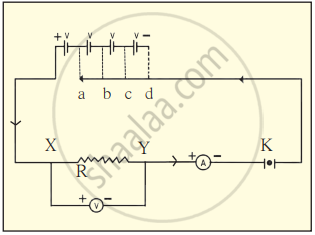
Verification of Ohm’s Law
4. Observation Chart
| No. | Cells Used | Current (I) (mA) | Current (I) (A) | Potential Difference (V) | R = V/I (Ω) |
|---|---|---|---|---|---|
| 1 | 1 | 50 | 0.05 | 1.5 | 30 |
| 2 | 2 | 100 | 0.10 | 3.0 | 30 |
| 3 | 3 | 150 | 0.15 | 4.5 | 30 |
| 4 | 4 | 200 | 0.20 | 6.0 | 30 |
5. Graph

The graph above illustrates the relationship between current (I) and potential difference (V) based on the provided data. It is a straight line, indicating that V∝I, which confirms Ohm's Law. This linear relationship shows that the resistance (R) of the conductor is constant.
6. Conclusion: The graph between current (I) and potential difference (V) is a straight line passing through the origin, confirming that V∝I. The ratio `"V"/"I"`=R remains constant, verifying Ohm's law. Resistance (R) of the nichrome wire is found to be constant at 30 Ω.
