Advertisements
Online Mock Tests
Chapters
1: Bricks, Beads And Bones: The Harappan Civilisation
2: Kings, Farmers And Towns: Early States and Economies
3: Kinship, Caste And Class: Early Societies
4: Thinkers, Beliefs And Buildings: Cultural Developments
Part 2
▶ 5: Through The Eyes Of Travellers: Perceptions of Society
6: Bhakti –Sufi Traditions: Changes in Religious Beliefs and Devotional Texts
7: An Imperial Capital: Vijayanagara
8: Peasants, Zamindars And The State: Agrarian Society and the Mughal Empire
Part 3
9: Colonialism And The Countryside: Exploring Official Archives
10: Rebels And The Raj: 1857 Revolt and its Representations
11: Mahatma Gandhi And The Nationalist Movement: Civil Disobedience and Beyond
12: Framing The Constitution: The Beginning of a New Era
![NCERT solutions for Themes In Indian History Part I, II, and III [English] Class 12 chapter 5 - Through The Eyes Of Travellers: Perceptions of Society - Shaalaa.com](/images/themes-in-indian-history-part-i-ii-and-iii-english-class-12_6:81c2d22dfccf437dbdcef1d2cd896e40.jpg "NCERT solutions for Themes In Indian History Part I, II, and III [English] Class 12 chapter 5 - Through The Eyes Of Travellers: Perceptions of Society")
Advertisements
Solutions for Chapter 5: Through The Eyes Of Travellers: Perceptions of Society
Below listed, you can find solutions for Chapter 5 of CBSE NCERT for Themes In Indian History Part I, II, and III [English] Class 12.
NCERT solutions for Themes In Indian History Part I, II, and III [English] Class 12 5 Through The Eyes Of Travellers: Perceptions of Society Intext Question [Pages 116 - 136]
|
Al-Biruni described his work as: a help to those who want to discuss religious questions with them (the Hindus), and as a repertory of information to those who want to associate with them. |
Read the excerpt from Al-Biruni (The system of varnas) and discuss whether his work met these objectives.
Discuss
If Al-Biruni lived in the twenty-first century, which are the areas of the world where he could have been easily understood, if he still knew the same languages?
Are these clothes Greek or Arabian?
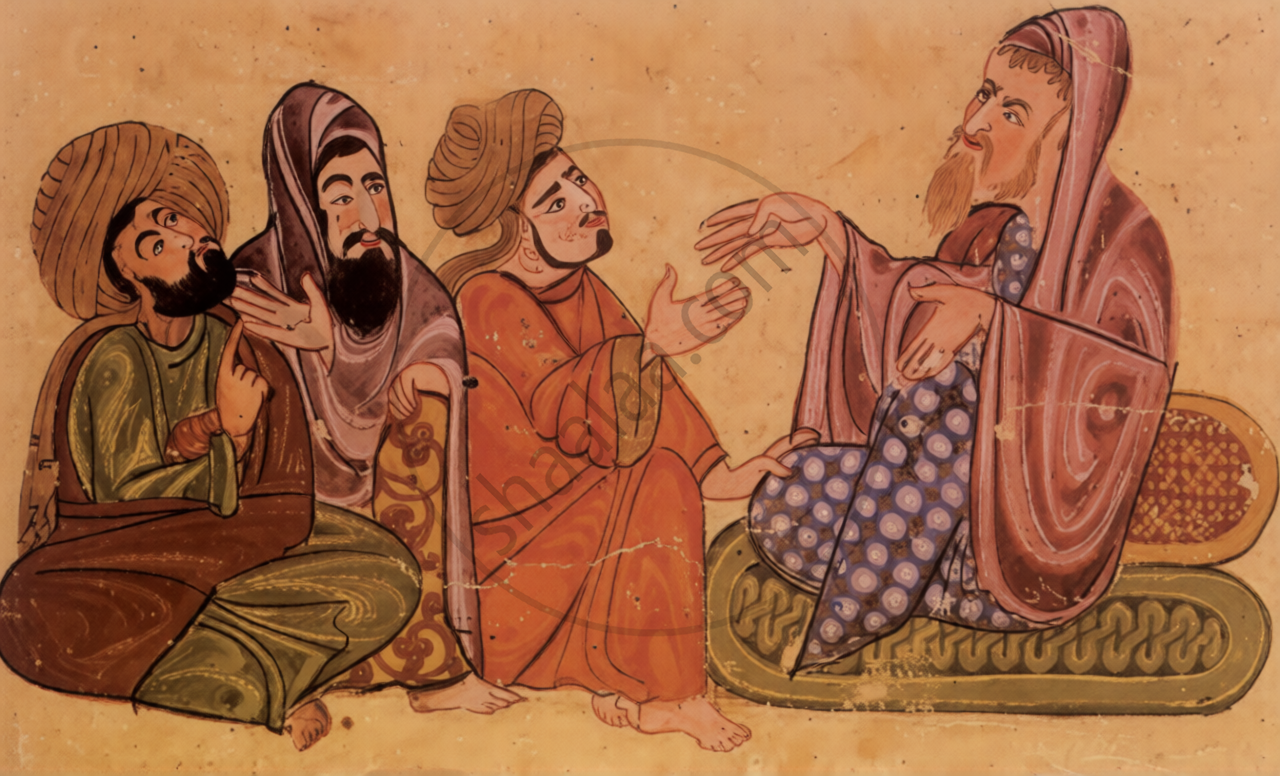
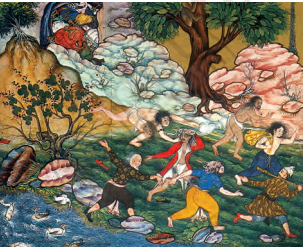
How can you distinguish the travellers from the robbers?
Why do you think some of the passengers are carrying arms?
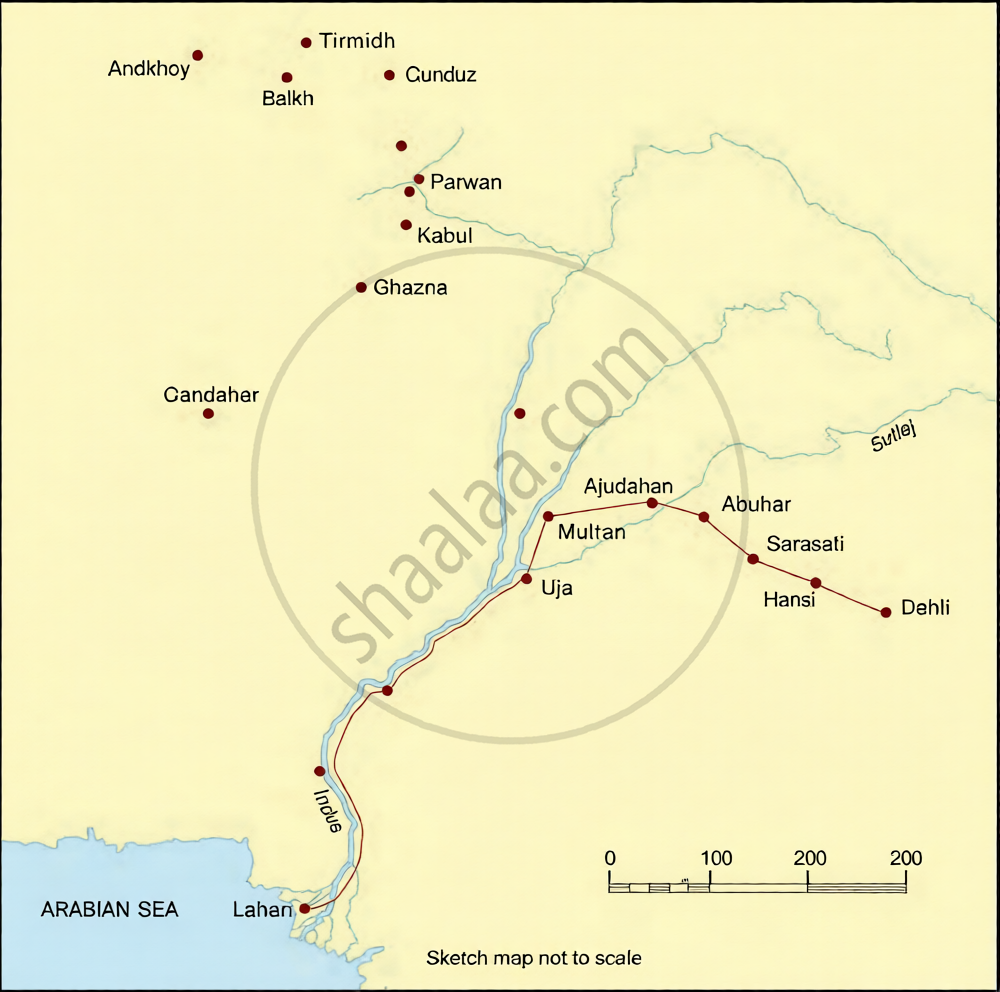
Use the scale on the map to calculate the distance in miles between Multan and Delhi.
Discuss
Compare the objectives of Al-Biruni and Ibn Battuta in writing their accounts.
|
Bernier often travelled with the army. This is an excerpt from his description of the army’s march to Kashmir: I am expected to keep two good Turkoman horses, and I also take with me a powerful Persian camel and driver, a groom for my horses, a cook and a servant to go before my horse with a flask of water in his hand, according to the custom of the country. I am also provided with every useful article, such as a tent of moderate size, a carpet, a portable bed made of four very strong but light canes, a pillow, a mattress, round leather table-cloths used at meals, some few napkins of dyed cloth, three small bags with culinary utensils which are all placed in a large bag, and this bag is again carried in a very capacious and strong double sack or net made of leather thongs. This double sack likewise contains the provisions, linen and wearing apparel, both of master and servants. I have taken care to lay in a stock of excellent rice for five or six days’ consumption, of sweet biscuits flavoured with anise (a herb), of limes and sugar. Nor have I forgotten a linen bag with its small iron hook for the purpose of suspending and draining dahi or curds; nothing being considered so refreshing in this country as lemonade and dahi. |
What are the things from Bernier’s list that you would take on a journey today?
Discuss
There is a very rich travel literature in Indian languages. Find out about travel writers in the language you use at home. Read one such account and describe the areas visited by the traveller, what he saw, and why he wrote the account.
|
This is Al-Biruni’s account of the system of varnas: The highest caste are the Brahmana, of whom the books of the Hindus tell us that they were created from the head of Brahman. And as the Brahman is only another name for the force called nature, and the head is the highest part of the … body, the Brahmana are the choice part of the whole genus. Therefore the Hindus consider them as the very best of mankind. The next caste are the Kshatriya, who were created, as they say, from the shoulders and hands of Brahman. Their degree is not much below that of the Brahmana. After them follow the Vaishya, who were created from the thigh of Brahman. The Shudra, who were created from his feet . . . Between the latter two classes there is no very great distance. Much, however, as these classes differ from each other, they live together in the same towns and villages, mixed together in the same houses and lodgings. |
Compare what Al-Biruni wrote with the Purusha Sukta hymn from the Rigveda. Do you notice any similarities and differences? Do you think Al-Biruni depended only on Sanskrit texts for his information and understanding of Indian society?
Discuss
How important is knowledge of the language of the area for a traveller from a different region?
|
The following is how Ibn Battuta described the coconut: These trees are among the most peculiar trees in kind and most astonishing in habit. They look exactly like date-palms, without any difference between them except that the one produces nuts as its fruits and the other produces dates. The nut of a coconut tree resembles a man’s head, for in it are what look like two eyes and a mouth, and the inside of it when it is green looks like the brain, and attached to it is a fibre which looks like hair. They make from this cords with which they sew up ships instead of (using) iron nails, and they (also) make from it cables for vessels. |
What are the comparisons that Ibn Battuta makes to give his readers an idea about what coconuts looked like? Do you think these are appropriate? How does he convey a sense that this fruit is unusual? How accurate is his description?
|
Read Ibn Battuta’s description of the paan: The betel is a tree which is cultivated in the same manner as the grape-vine; … The betel has no fruit and is grown only for the sake of its leaves … The manner of its use is that before eating it one takes areca nut; this is like a nutmeg but is broken up until it is reduced to small pellets, and one places these in his mouth and chews them. Then he takes the leaves of betel, puts a little chalk on them, and masticates them along with the betel. |
Why do you think this attracted Ibn Battuta’s attention? Is there anything you would like to add to this description?
|
Here is an excerpt from Ibn Battuta’s account of Delhi, often spelt as Dehli in texts of the period: The city of Dehli covers a wide area and has a large population ... The rampart round the city is without parallel. The breadth of its wall is eleven cubits; and inside it are houses for the night sentry and gatekeepers. Inside the ramparts, there are storehouses for storing edibles, magazines, ammunition, ballistas and siege machines. The grains that are stored (in these ramparts) can last for a long time, without rotting ... In the interior of the rampart, horsemen as well as infantrymen move from one end of the city to another. The rampart is pierced through by windows which open on the side of the city, and it is through these windows that light enters inside. The lower part of the rampart is built of stone; the upper part of bricks. It has many towers close to one another. There are twenty-eight gates of this city which are called darwaza, and of these, the Budaun darwaza is the greatest; inside the Mandwi darwaza there is a grain market; adjacent to the Gul darwaza there is an orchard ... It (the city of Dehli) has a fine cemetery in which graves have domes over them, and those that do not have a dome, have an arch, for sure. In the cemetery they sow flowers such as tuberose, jasmine, wild rose, etc.; and flowers blossom there in all seasons. An arch in Tughlakabad, Delhi
Part of the fortification wall of the settlement
|
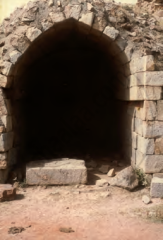
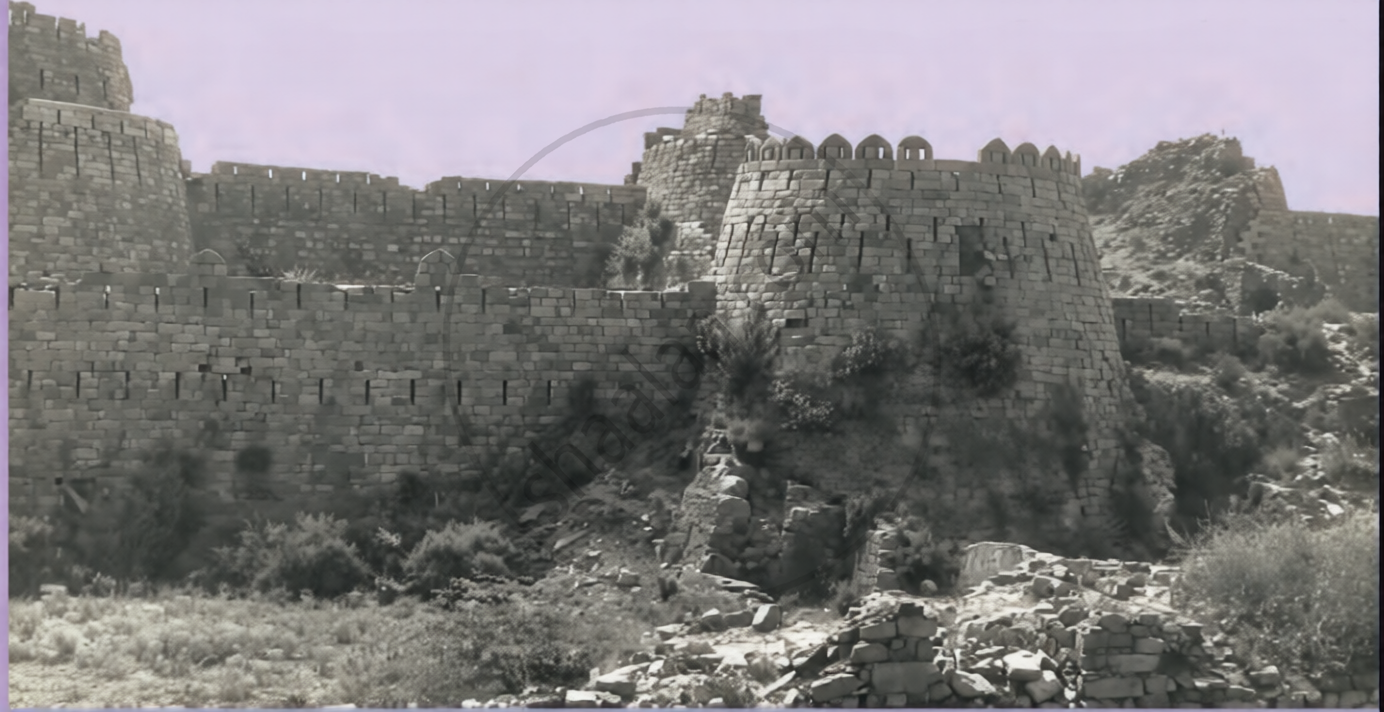
What were the architectural features that Ibn Battuta noted?
Compare this description with the illustrations of the city shown in Figs. An arch in Tughlakabad, Delhi and Part of the fortification wall of the settlement.
|
Read Ibn Battuta’s description of Daulatabad: In Daulatabad there is a marketplace for male and female singers, which is known as Tarababad. It is one of the greatest and most beautiful bazaars. It has numerous shops, and every shop has a door which leads into the house of the owner... The shops are decorated with carpets and at the centre of a shop there is a swing on which sits the female singer. She is decked with all kinds of finery and her female attendants swing her. In the middle of the marketplace there stands a large cupola, which is carpeted and decorated and in which the chief of the musicians takes his place every Thursday after the dawn prayers, accompanied by his servants and slaves. The female singers come in successive crowds, sing before him and dance until dusk, after which he withdraws. In this bazaar there are mosques for offering prayers ... One of the Hindu rulers ... alighted at the cupola every time he passed by this marketplace, and the female singers would sing before him. Even some Muslim rulers did the same. |
Why do you think Ibn Battuta highlighted these activities in his description?
|
This is how Ibn Battuta describes the postal system: In India, the postal system is of two kinds. The horsepost, called uluq, is run by royal horses stationed at a distance of every four miles. The foot-post has three stations per mile; it is called dawa, that is one-third of a mile ... Now, at every third of a mile there is a well-populated village, outside which are three pavilions in which sit men with girded loins ready to start. Each of them carries a rod, two cubits in length, with copper bells at the top. When the courier starts from the city, he holds the letter in one hand and the rod with its bells on the other; and he runs as fast as he can. When the men in the pavilion hear the ringing of the bell, they get ready. As soon as the courier reaches them, one of them takes the letter from his hand and runs at top speed shaking the rod all the while until he reaches the next dawa. And the same process continues till the letter reaches its destination. This foot-post is quicker than the horse-post; and often it is used to transport the fruits of Khurasan which are much desired in India. |
Do you think the foot-post system could have operated throughout the subcontinent?
Discuss
How did Ibn Battuta handle the problem of describing things or situations to people who had not seen or experienced them?
|
An excerpt from Bernier’s description of the peasantry in the countryside: Of the vast tracts of country constituting the empire of Hindustan, many are little more than sand, or barren mountains, badly cultivated, and thinly populated. Even a considerable portion of the good land remains untilled for want of labourers; many of whom perish in consequence of the bad treatment they experience from Governors. The poor people, when they become incapable of discharging the demands of their rapacious lords, are not only often deprived of the means of subsistence, but are also made to lose their children, who are carried away as slaves. Thus, it happens that the peasantry, driven to despair by so excessive a tyranny, abandon the country. In this instance, Bernier was participating in contemporary debates in Europe concerning the nature of state and society, and intended that his description of Mughal India would serve as a warning to those who did not recognise the “merits” of private property. |
What, according to Bernier, were the problems faced by peasants in the subcontinent? Do you think his description would have served to strengthen his case?
|
Bernier warned that if European kings followed the Mughal model: Their kingdoms would be very far from being well cultivated and peopled, so well built, so rich, so polite and flourishing as we see them. Our kings are otherwise rich and powerful; and we must avow that they are much better and more royally served. They would soon be kings of deserts and solitudes, of beggars and barbarians, such as those are whom I have been representing (the Mughals) … We should find the great Cities and the great Burroughs (boroughs) rendered uninhabitable because of ill air, and to fall to ruine (ruin) without any bodies (anybody) taking care of repairing them; the hillocks abandon’d, and the fields overspread with bushes, or fill’d with pestilential marishes (marshes), as hath been already intimated. |
How does Bernier depict a scenario of doom? Once you have read about Mughal agrarian society and the court, return to this description and analyse it again.
|
Read this excerpt from Bernier’s description of both agriculture and craft production: It is important to observe, that of this vast tract of country, a large portion is extremely fertile; the large kingdom of Bengale (Bengal), for instance, surpassing Egypt itself, not only in the production of rice, corn, and other necessaries of life, but of innumerable articles of commerce which are not cultivated in Egypt; such as silks, cotton, and indigo. There are also many parts of the Indies, where the population is sufficiently abundant, and the land pretty well tilled; and where the artisan, although naturally indolent, is yet compelled by necessity or otherwise to employ himself in manufacturing carpets, brocades, embroideries, gold and silver cloths, and the various sorts of silk and cotton goods, which are used in the country or exported abroad. It should not escape notice that gold and silver, after circulating in every other quarter of the globe, come at length to be swallowed up, lost in some measure, in Hindustan. |
In what ways is the description in this excerpt different from that in ‘A warning for Europe’?
|
Bernier is perhaps the only historian who provides a detailed account of the working of the imperial karkhanas or workshops: Large halls are seen at many places, called karkhanas or workshops for the artisans. In one hall, embroiderers are busily employed, superintended by a master. In another, you see the goldsmiths; in a third, painters; in a fourth, varnishers in lacquer-work; in a fifth, joiners, turners, tailors and shoe-makers; in a sixth, manufacturers of silk, brocade and fine muslins … The artisans come every morning to their karkhanas where they remain employed the whole day; and in the evening return to their homes. In this quiet regular manner, their time glides away; no one aspiring for any improvement in the condition of life wherein he happens to be born. |
How does Bernier convey a sense that although there was a great deal of activity, there was little progress?
Discuss
Why do you think scholars like Bernier chose to compare India with Europe?
Why do you think the lives of ordinary women workers did not attract the attention of travellers such as Ibn Battuta and Bernier?
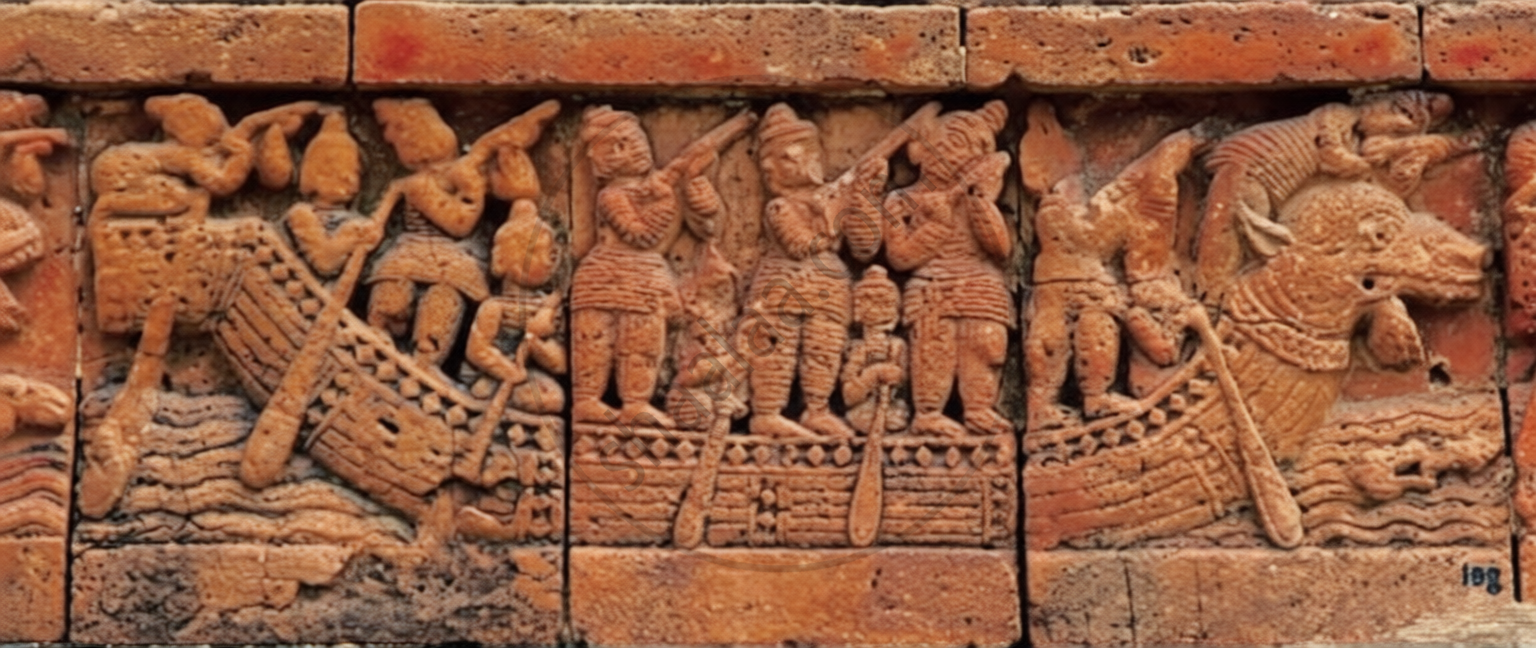
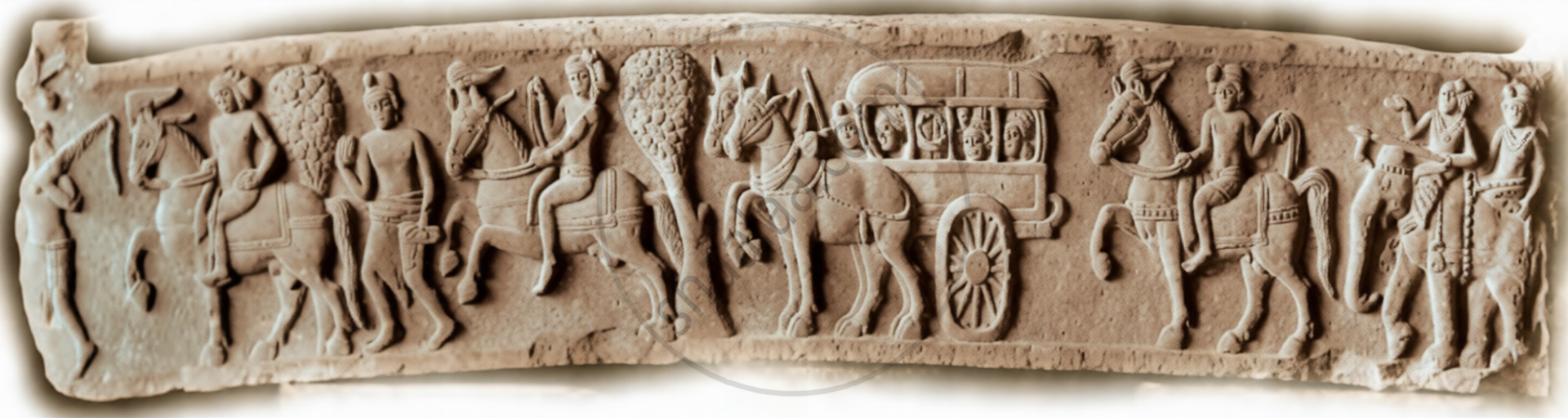
What are the various modes of transport that are shown?
NCERT solutions for Themes In Indian History Part I, II, and III [English] Class 12 5 Through The Eyes Of Travellers: Perceptions of Society Exercises [Pages 138 - 139]
Answer in 100-150 Words
Write a note on the Kitab-ul-Hind.
Answer in 100-150 Words
Compare and contrast the perspectives from which Ibn Battuta and Bernier wrote their accounts of their travels in India.
Answer in 100-150 Words
Discuss the picture of urban centres that emerges from Bernier’s account.
Answer in 100-150 words
Analyse the evidence for slavery provided by Ibn Battuta.
Answer in 100-150 words
What were the elements of the practice of sati that drew the attention of Bernier?
Write a short essay (about 250-300 words) on the following:-
Discuss Al-Biruni’s understanding of the caste system.
Write a short essay (about 250-300 words) on the following:-
Do you think Ibn Battuta’s account is useful in arriving at an understanding of life in contemporary urban centres? Give reasons for your answer.
Write a short essay (about 250-300 words) on the following:-
Discuss the extent to which Bernier’s account enables historians to reconstruct contemporary rural society.
Write a short essay (about 250-300 words) on the following:-
Read this excerpt from Bernier :-
Numerous are the instances of handsome pieces of workmanship made by persons destitute of tools, and who can scarcely be said to have received instruction from a master. Sometimes they imitate so perfectly articles of European manufacture that the difference between the original and copy can hardly be discerned. Among other things, the Indians make excellent muskets, and fowlingpieces, and such beautiful gold ornaments that it may be doubted if the exquisite workmanship of those articles can be exceeded by any European goldsmith. I have often admired the beauty, softness, and delicacy of their paintings.
List the crafts mentioned in the passage. Compare these with the descriptions of artisanal activity in the chapter.
Map work
On an outline map of the world mark the countries visited by Ibn Battuta. What are the seas that he may have crossed?
Projects (choose one)
Interview any one of your older relatives (mother/ father/grandparents/uncles/aunts) who has travelled outside your town or village. Find out (a) where they went, (b) how they travelled, (c) how long did it take, (d) why did they travel (e) and did they face any difficulties. List as many similarities and differences that they may have noticed between their place of residence and the place they visited, focusing on language, clothes, food, customs, buildings, roads, the lives of men and women. Write a report on your findings.
For any one of the travellers mentioned in “Through the Eyes of Travellers: Perceptions of Society”, find out more about his life and writings. Prepare a report on his travels, noting in particular how he described society, and comparing these descriptions with the excerpts included in “Through the Eyes of Travellers: Perceptions of Society.”
Solutions for 5: Through The Eyes Of Travellers: Perceptions of Society
NCERT solutions for Themes In Indian History Part I, II, and III [English] Class 12 chapter 5 - Through The Eyes Of Travellers: Perceptions of Society
Shaalaa.com has the CBSE Mathematics Themes In Indian History Part I, II, and III [English] Class 12 CBSE solutions in a manner that help students grasp basic concepts better and faster. The detailed, step-by-step solutions will help you understand the concepts better and clarify any confusion. NCERT solutions for Mathematics Themes In Indian History Part I, II, and III [English] Class 12 CBSE 5 (Through The Eyes Of Travellers: Perceptions of Society) include all questions with answers and detailed explanations. This will clear students' doubts about questions and improve their application skills while preparing for board exams.
Further, we at Shaalaa.com provide such solutions so students can prepare for written exams. NCERT textbook solutions can be a core help for self-study and provide excellent self-help guidance for students.
Concepts covered in Themes In Indian History Part I, II, and III [English] Class 12 chapter 5 Through The Eyes Of Travellers: Perceptions of Society are Al-biruni and the Kitab-ul-hind, Ibn Battuta’s Rihla, Francois Bernier - a Doctor with a Difference, Making Sense of an Alien World Al-biruni and the Sanskritic Tradition, Ibn Battuta and the Excitement of the Unfamiliar, Bernier and the “Degenerate” East, Women Slaves, Sati and Labourers, Overview of Through the Eyes of Travellers Perceptions of Society (c. tenth to seventeenth centuries), Overview of Through the Eyes of Travellers Perceptions of Society (c. tenth to seventeenth centuries).
Using NCERT Themes In Indian History Part I, II, and III [English] Class 12 solutions Through The Eyes Of Travellers: Perceptions of Society exercise by students is an easy way to prepare for the exams, as they involve solutions arranged chapter-wise and also page-wise. The questions involved in NCERT Solutions are essential questions that can be asked in the final exam. Maximum CBSE Themes In Indian History Part I, II, and III [English] Class 12 students prefer NCERT Textbook Solutions to score more in exams.
Get the free view of Chapter 5, Through The Eyes Of Travellers: Perceptions of Society Themes In Indian History Part I, II, and III [English] Class 12 additional questions for Mathematics Themes In Indian History Part I, II, and III [English] Class 12 CBSE, and you can use Shaalaa.com to keep it handy for your exam preparation.
