Advertisements
Online Mock Tests
Chapters
1: Bricks, Beads And Bones: The Harappan Civilisation
2: Kings, Farmers And Towns: Early States and Economies
3: Kinship, Caste And Class: Early Societies
4: Thinkers, Beliefs And Buildings: Cultural Developments
Part 2
5: Through The Eyes Of Travellers: Perceptions of Society
6: Bhakti –Sufi Traditions: Changes in Religious Beliefs and Devotional Texts
7: An Imperial Capital: Vijayanagara
8: Peasants, Zamindars And The State: Agrarian Society and the Mughal Empire
Part 3
9: Colonialism And The Countryside: Exploring Official Archives
▶ 10: Rebels And The Raj: 1857 Revolt and its Representations
11: Mahatma Gandhi And The Nationalist Movement: Civil Disobedience and Beyond
12: Framing The Constitution: The Beginning of a New Era
![NCERT solutions for Themes In Indian History Part I, II, and III [English] Class 12 chapter 10 - Rebels And The Raj: 1857 Revolt and its Representations - Shaalaa.com](/images/themes-in-indian-history-part-i-ii-and-iii-english-class-12_6:81c2d22dfccf437dbdcef1d2cd896e40.jpg "NCERT solutions for Themes In Indian History Part I, II, and III [English] Class 12 chapter 10 - Rebels And The Raj: 1857 Revolt and its Representations")
Advertisements
Solutions for Chapter 10: Rebels And The Raj: 1857 Revolt and its Representations
Below listed, you can find solutions for Chapter 10 of CBSE NCERT for Themes In Indian History Part I, II, and III [English] Class 12.
NCERT solutions for Themes In Indian History Part I, II, and III [English] Class 12 10 Rebels And The Raj: 1857 Revolt and its Representations Intext Question [Pages 260 - 283]
|
What happened in the cities during the months of the revolt? How did people live through those months of tumult? How was normal life affected? Reports from different cities tell us about the breakdown in routine activities. Read these reports from the Delhi Urdu Akhbar, 14 June 1857: The same thing is true for vegetables and saag (spinach). People have been found to complain that even kaddu (pumpkin) and baingan (brinjal) cannot be found in the bazaars. Potatoes and arvi (yam), when available, are of stale and rotten variety, stored from before by farsighted kunjras (vegetable growers). From the gardens inside the city, some produce does reach a few places, but the poor and the middle class can only lick their lips and watch them (as they are earmarked for the select). ... There is something else that needs attention which is causing a lot of damage to the people, which is that the water-carriers have stopped filling water. Poor Shurfas (gentility) are seen carrying water in pails on their shoulders, and only then the necessary household tasks such as cooking, etc. can take place. The halalkhors (righteous) have become haramkhors (corrupt); many mohallas have not been able to earn for several days, and if this situation continues, then decay, death and disease will combine together to spoil the city’s air, and an epidemic will spread all over the city and even to areas adjacent and around. |
Read the two reports and the descriptions of what was happening in Delhi provided in “Rebels and the Raj: The Revolt of 1857 and Its Representations. Remember that newspaper reports often express the prejudices of the reporter. How did Delhi Urdu Akhbar view the actions of the people?
| In the context of the communication of the message of revolt and mutiny, the experience of François Sisten, a native Christian police inspector in Sitapur, is telling. He had gone to Saharanpur to pay his respects to the magistrate. Sisten was dressed in Indian clothes and sitting cross-legged. A Muslim tahsildar from Bijnor entered the room; upon learning that Sisten was from Awadh, he enquired, “What news from Awadh? How does the work progress, brother?” Playing safe, Sisten replied, “If we have work in Awadh, your highness will know it.” The tahsildar said, “Depend upon it, we will succeed this time. The direction of the business is in able hands.” The tahsildar was later identified as the principal rebel leader of Bijnor. |
What does this conversation suggest about the ways in which plans were communicated and discussed by the rebels? Why did the tahsildar regard Sisten as a potential rebel?
Discuss
Read the section once more and explain the similarities and differences you notice in the ways in which leaders emerged during the revolt. For any two leaders, discuss why ordinary people were drawn to them.
|
Another song mourned the plight of the ruler who had to leave his motherland: Noble and peasant all wept together |
Read the entire section and discuss why people mourned the departure of Wajid Ali Shah.
|
The attitude of the taluqdars was best expressed by Hanwant Singh, the Raja of Kalakankar, near Rae Bareli. During the mutiny, Hanwant Singh had given shelter to a British officer and conveyed him to safety. While taking leave of the officer, Hanwant Singh told him: Sahib, your countrymen came into this country and drove out our King. You sent your officers round the districts to examine the titles to the estates. At one blow you took from me lands which from time immemorial had been in my family. I submitted. Suddenly misfortune fell upon you. The people of the land rose against you. You came to me whom you had despoiled. I have saved you. But now – now I march at the head of my retainers to Lucknow to try and drive you from the country |
What does this excerpt tell you about the attitude of the taluqdars? Who did Hanwant Singh mean by the people of the land? What reason does Hanwant Singh give for the anger of the people?
Discuss
Find out whether people in your state participated in the revolt of 1857. If they did, find out why they did so. If they did not, try and explain this.
|
This is one of the main sources of our knowledge about what the rebels wanted: It is well known to all that in this age the people of Hindostan, both Hindoos and Mohammedans, are being ruined under the tyranny and the oppression of the infidel and treacherous English. It is therefore the bounden duty of all the wealthy people of India, especially those who have any sort of connection with the Mohammedan royal families, and are considered the pastors and masters of their people, to stake their lives and property for the well-being of the public. … Several of the Hindoo and Mussalman Chiefs, who have long since quitted their homes for the preservation of their religion, and have been trying their best to root out the English in India, have presented themselves to me, and taken part in the reigning Indian crusade, and it is more than probable that I shall very shortly receive succours from the West. Therefore, for the information of the public, the present Ishtahar, consisting of several sections, is put in circulation, and it is the imperative duty of all to take into their careful consideration, and abide by it. Parties anxious to participate in the common cause, but having no means to provide for themselves, shall receive their daily subsistence from me; and be it known to all, that the ancient works, both of the Hindoos and Mohammedans, the writings of miracle workers, and the calculation of the astrologers, pundits, … all agree in asserting that the English will no longer have any footing in India or elsewhere. Therefore it is incumbent on all to give up the hope of the continuation of the British sway, side with me, and deserve the consideration of the Badshahi, or imperial government, by their individual exertion in promoting the common good, and thus attain their respective ends; otherwise if this golden opportunity slips away, they will have to repent for their folly, … . Section I – Regarding Zemindars. It is evident, that the British Government in making zemindary settlements have imposed exorbitant Jumas (revenue demand) and have disgraced and ruined several zemindars, by putting up their estates for public auction for arrears of rent, in so much, in the institution of a suit by a common Ryot, a maid servant, or a slave, the respectable zemindars are summoned into court, arrested, put in goal and disgraced. In litigation regarding zemindaries, the immense value of stamps, and other unnecessary expenses of the civil courts, … are all calculated to impoverish the litigants. Besides this, the coffers of the zemindars are annually taxed with the subscription for schools, hospitals, roads, etc. Such extortions will have no manner of existence in the Badshahi Government; but on the contrary the Jumas will be light, the dignity and honour of the zemindars safe, and every zemindar will have absolute rule in his own zemindary … Section II – Regarding Merchants. It is plain that the infidel and treacherous British Government have monopolised the trade of all the fine and valuable merchandise, such as indigo, cloth, and other articles of shipping, leaving only the trade of trifles to the people, … Besides this, the profits of the traders are taxed, with postages, tolls and subscriptions for schools, etc. Notwithstanding all these concessions, the merchants are liable to imprisonment and disgrace at the instance or complaint of a worthless man. When the Badshahi Government is established all these aforesaid fraudulent practices shall be dispensed with, and the trade of every article, without exception, both by land and water, will be opened to the native merchants of India, … It is therefore the duty of every merchant to take part in the war, and aid the Badshahi Government with his men and money, … . Section III – Regarding Public Servants. It is not a secret thing, that under the British Government, natives employed in the civil and military services have little respect, low pay, and no manner of influence; and all the posts of dignity and emolument in both the departments are exclusively bestowed on Englishmen, … Therefore, all the natives in the British service ought to be alive to their religion and interest, and abjuring their loyalty to the English, side with the Badshahi Government, and obtain salaries of 200 and 300 rupees a month for the present, and be entitled to high posts in the future. … Section IV – Regarding Artisans. It is evident that the Europeans, by the introduction of English articles into India, have thrown the weavers, the cotton dressers, the carpenters, the blacksmiths, and the shoemakers, etc., out of employ, and have engrossed their occupations, so that every description of native artisan has been reduced to beggary. But under the Badshahi Government the native artisans will exclusively be employed in the service of the kings, the rajahs, and the rich; and this will no doubt ensure their prosperity. Therefore these artisans ought to renounce the English services, … . Section V – Regarding Pundits, Fakirs and Other Learned Persons. The pundits and fakirs being the guardians of the Hindoo and Mohammadan religions respectively, and the Europeans being the enemies of both the religions, and as at present a war is raging against the English on account of religion, the pundits and fakirs are bound to present themselves to me, and take their share in the holy war… . |
What are the issues against British rule highlighted in this proclamation? Read the section on each social group carefully. Notice the language in which the proclamation is formulated and the variety of sentiments it appeals to.
|
This is one of the arzis (petition or application) of rebel sepoys that have survived: A century ago the British arrived in Hindostan and gradually entertained troops in their service, and became masters of every state. Our forefathers have always served them, and we also entered their service … By the mercy of God and with our assistance the British also conquered every place they liked, in which thousands of us, Hindostani men, were sacrificed, but we never made any excuses or pretences nor revolted … But in the year eighteen fifty seven the British issued an order that new cartridges and muskets which had arrived from England were to be issued; in the former of which the fats of cows and pigs were mixed; and also that attah of wheat mixed with powdered bones was to be eaten; and even distributed them in every Regiment of infantry, cavalry and artillery … They gave these cartridges to the sowars (mounted soldiers) of the 3rd Light Cavalry, and ordered them to bite them; the troopers objected to it, and said that they would never bite them, for if they did, their religion and faith would be destroyed … upon this the British officers paraded the men of the 3 Regiments and having prepared 1,400 English soldiers, and other Battalions of European troops and Horse Artillery, surrounded them, and placing six guns before each of the infantry regiments, loaded the guns with grape and made 84 new troopers prisoners, and put them in jail with irons on them … The reason that the sowars of the Cantonment were put into jail was that we should be frightened into biting the new cartridges. On this account we and all our country-men having united together, have fought the British for the preservation of our faith … we have been compelled to make war for two years and the Rajahs and Chiefs who are with us in faith and religion, are still so, and have undergone all sorts of trouble; we have fought for two years in order that our faith and religion may not be polluted. If the religion of a Hindoo or Mussalman is lost, what remains in the world? |
Compare the reasons for the mutiny as stated in the arzi with those mentioned by the taluqdars in “What taluqdars thought.”
Discuss
What do you think are the major problems faced by historians in reconstructing the point of view of the rebels?
|
An officer reporting from rural Awadh (spelt as Oude in the following account) noted: The Oude people are gradually pressing down on the line of communication from the North … the Oude people are villagers … these villagers are nearly intangible to Europeans melting away before them and collecting again. The Civil Authorities report these villagers to amount to a very large number of men, with a number of guns. |
What, according to this account, were the problems faced by the British in dealing with these villagers?
What idea is the picture projecting? What is being expressed through the images of the lion and the tiger? What do the figures of the woman and the child depict?
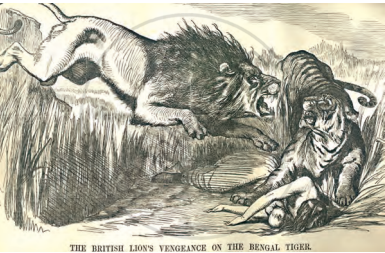
Discuss
Examine the elements in each of the visuals in this section and discuss how they allow you to identify the perspective of the artist.
NCERT solutions for Themes In Indian History Part I, II, and III [English] Class 12 10 Rebels And The Raj: 1857 Revolt and its Representations Exercises [Pages 284 - 285]
Answer in 100-150 Words
Why Did the Mutinous Sepoys in Many Places Turn to Erstwhile Rulers to Provide Leadership to the Revolt?
Answer in 100-150 Words
Discuss the evidence that indicates planning and coordination on the part of the rebels.
Answer in 100-150 Words
Discuss the Extent to Which Religious Beliefs Shaped the Events of 1857.
Answer in 100-150 Words
What Were the Measures Taken to Ensure Unity Among the Rebels?
Answer in 100-150 Words
What Steps Did the British Take to Quell the Uprising?
Write a Short Essay (250-300 Words) on the Following:
Why Was the Revolt Particularly Widespread in Awadh? What Prompted the Peasants, Taluqdars and Zamindars to Join the Revolt?
Write a short essay (250-300 words) on the following:
What did the rebels want? To what extent did the vision of different social group differ?
Write a short essay (250-300 words) on the following:
What do visual representations tell us about the revolt of 1857? How do historians analyse these representations?
Write a short essay (250-300 words) on the following:
Examine any two sources presented in the chapter, choosing one visual and one text, and discuss how these represent the point of view of the victor and the vanquished.
Map work
On an outline map of India, mark Calcutta (Kolkata), Bombay (Mumbai) and Madras (Chennai), three major centres of British power in 1857. Refer to Maps 1 and 2 and plot the areas where the revolt was most widespread. How close or far were these areas from the colonial cities?
Map 1

Map 2

Projects (choose one)
Read a biography of any one of the leaders of the revolt of 1857. Check the sources used by the biographer. Do these include government reports, newspaper accounts, stories in regional languages, visual material, anything else? Do all the sources say the same thing, or are there differences? Prepare a report on your findings.
See a film made on the revolt of 1857 and write about the way it represents the revolt. How does it depict the British, the rebels, and those who remained loyal to the British? What does it say about peasants, city dwellers, tribals, zamindars and taluqdars? What kind of a response does the film seek to evoke?
Solutions for 10: Rebels And The Raj: 1857 Revolt and its Representations
NCERT solutions for Themes In Indian History Part I, II, and III [English] Class 12 chapter 10 - Rebels And The Raj: 1857 Revolt and its Representations
Shaalaa.com has the CBSE Mathematics Themes In Indian History Part I, II, and III [English] Class 12 CBSE solutions in a manner that help students grasp basic concepts better and faster. The detailed, step-by-step solutions will help you understand the concepts better and clarify any confusion. NCERT solutions for Mathematics Themes In Indian History Part I, II, and III [English] Class 12 CBSE 10 (Rebels And The Raj: 1857 Revolt and its Representations) include all questions with answers and detailed explanations. This will clear students' doubts about questions and improve their application skills while preparing for board exams.
Further, we at Shaalaa.com provide such solutions so students can prepare for written exams. NCERT textbook solutions can be a core help for self-study and provide excellent self-help guidance for students.
Concepts covered in Themes In Indian History Part I, II, and III [English] Class 12 chapter 10 Rebels And The Raj: 1857 Revolt and its Representations are Pattern of the Rebellion, Awadh in Revolt, What the Rebels Wanted, Repression, Images of the Revolt, Overview of Rebels and The Raj 1857 Revolt and its Representations, Overview of Rebels and The Raj 1857 Revolt and its Representations.
Using NCERT Themes In Indian History Part I, II, and III [English] Class 12 solutions Rebels And The Raj: 1857 Revolt and its Representations exercise by students is an easy way to prepare for the exams, as they involve solutions arranged chapter-wise and also page-wise. The questions involved in NCERT Solutions are essential questions that can be asked in the final exam. Maximum CBSE Themes In Indian History Part I, II, and III [English] Class 12 students prefer NCERT Textbook Solutions to score more in exams.
Get the free view of Chapter 10, Rebels And The Raj: 1857 Revolt and its Representations Themes In Indian History Part I, II, and III [English] Class 12 additional questions for Mathematics Themes In Indian History Part I, II, and III [English] Class 12 CBSE, and you can use Shaalaa.com to keep it handy for your exam preparation.
