Advertisements
Online Mock Tests
Chapters
1: Power-sharing
2: Federalism
Unit II
3: Gender, Religion and Caste
Unit III
▶ 4: Political Parties
Unit IV
5: Outcomes of Democracy
![NCERT solutions for Social Science Democratic Politics 2 [English] Class 10 chapter 4 - Political Parties - Shaalaa.com](/images/social-science-democratic-politics-2-english-class-10_6:a07500aaf6d7438ba0e0990bd779983e.jpg "NCERT solutions for Social Science Democratic Politics 2 [English] Class 10 chapter 4 - Political Parties")
Advertisements
Solutions for Chapter 4: Political Parties
Below listed, you can find solutions for Chapter 4 of CBSE NCERT for Social Science Democratic Politics 2 [English] Class 10.
NCERT solutions for Social Science Democratic Politics 2 [English] Class 10 4 Political Parties Intext Questions [Pages 47 - 60]
So, you agree with me. Parties are partial, partisan and lead to partitions. Parties do nothing but divide people. That is their real function!
Okay, granted that we can’t live without political parties. But tell me on what grounds do people support a political party?
Let us revise
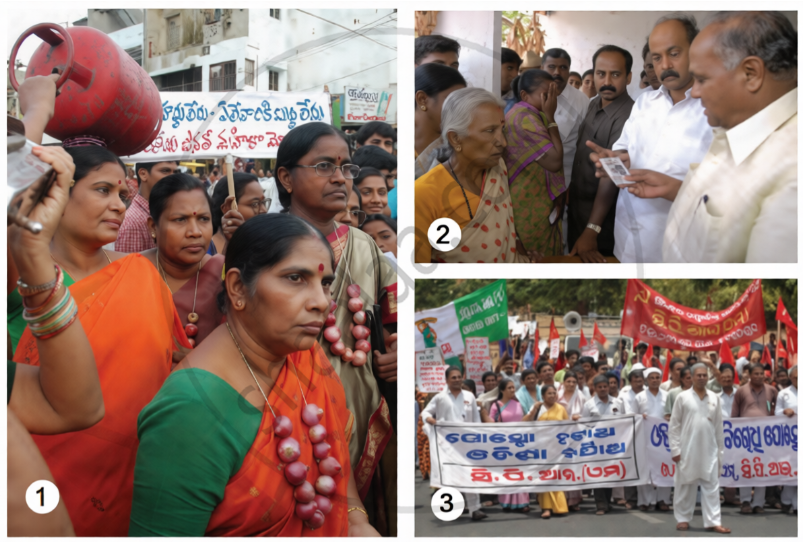
Categorise these photographs by the functions of political parties they illustrate. Find one photograph or news clipping from your own area for each of the functions listed above.
I wonder how politicians manage these coalitions. I can’t even remember the names of all the parties.
Let us revise
Let us apply what we have learnt about party systems to the various states within India. Here are three major types of party systems that exist at the State level. Can you find the names of at least two States for each of these types?
- Two-party system
- Multiparty system with two alliances
- Multiparty system
Does the cartoon reflect the data graphics shown on the previous page?
Why don’t parties give enough tickets to women? Is that also due to lack of internal democracy?
Does this suggest that in democracies people contest elections only to make money? But isn’t it true that there are politicians committed to the well-being of the people?
Let us revise
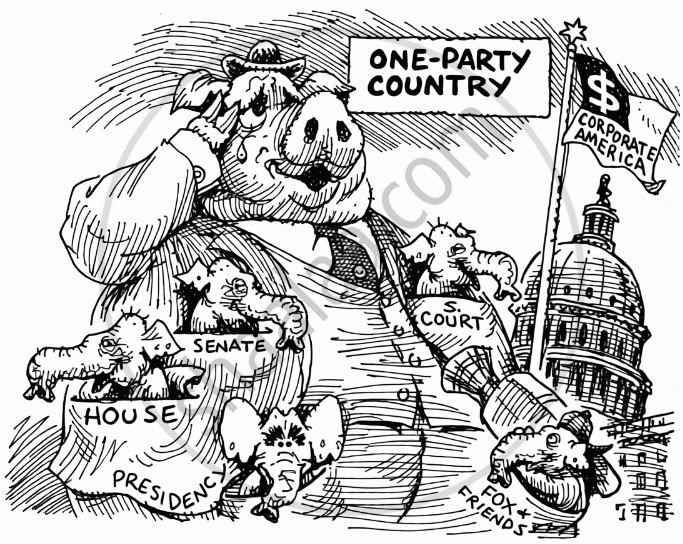
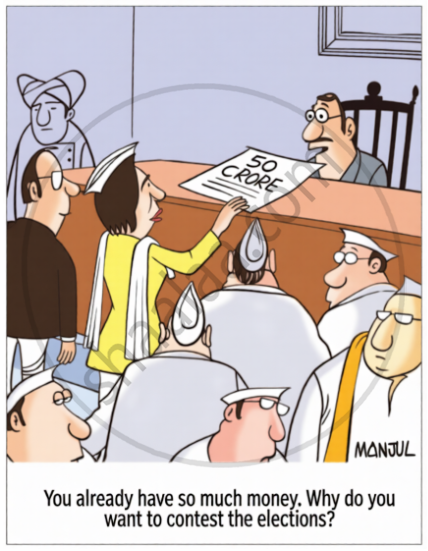
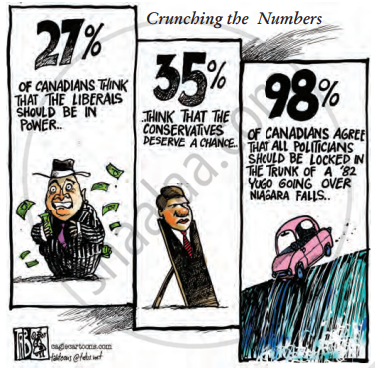
Can you identify which of the challenges described in this section are being highlighted in these cartoons? What are the ways to curb the misuse of money and muscle power in politics?
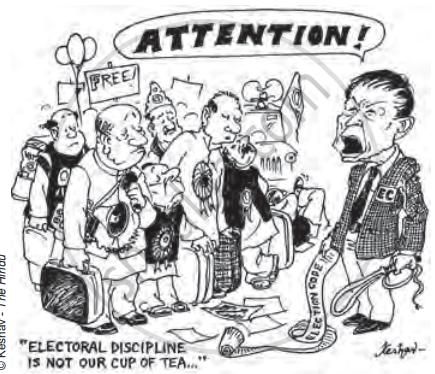
Do you agree that this form of reforming political parties will be acceptable to them?
NCERT solutions for Social Science Democratic Politics 2 [English] Class 10 4 Political Parties Exercises [Pages 61 - 62]
State the various functions political parties perform in a democracy.
What are the various challenges faced by political parties?
Suggest some reforms to strengthen parties so that they perform their functions well?
What is a political party?
What are the characteristics of a political party?
A group of people who come together to contest elections and hold power in the government is called a ______.
Match List I (organisations and struggles) with List II and select the correct answer using the codes given below the lists:
| List I | List II |
| 1. Congress Party | A. National Democratic Alliance |
| 2. Bharatiya Janata Party | B. State party |
| 3. Communist Party of India (Marxist) | C. United Progressive Alliance |
| 4. Telugu Desam party | D. Left Front |
1 - C, 2 - A, 3 - B, 4 - D
1 - C, 2 - D, 3 - A, 4 - B
1 - C, 2 - A, 3 - D, 4 - B
1 - D, 2 - C, 3 - A, 4 - B
Who among the following is the founder of the Bahujan Samaj Party?
Kanshi Ram
Sahu Maharaj
Β.R. Ambedker
Jotiba Phule
What is the guiding philosophy of the Bharatiya Janata Party?
Bahujan Samaj
Revolutionary democracy
Integral humanism
Modernity
Consider the following statements on parties.
- Political parties do not enjoy much trust among the people.
- Parties are often rocked by scandals involving top party leaders.
- Parties are not necessary to run governments.
Which of the statements given above are correct?
A, B and C
A and B
B and C
A and C
Read the following passage and answer the questions given below:
|
Muhammad Yunus is a famous economist of Bangladesh. He received several international honours for his efforts to promote economic and social development for the benefit of the poor. He and the Grameen Bank he started, jointly received the Noble Peace Prize for 2006. In February 2007, he decided to launch a political party and contest in the parliamentary elections. His objective was to foster proper leadership, good governance and build a new Bangladesh. He felt that only a political party different from the traditional ones would bring about new political culture. His party would be democratic from the grassroots level. The launching of the new party, called Nagarik Shakti (Citizens’ Power), has caused a stir among the Bangladeshis. While many welcomed his decisions, some did not like it. “Now I think Bangladesh will have a chance to choose between good and bad and eventually have a good government,” said Shahedul Islam, a government official. “That government, we hope, would not only keep itself away from corruption but also make fighting corruption and black money a top priority.” But leaders of traditional political parties who dominated the country’s politics for decades were apprehensive. “There was no debate (over him) winning the Novel, but politics is different, very challenging and often controversial,” said a senior leader of the Bangladesh Nationalist Party. Some others were highly critical. They asked why he was rushing into politics. “Is he being planted in politics by mentors from outside the country,” asked one political observer. |
- Do you think Yunus made a right decision to float a new political party?
- Do you agree with the statements and fears expressed by various people?
- How do you want this new party organised to make it different from other parties?
- If you were the one to begin this political party how would you defend it?
Solutions for 4: Political Parties
NCERT solutions for Social Science Democratic Politics 2 [English] Class 10 chapter 4 - Political Parties
Shaalaa.com has the CBSE Mathematics Social Science Democratic Politics 2 [English] Class 10 CBSE solutions in a manner that help students grasp basic concepts better and faster. The detailed, step-by-step solutions will help you understand the concepts better and clarify any confusion. NCERT solutions for Mathematics Social Science Democratic Politics 2 [English] Class 10 CBSE 4 (Political Parties) include all questions with answers and detailed explanations. This will clear students' doubts about questions and improve their application skills while preparing for board exams.
Further, we at Shaalaa.com provide such solutions so students can prepare for written exams. NCERT textbook solutions can be a core help for self-study and provide excellent self-help guidance for students.
Concepts covered in Social Science Democratic Politics 2 [English] Class 10 chapter 4 Political Parties are Role Do Political Parties Play in Competition and Contestation, Major National and Regional Parties in India/ Types of Political Parties, Overview of Political Parties, Role of Political Parties in a Democracy, Number of Political Parties, National Parties, State Parties, Challenges to Political Parties, Reforms in Political Parties, Popular Participation in Political Parties, Role Do Political Parties Play in Competition and Contestation, Major National and Regional Parties in India/ Types of Political Parties, Overview of Political Parties, Role of Political Parties in a Democracy, Number of Political Parties, National Parties, State Parties, Challenges to Political Parties, Reforms in Political Parties, Popular Participation in Political Parties.
Using NCERT Social Science Democratic Politics 2 [English] Class 10 solutions Political Parties exercise by students is an easy way to prepare for the exams, as they involve solutions arranged chapter-wise and also page-wise. The questions involved in NCERT Solutions are essential questions that can be asked in the final exam. Maximum CBSE Social Science Democratic Politics 2 [English] Class 10 students prefer NCERT Textbook Solutions to score more in exams.
Get the free view of Chapter 4, Political Parties Social Science Democratic Politics 2 [English] Class 10 additional questions for Mathematics Social Science Democratic Politics 2 [English] Class 10 CBSE, and you can use Shaalaa.com to keep it handy for your exam preparation.
