Advertisements
Online Mock Tests
Chapters
1: Power-sharing
2: Federalism
Unit II
▶ 3: Gender, Religion and Caste
Unit III
4: Political Parties
Unit IV
5: Outcomes of Democracy
![NCERT solutions for Social Science Democratic Politics 2 [English] Class 10 chapter 3 - Gender, Religion and Caste - Shaalaa.com](/images/social-science-democratic-politics-2-english-class-10_6:a07500aaf6d7438ba0e0990bd779983e.jpg "NCERT solutions for Social Science Democratic Politics 2 [English] Class 10 chapter 3 - Gender, Religion and Caste")
Advertisements
Solutions for Chapter 3: Gender, Religion and Caste
Below listed, you can find solutions for Chapter 3 of CBSE NCERT for Social Science Democratic Politics 2 [English] Class 10.
NCERT solutions for Social Science Democratic Politics 2 [English] Class 10 3 Gender, Religion and Caste Intext Questions [Pages 30 - 42]
Why are we discussing things like household work in this textbook on Political Science? Is this politics?
If politics is about power, then surely male dominance in the household should be considered political.
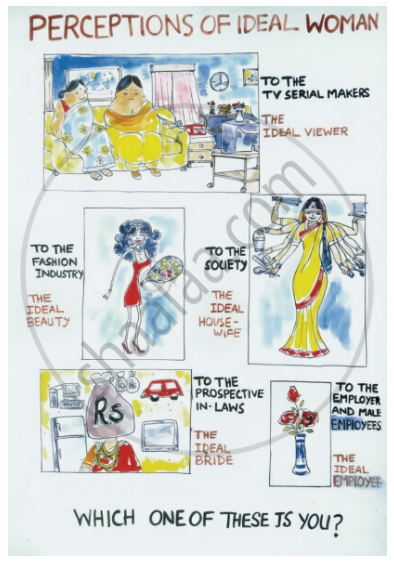
Discuss all these perceptions of an ideal woman that prevail in our society. Do you agree with any of these? If not, what is your image of an ideal woman?
A ‘time use survey’ was conducted in six states of our country. It shows that an average woman works every day for a little over seven and half hours while an average man works for six and a half hours. Yet the work done by men is more visible because most of their work leads to generation of income. Women also do a lot of direct income generating work, but the bulk of their work is household related. This work remains unpaid and invisible.
Daily time use (hours:minutes)
| Activities | Men | Women |
| Income generating work | 6:00 | 2:40 |
| Household and related work | 0:30 | 5:00 |
| Talking, Gossip | 1:25 | 1:20 |
| No work/ Leisure | 3:40 | 3:50 |
| Sleep, self-care, reading etc. | 12:25 | 11:10 |
You can conduct a similar time use survey in your own household. Observe all the adult male and female members of your family for one week. Every day note down the number of hours each of them spends on the following activities: income generating activity (working at the office or shop or factory or field, etc.), household related activity (cooking, cleaning, washing, fetching water, looking after children or elders, etc.), reading and recreation, talking/gossiping, self-care, taking rest or sleeping. If necessary make new categories. Add up the time taken on each activity for a week and calculate the daily average for each activity for each member. Do women work more in your family as well?
Mummy always says to outsiders, “I don’t work. I am a housewife.” But I see her working non-stop all the time. If what she does is not work, what else is work?
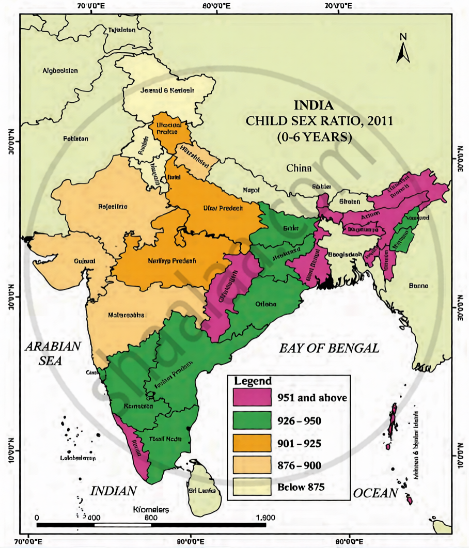
- Can you identify your State on this map? What is the child sex ratio in it? How is it different from others with a different colour?
- Identify the States which have child sex ratio below 900.
- Compare this map with the poster on the next page. How do the two of them tell us about the same issue?
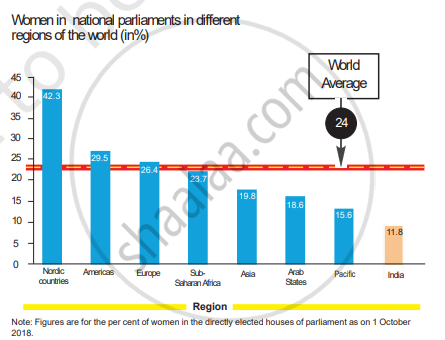
Could you think of some reasons why women’s representation is so low in India? Do you think Americas and Europe have achieved a satisfactory level of women’s representation?
If casteism and communalism are bad, what makes feminism a good thing? Why don’t we oppose all those who divide the society on any lines - caste, religion or gender?
I am not religious. Why should I bother about communalism and secularism?
I often crack jokes about people from one religion. Does that make me communal?
I don’t care what my caste is. Why are we discussing all this in the textbook? Are we not promoting casteism by talking about caste?
Now you don’t like it! Didn’t you tell me that wherever there is domination, we should discuss it in Political Science? Will caste disappear if we keep mum about it?
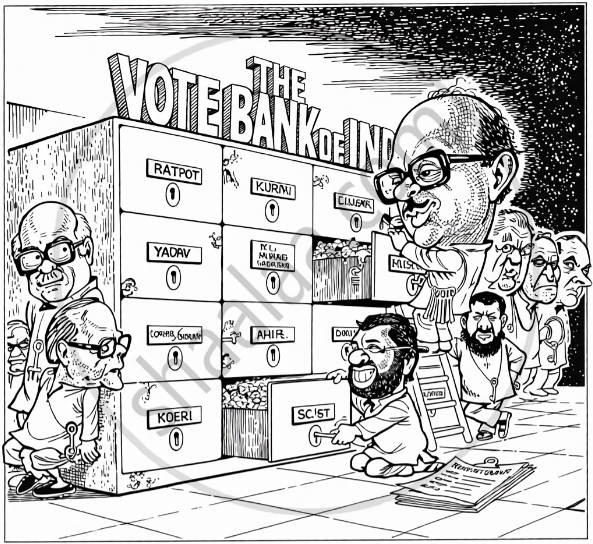
Do you think that political leaders are right to treat people belonging to a caste as ‘vote banks’?
NCERT solutions for Social Science Democratic Politics 2 [English] Class 10 3 Gender, Religion and Caste Exercises [Pages 44 - 45]
Mention different aspects of life in which women are discriminated or disadvantaged in India.
State different forms of communal politics with one example each.
State how caste inequalities are still continuing in India.
State two reasons to say that caste alone cannot determine election results in India.
What is the status of women’s representation in India’s legislative bodies?
Mention any two constitutional provisions that make India a secular state.
When we speak of gender divisions, we usually refer to ______.
Biological difference between men and women
Unequal roles assigned by the society to men and women
Unequal child sex ratio
Absence of voting rights for women in democracies
In India, seats are reserved for women in ______.
Lok Sabha
State Legislative assemblies
Cabinets
Panchayati Raj bodies
Consider the following statements on the meaning of communal politics. Communal politics is based on the belief that:
- One religion is superior to that of others.
- People belonging to different religions can live together happily as equal citizens.
- Followers of a particular religion constitute one community.
- State power cannot be used to establish the domination of one religious group over others.
Which of the statements are correct?
A, B, C and D
A, B and D
A and C
B and D
Which among the following statements about India’s Constitution is wrong? It ______.
prohibits discrimination on grounds of religion
gives official status to one religion
provides to all individuals freedom to profess any religion
ensures equality of citizens within religious communities
Social divisions based on ______ are peculiar to India.
Match List I with List II and select the correct answer using the codes given below the Lists:
| List I | List II |
| 1. A person who believes in equal rights and opportunities for women and men | A. Communalist |
| 2. A person who says that religion is the principal basis of community | B. Feminist |
| 3. A person who thinks that caste is the principal basis of community | C. Secularist |
| 4. A person who does not discriminate others on the basis of religious beliefs | D. Castiest |
1 - B, 2 - C, 3 - A, 4 - D
1 - B, 2 - A, 3 - D, 4 - C
1 - D, 2 - C, 3 - A, 4 - B
1 - C, 2 - A, 3 - B, 4 - D
Solutions for 3: Gender, Religion and Caste
NCERT solutions for Social Science Democratic Politics 2 [English] Class 10 chapter 3 - Gender, Religion and Caste
Shaalaa.com has the CBSE Mathematics Social Science Democratic Politics 2 [English] Class 10 CBSE solutions in a manner that help students grasp basic concepts better and faster. The detailed, step-by-step solutions will help you understand the concepts better and clarify any confusion. NCERT solutions for Mathematics Social Science Democratic Politics 2 [English] Class 10 CBSE 3 (Gender, Religion and Caste) include all questions with answers and detailed explanations. This will clear students' doubts about questions and improve their application skills while preparing for board exams.
Further, we at Shaalaa.com provide such solutions so students can prepare for written exams. NCERT textbook solutions can be a core help for self-study and provide excellent self-help guidance for students.
Concepts covered in Social Science Democratic Politics 2 [English] Class 10 chapter 3 Gender, Religion and Caste are Gender and Politics, Religion, Communalism and Politics, Caste and Politics, Religious Diversity, Inequalities in a Triangle, Overview of Gender, Religion and Caste, Gender and Politics, Women’s Political Representation, Religion, Communalism and Politics, Caste and Politics, Gender and Politics, Religion, Communalism and Politics, Caste and Politics, Religious Diversity, Inequalities in a Triangle, Overview of Gender, Religion and Caste, Gender and Politics, Women’s Political Representation, Religion, Communalism and Politics, Caste and Politics.
Using NCERT Social Science Democratic Politics 2 [English] Class 10 solutions Gender, Religion and Caste exercise by students is an easy way to prepare for the exams, as they involve solutions arranged chapter-wise and also page-wise. The questions involved in NCERT Solutions are essential questions that can be asked in the final exam. Maximum CBSE Social Science Democratic Politics 2 [English] Class 10 students prefer NCERT Textbook Solutions to score more in exams.
Get the free view of Chapter 3, Gender, Religion and Caste Social Science Democratic Politics 2 [English] Class 10 additional questions for Mathematics Social Science Democratic Politics 2 [English] Class 10 CBSE, and you can use Shaalaa.com to keep it handy for your exam preparation.
