Advertisements
Online Mock Tests
Chapters
![NCERT solutions for Political Science Politics in India Since Independence [English] Class 12 chapter 2 - era of one-party dominance - Shaalaa.com](/images/political-science-politics-in-india-since-independence-english-class-12_6:6ebe260af61b4bd7af6108945e3d6be6.jpg "NCERT solutions for Political Science Politics in India Since Independence [English] Class 12 chapter 2 - era of one-party dominance")
Advertisements
Solutions for Chapter 2: era of one-party dominance
Below listed, you can find solutions for Chapter 2 of CBSE NCERT for Political Science Politics in India Since Independence [English] Class 12.
NCERT solutions for Political Science Politics in India Since Independence [English] Class 12 2 era of one-party dominance Intext Questions [Pages 27 - 36]
What’s so special about our being a democracy? Sooner or later every country has become a democracy, isn’t it?
That was a good decision. But what about men who still refer to a woman as Mrs. Somebody, as if she does not have a name of her own?
Let's re-search
Ask the elders in your family and neighbourhood about their experience of participating in elections.
- Did anyone vote in the first or second general election? Who did they vote for and why?
- Is there someone who has used all the three methods of voting? Which one did they prefer?
- In which ways do they find the elections of those days different from the present ones?
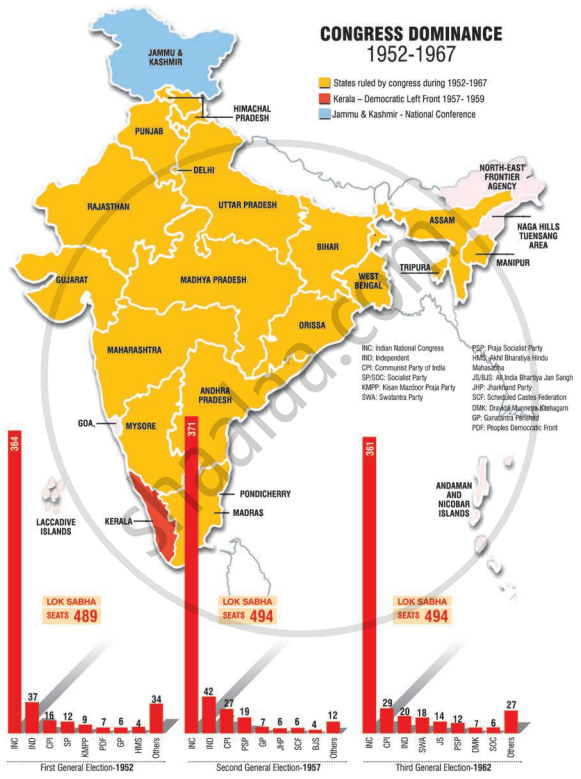
Can you identify the places where the Congress had a strong presence?
In which States, did the other parties perform reasonably well?
Earlier we had coalition in a party, now we have coalition of parties. Does it mean that we have had a coalition government since 1952?
NCERT solutions for Political Science Politics in India Since Independence [English] Class 12 2 era of one-party dominance Exercise [Pages 42 - 43]
Choose the correct option to fill in the blank.
The First General Elections in 1952 involved simultaneous elections to the Lok Sabha and ______.
The President of India
State Assemblies
Rajya Sabha
The Prime Minister
Choose the correct option to fill in the blank.
The party that won the second largest number of Lok Sabha seats in the first elections was the ______.
Praja Socialist Party
Bharatiya Jana Sangh
Communist Party of India
Bharatiya Janata Party
Choose the correct option to fill in the blank.
One of the guiding principles of the ideology of the Swatantra Party was ______________ .
Working class interests
Protection of Princely States
Economy free from State control
Autonomy of States within the Union
Match the following leaders listed in List A with the parties in List B.
| List A | List B |
| (a) S.A. Dange | i. Bharatiya Jana Sangh |
| (b) Shyama Prasad Mukherjee | ii. Swatantra Party |
| (c) Minoo Masani | iii. Praja Socialist Party |
| (d) Asoka Mehta | iv. Communist Party of India |
The statement regarding one-party dominance is given below. Mark it as true or false.
One-party dominance is rooted in the absence of strong alternative political parties.
True
False
The statement regarding one-party dominance is given below. Mark it as true or false.
One-party dominance occurs because of weak public opinion.
True
False
The statement regarding one-party dominance is given below. Mark it as true or false.
One-party dominance is linked to the nation’s colonial past.
True
False
The statement regarding one-party dominance is given below. Mark it as true or false.
One-party dominance reflects the absence of democratic ideals in a country.
True
False
Take a political map of India (with State outlines) and mark :
(a) two states where congress was not in power at same point during 1952-67.
(b) two states where the congress remained in power through this period.
Read the following passage and answer the questions below :
" Patel, the organisational man of the congress, wanted to purge the congress of other political groups and sought to make of it a cohesive and disciplined political party . He ... sought to take the Congress away from its all-embracing character and turn it into a close-knit party of disciplined cadres . Being a 'realist' he looked more for discipline than for comprehension . while Gandhi took too romantic view of "carrying on the movement," Patel's idea of transforming the congress into strictly political party with a single ideology and tight discipline showed an equal lack of understanding of the eclectic role that the congress, as a government, was to be called upon to perform in the decades to follow." - Rajni Kothari
(a) Why does the author think that Congress should not have been a cohesive and disciplined party?
(b) Give some examples of the eclectic role of the Congress party in the early years.
(c) Why does the author say that Gandhi’s view about Congress future was romantic?
LET US DO IT TOGETHER
Make a chart of elections and governments in your State since 1952. The chart could have the following columns: year of election, name of the winning party, name of ruling party or parties, name of the Chief Minister(s).
Solutions for 2: era of one-party dominance
NCERT solutions for Political Science Politics in India Since Independence [English] Class 12 chapter 2 - era of one-party dominance
Shaalaa.com has the CBSE Mathematics Political Science Politics in India Since Independence [English] Class 12 CBSE solutions in a manner that help students grasp basic concepts better and faster. The detailed, step-by-step solutions will help you understand the concepts better and clarify any confusion. NCERT solutions for Mathematics Political Science Politics in India Since Independence [English] Class 12 CBSE 2 (era of one-party dominance) include all questions with answers and detailed explanations. This will clear students' doubts about questions and improve their application skills while preparing for board exams.
Further, we at Shaalaa.com provide such solutions so students can prepare for written exams. NCERT textbook solutions can be a core help for self-study and provide excellent self-help guidance for students.
Concepts covered in Political Science Politics in India Since Independence [English] Class 12 chapter 2 era of one-party dominance are Coalitional Nature of Congress, Emergence of Opposition Parties, Congress Dominance in the First Three General Elections, Nature of Congress Dominance at the National Level, Uneven Dominance at the State Level, Introduction of Era of One-party Dominance, Challenge of Building Democracy, Overview of Era of One-party Dominance, Coalitional Nature of Congress, Emergence of Opposition Parties, Congress Dominance in the First Three General Elections, Nature of Congress Dominance at the National Level, Uneven Dominance at the State Level, Introduction of Era of One-party Dominance, Challenge of Building Democracy, Overview of Era of One-party Dominance.
Using NCERT Political Science Politics in India Since Independence [English] Class 12 solutions era of one-party dominance exercise by students is an easy way to prepare for the exams, as they involve solutions arranged chapter-wise and also page-wise. The questions involved in NCERT Solutions are essential questions that can be asked in the final exam. Maximum CBSE Political Science Politics in India Since Independence [English] Class 12 students prefer NCERT Textbook Solutions to score more in exams.
Get the free view of Chapter 2, era of one-party dominance Political Science Politics in India Since Independence [English] Class 12 additional questions for Mathematics Political Science Politics in India Since Independence [English] Class 12 CBSE, and you can use Shaalaa.com to keep it handy for your exam preparation.
