Advertisements
Chapters
2: Is Matter Around Us Pure
3: Atoms and Molecules
4: Structure of the Atom
5: The Fundamental Unit of Life
6: Tissues
7: Diversity In Living Organisms
8: Motion
9: Force and Laws of Motion
10: Gravitation
11: Work and Energy
12: Sound
13: Why Do We Fall Ill
14: Natural Resources
▶ 15: Improvement In Food Resources
![NCERT Exemplar solutions for Science Exemplar [English] Class 9 chapter 15 - Improvement In Food Resources - Shaalaa.com](/images/science-exemplar-english-class-9_6:8a2dfce60c4a4f95b33837d539d21edf.png "NCERT Exemplar solutions for Science Exemplar [English] Class 9 chapter 15 - Improvement In Food Resources")
Advertisements
Solutions for Chapter 15: Improvement In Food Resources
Below listed, you can find solutions for Chapter 15 of CBSE NCERT Exemplar for Science Exemplar [English] Class 9.
NCERT Exemplar solutions for Science Exemplar [English] Class 9 15 Improvement In Food Resources Multiple Choice Questions [Pages 85 - 87]
Which one is an oil yielding plant among the following?
Lentil
Sunflower
Cauliflower
Hibiscus
Which one is not a source of carbohydrates?
Rice
Millets
Sorghum
Gram
Find out the wrong statement from the following
White revolution is meant for an increase in milk production
Blue revolution is meant for an increase in fish production
Increasing food production without compromising with environmental quality is called sustainable agriculture
None of the above
To solve the food problem of the country, which among the following is necessary?
Increased production and storage of food grains
Easy access of people to the food grain
People should have money to purchase the grains
All of the above
Find out the correct sentence
- Hybridisation means crossing between genetically dissimilar plants
- Cross between two varieties is called as interspecific hybridisation
- Introducing genes of the desired character into a plant gives genetically modified crop
- Cross between plants of two species is called inter varietal hybridisation
(i) and (iii)
(ii) and (iv)
(ii) and (iii)
(iii) and (iv)
Weeds affect the crop plants by
the killing of plants in the field before they grow
dominating the plants to grow
competing for various resources of crops (plants) causing low availability of nutrients
all of the above
Which one of the following species of the honey bee is an Italian species?
Apis dorsata
Apis florae
Apis cerana indica
Apis mellifera
Find out the correct sentence about manure
- Manure contains large quantities of organic matter and small quantities of nutrients.
- It increases the water-holding capacity of sandy soil.
- It helps in draining out an excess of water from clayey soil.
- ts excessive use pollutes the environment because it is made of animal excretory waste.
(i) and (iii)
(i) and (ii)
(ii) and (iii)
(iii) and (iv)
Cattle husbandry is done for the following purposes
- Milk Production
- Agricultural work
- Meat production
- Egg production
(i), (ii) and (iii)
(ii), (iii) and (iv)
(iii) and (iv)
(i) and (iv)
Which of the following are Indian cattle?
- Bos indicus
- Bos domestic
- Bos bubalis
- Bos vulgaris
(i) and (iii)
(i) and (ii)
(ii) and (iii)
(iii) and (iv)
Which of the following are exotic breeds?
- Brawn
- Jersey
- Brown Swiss
- Jersey Swiss
(i) and (iii)
(ii) and (iii)
(i) and (iv)
(ii) and (iv)
Poultry farming is undertaken to raise the following
- Egg production
- Feather production
- Chicken meat
- Milk production
(i) and (iii)
(i) and (ii)
(ii) and (iii)
(iii) and (iv)
Poultry fowl are susceptible to the following pathogens
Viruses
Bacteria
Fungi
All of the above
Which one of the following fish is a surface feeder?
Rohus
Mrigals
Common carps
Catlas
Animal husbandry is the scientific management of
- animal breeding
- culture of animals
- animal livestock
- rearing of animals
(i), (ii) and (iii)
ii), (iii) and (iv)
(i), (ii) and (iv)
(i), (iii) and (iv)
Which one of the following nutrients is not available in fertilizers?
Nitrogen
Phosphorus
Iron
Potassium
Preventive and control measures adopted for the storage of grains include
strict cleaning
proper disjoining
fumigation
all of the above
NCERT Exemplar solutions for Science Exemplar [English] Class 9 15 Improvement In Food Resources Short Answer Questions [Pages 89 - 90]
Match column A with the column B
| (A) | (B) | ||
| (a) | Catla | (i) | Bottom feeders |
| (b) | Rohu | (ii) | Surface feeders |
| (c) | Mrigal | (iii) | Middle-zone feeders |
| (d) | Fish farming | (iv) | Culture fishery |
Fill in the blanks
Pigeon pea is a good source of ______.
Berseem is an important ______ crop.
The crops which are grown in the rainy season are called ______ crops.
______ are rich in vitamins.
______ crop grows in winter season.
______ nutrients are needed in small quantity for plants and are called ______.
What is a GM crop? Name anyone such crop which is grown in India.
List out some useful traits in the improved crop?
Why is organic matter important for crop production?
Why is excess use of fertilizers detrimental to the environment?
Fill in the blanks
Farming without the use of chemicals such as fertilizers, herbicides and pesticides is known as ______.
Growing wheat and groundnut on the same field is called ______.
Planting soybean and maize in alternate rows in the same field is called ______.
Growing different crops on a piece of land in pre-planned succession is known as ______.
Xanthium and Parthenium are commonly known as ______
Causal organism of any disease is called as ______.
Match the following A and B
| (A) | (B) | ||
| (a) | Cattle used for tilling and carting | (i) | Milk producing female |
| (b) | Indian breed of chicken | (ii) | Broiler |
| (c) | Sahiwal, Red Sindhi | (iii) | Drought animals |
| (d) | Milch | (iv) | The local breed of cattle |
| (e) | Chicken better fed for obtaining | (v) | Aseel |
If there is low rainfall in a village throughout the year, what measures will you suggest to the farmers for better cropping?
Group the following and tabulate them as energy-yielding, protein yielding, oil yielding and fodder crop.
Wheat, rice, berseem, maize, gram, oat, pigeon gram, sudangrass, lentil, soybean, groundnut, castor and mustard.
Define the terms hybridization and photoperiod.
Fill in the blanks
Photoperiod affect the ______.
Kharif crops are cultivated from ______ to ______.
Rabi crops are cultivated from ______to______.
Paddy, maize, green gram and black gram are ______ crops.
Wheat, gram, pea, mustard are ______ crops.
Cultivation practices and crop yield are related to environmental conditions. Explain.
Fill in the blanks
A total of ______ nutrients are essential to plants.
______ and ______ are supplied by air to plants.
______ is supplied by water to plants.
Soil supply ______ nutrients to plants.
______ nutrients are required in large quantity and called as ______.
Differentiate between compost and vermicompost?
Differentiate between compost and vermicompost?
Arrange these statements in the correct sequence of preparation of green manure.
(a) Green plants are decomposed in soil.
(b) Green plants are cultivated for preparing manure or crop plant parts are used.
(c) Plants are ploughed and mixed into the soil.
(d) After decomposition it becomes green manure.
An Italian bee variety A. mellifera has been introduced in India for honey production. Write about its merits over other varieties.
In agricultural practices, higher input gives a higher yield. Discuss how?
NCERT Exemplar solutions for Science Exemplar [English] Class 9 15 Improvement In Food Resources Long Answer Questions [Page 91]
Discuss the role of hybridisation in crop improvement.
Define Vermicompost
Define Green manure
Define Biofertilizer.
Discuss various methods for weed control.
Differentiate between the following
Capture fishery and Culture fishery
Differentiate between the following
Mixed cropping and Intercropping
Differentiate between the following
Beekeeping and Poultry farming
Give the merits and demerits of fish culture?
What do you understand by composite fish culture?
Why beekeeping should be done in good pasturage?
Write the modes by which insects affect the crop yield.
Discuss why pesticides are used in very accurate concentrations and in a very appropriate manner?
Name two types of animal feed and write their functions.
What would happen if poultry birds are larger in size and have no summer adaptation capacity? In order to get small sized poultry birds, having summer adaptability, what method will be employed?
Suggest some preventive measures for the diseases of poultry birds
Figure15.1 shows the two crop fields [Plots A and B] have been treated by manures and chemical fertilizers respectively, keeping other environmental factors the same. Observe the graph and answer the following questions.
(i) Why does plot B show a sudden increase and then a gradual decrease in yield?
(ii) Why is the highest peak in plot A graph slightly delayed?
(ii) What is the reason for the different patterns of the two graphs?

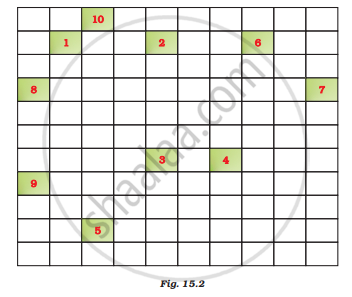
Across
1. Oil yielding plant (9)
3. Crop is grown in the winter season (4)
5. Fixed by Rhizobium (8)
9. Common honey bee (4)
Downward
2. Animal feed (6)
4. A micronutrient (5)
6. Unwanted plant in crop fields (4)
7. An exotic breed of chicken(7)
8. Bottom feeders in the fish pond(7)
10. A marine fish (4)
Solutions for 15: Improvement In Food Resources
NCERT Exemplar solutions for Science Exemplar [English] Class 9 chapter 15 - Improvement In Food Resources
Shaalaa.com has the CBSE Mathematics Science Exemplar [English] Class 9 CBSE solutions in a manner that help students grasp basic concepts better and faster. The detailed, step-by-step solutions will help you understand the concepts better and clarify any confusion. NCERT Exemplar solutions for Mathematics Science Exemplar [English] Class 9 CBSE 15 (Improvement In Food Resources) include all questions with answers and detailed explanations. This will clear students' doubts about questions and improve their application skills while preparing for board exams.
Further, we at Shaalaa.com provide such solutions so students can prepare for written exams. NCERT Exemplar textbook solutions can be a core help for self-study and provide excellent self-help guidance for students.
Concepts covered in Science Exemplar [English] Class 9 chapter 15 Improvement In Food Resources are Improvement in Crop Yields, Improvements in Food Resources, Crop Variety Improvement, Crop Production Improvement, Crop Protection Management, Methods to Replenish Nutrients in Your Soil, Manuring (Biomanuring), Improved methods of agriculture, Animal Husbandry (Livestock) > Poultry Farm Management, Animal Husbandry (Livestock) > Pisciculture (Fish Farming), Animal Husbandry (Livestock) > Apiculture (Bee Farming), Agricultural Assistance Programme, Fertilizers.
Using NCERT Exemplar Science Exemplar [English] Class 9 solutions Improvement In Food Resources exercise by students is an easy way to prepare for the exams, as they involve solutions arranged chapter-wise and also page-wise. The questions involved in NCERT Exemplar Solutions are essential questions that can be asked in the final exam. Maximum CBSE Science Exemplar [English] Class 9 students prefer NCERT Exemplar Textbook Solutions to score more in exams.
Get the free view of Chapter 15, Improvement In Food Resources Science Exemplar [English] Class 9 additional questions for Mathematics Science Exemplar [English] Class 9 CBSE, and you can use Shaalaa.com to keep it handy for your exam preparation.
