Please select a subject first
Advertisements
Advertisements
Arrange the following in order of increasing molar conductivity.
i) \[\ce{Mg[Cr(NH3) (Cl)5]}\]
ii) \[\ce{[Cr(NH3)5 Cl]3 [CoF6]2}\]
iii) \[\ce{[Cr(NH3)3 Cl3]}\]
Concept: undefined >> undefined
Give an example for a complex of the type [Ma2b2c2] where a, b, c are monodentate ligands and give the possible isomers.
Concept: undefined >> undefined
Advertisements
Give one test to differentiate \[\ce{[Co(NH3)5Cl]SO4}\] and \[\ce{[Co(NH3)5SO4]Cl}\].
Concept: undefined >> undefined
In an octahedral crystal field, draw the figure to show the splitting of d orbitals.
Concept: undefined >> undefined
Why tetrahedral complexes do not exhibit geometrical isomerism.
Concept: undefined >> undefined
What is crystal field stabilization energy (CFSE)?
Concept: undefined >> undefined
Discuss briefly the nature of bonding in metal carbonyls.
Concept: undefined >> undefined
What are the limitations of VB theory?
Concept: undefined >> undefined
Write the oxidation state, coordination number, nature of ligand, magnetic property and electronic configuration in octahedral crystal field for the complex \[\ce{K4[Mn(CN)6]}\].
Concept: undefined >> undefined
The ratio of close packed atoms to tetrahedral hole in cubic packing is ____________.
Concept: undefined >> undefined
A two-dimensional solid pattern formed by two different atoms X and Y is shown below. The black and white squares represent atoms X and Y respectively. the simplest formula for the compound based on the unit cell from the pattern is
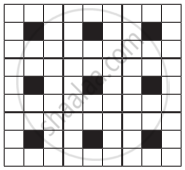
Concept: undefined >> undefined
Distinguish between hexagonal close packing and cubic close packing.
Concept: undefined >> undefined
Distinguish tetrahedral and octahedral voids.
Concept: undefined >> undefined
Explain AAAA and ABABA and ABCABC type of three dimensional packing with the help of neat diagram.
Concept: undefined >> undefined
Calculate the percentage efficiency of packing in the case of a body-centred cubic crystal.
Concept: undefined >> undefined
What is the two dimensional coordination number of a molecule in square close packed layer?
Concept: undefined >> undefined
Derive integrated rate law for a zero-order reaction \[\ce{A -> Product}\].
Concept: undefined >> undefined
Explain the common ion effect with an example.
Concept: undefined >> undefined
Give three uses of emulsions.
Concept: undefined >> undefined
In the following reaction,
\[\ce{HC ≡ CH ->[H2SO4][HgSO4] X}\]
Product ‘X’ will not give
Concept: undefined >> undefined
