Advertisements
Advertisements
Suppose the platform of the previous problem is brought to rest with the ball in the hand of the kid standing on the rim. The kid throws the ball horizontally to his friend in a direction tangential to the rim with a speed \[\nu\] as seen by his friend. Find the angular velocity with which the platform will start rotating.
Concept: undefined >> undefined
A steel rod of cross-sectional area 4 cm2 and 2 m shrinks by 0.1 cm as the temperature decreases in night. If the rod is clamped at both ends during the day hours, find the tension developed in it during night hours. Young modulus of steel = 1.9 × 10¹¹ N m−2.
Concept: undefined >> undefined
Advertisements
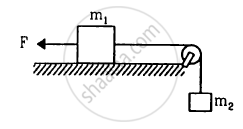
Consider the situation shown in figure. The force F is equal to the m2 g/2. If the area of cross section of the string is A and its Young modulus Y, find the strain developed in it. The string is light and there is no friction anywhere.
Concept: undefined >> undefined
An open organ pipe of length L vibrates in its fundamental mode. The pressure variation is maximum
Concept: undefined >> undefined
A copper wire of cross-sectional area 0.01 cm2 is under a tension of 20N. Find the decrease in the cross-sectional area. Young modulus of copper = 1.1 × 10¹¹ N m−2 and Poisson ratio = 0.32.
`["Hint" : (Delta"A")/"A"=2(Delta"r")/"r"]`
Concept: undefined >> undefined
In a streamline flow,
(a) the speed of a particle always remains same
(b) the velocity of a particle always remains same
(c) the kinetic energies of all the particles arriving at a given point are the same
(d) the momenta of all the particles arriving at a given point are the same
Concept: undefined >> undefined
Water flows through two identical tubes A and B. A volume V0 of water passes through the tube A and 2 V0 through B in a given time. Which of the following may be correct?
(a) Flow in both the tubes are steady.
(b) Flow in both the tubes are turbulent.
(c) Flow is steady in A but turbulent in B.
(d) Flow is steady in B but turbulent in A.
Concept: undefined >> undefined
Water is flowing in streamline motion through a tube with its axis horizontal. Consider two points A and B in the tube at the same horizontal level.
(a) The pressures at A and B are equal for any shape of the tube.
(b) The pressures are never equal.
(c) The pressures are equal if the tube has a uniform cross section.
(d) The pressures may be equal even if the tube has a nonuniform cross section.
Concept: undefined >> undefined
Two wires are kept tight between the same pair of supports. The tensions in the wires are in the ratio 2 : 1 the radii are in the ratio 3 : 1 and the densities are in the ratio 1 : 2. Find the ratio of their fundamental frequencies.
Concept: undefined >> undefined
A 2 m long string fixed at both ends is set into vibrations in its first overtone. The wave speed on the string is 200 m s−1 and the amplitude is 0⋅5 cm. (a) Find the wavelength and the frequency. (b) Write the equation giving the displacement of different points as a function of time. Choose the X-axis along the string with the origin at one end and t = 0 at the instant when the point x = 50 cm has reached its maximum displacement.
Concept: undefined >> undefined
When we place a gas cylinder on a van and the van moves, does the kinetic energy of the molecules increase? Does the temperature increase?
Concept: undefined >> undefined
Do you expect the gas in a cooking gas cylinder to obey the ideal gas equation?
Concept: undefined >> undefined
Can we define the temperature of (a) vacuum, (b) a single molecule?
Concept: undefined >> undefined
Comment on the following statement: the temperature of all the molecules in a sample of a gas is the same.
Concept: undefined >> undefined
Consider a gas of neutrons. Do you expect it to behave much better as an ideal gas as compared to hydrogen gas at the same pressure and temperature?
Concept: undefined >> undefined
It is said that the assumptions of kinetic theory are good for gases having low densities. Suppose a container is so evacuated that only one molecule is left in it. Which of the assumptions of kinetic theory will not be valid for such a situation? Can we assign a temperature to this gas?
Concept: undefined >> undefined
A gas is kept in an enclosure. The pressure of the gas is reduced by pumping out some gas. Will the temperature of the gas decrease by Charles's low?
Concept: undefined >> undefined
If the molecules were not allowed to collide among themselves, would you expect more evaporation or less evaporation?
Concept: undefined >> undefined
Is it possible to boil water at room temperature, say 30°C? If we touch a flask containing water boiling at this temperature, will it be hot?
Concept: undefined >> undefined
When you come out of a river after a dip, you feel cold. Explain.
Concept: undefined >> undefined
