Advertisements
Advertisements
For a reaction A + B ⟶ P, the rate is given by
Rate = k [A] [B]2
How is the rate of reaction affected if the concentration of B is doubled?
Concept: undefined >> undefined
For a reaction A + B ⟶ P, the rate is given by
Rate = k [A] [B]2
What is the overall order of reaction if A is present in large excess?
Concept: undefined >> undefined
Advertisements
For a reaction : 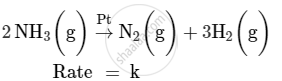
(i) Write the order and molecularity of this reaction.
(ii) Write the unit of k.
Concept: undefined >> undefined
For the hydrolysis of methyl acetate in aqueous solution, the following results were obtained :
| t/s | 0 | 30 | 60 |
| [CH3COOCH3] / mol L–1 | 0.60 | 0.30 | 0.15 |
(i) Show that it follows pseudo first order reaction, as the concentration of water remains constant.
(ii) Calculate the average rate of reaction between the time interval 30 to 60 seconds.
(Given log 2 = 0.3010, log 4 = 0.6021)
Concept: undefined >> undefined
Write the IUPAC name of the given compound:

Concept: undefined >> undefined
Write the names and structures of the monomers of the following polymers: Polyvinyl chloride
Concept: undefined >> undefined
For a chemical reaction R → P, the variation in the concentration (R) vs. time (t) plot is given as:
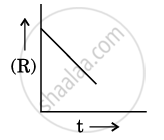
(i) Predict the order of the reaction.
(ii) What is the slope of the curve?
(iii) Write the unit of rate constant for this reaction.
Concept: undefined >> undefined
Write the name of monomers used for getting the following polymers : Bakelite
Concept: undefined >> undefined
The following data were obtained during the first order thermal decomposition of SO2Cl2 at a constant volume :
SO2Cl2 (g) → SO2 (g) + Cl2 (g)
| Experiment | Time/s–1 | Total pressure/atm |
| 1 | 0 | 0.4 |
| 2 | 100 | 0.7 |
Calculate the rate constant.
(Given : log 4 = 0.6021, log 2 = 0.3010)
Concept: undefined >> undefined
Write the name of the monomer used for getting the following polymer:
Teflon
Concept: undefined >> undefined
Solid A is a very hard electrical insulator in solid as well as in molten state and melts at extremely high temperature. What type of solid is it?
Concept: undefined >> undefined
Ionic solids conduct electricity in molten state but not in solid state. Explain
Concept: undefined >> undefined
What type of solids are electrical conductors, malleable and ductile?
Concept: undefined >> undefined
Explain the basis of similarities between metallic and ionic crystals.
Concept: undefined >> undefined
Explain ionic solids are hard and brittle.
Concept: undefined >> undefined
Copper crystallises into a fcc lattice with edge length 3.61 × 10⁻⁸ cm. Show that the calculated density is in agreement with its measured value of 8.92 g cm−3.
Concept: undefined >> undefined
Calculate the mass percentage of benzene (C6H6) and carbon tetrachloride (CCl4) if 22 g of benzene is dissolved in 122 g of carbon tetrachloride.
Concept: undefined >> undefined
Calculate the mole fraction of benzene in solution containing 30% by mass in carbon tetrachloride.
Concept: undefined >> undefined
Calculate the molarity of the following solution:
30 g of Co(NO3)2 . 6H2O in 4.3 L of solution.
Concept: undefined >> undefined
Calculate the mass of urea (NH2CONH2) required in making 2.5 kg of 0.25 molal aqueous solution.
Concept: undefined >> undefined
