Advertisements
Advertisements
According to the station clocks, two babies are born at the same instant, one in Howrah and other in Delhi. (a) Who is elder in the frame of 2301 Up Rajdhani Express going from Howrah to Delhi? (b) Who is elder in the frame of 2302 Dn Rajdhani Express going from Delhi to Howrah.
Concept: undefined >> undefined
Two babies are born in a moving train, one in the compartment adjacent to the engine and other in the compartment adjacent to the guard. According to the train frame, the babies are born at the same instant of time. Who is elder according to the ground frame?
Concept: undefined >> undefined
Advertisements
An electric bulb, connected to a make and break power supply, switches off and on every second in its rest frame. What is the frequency of its switching off and on as seen from a spaceship travelling at a speed 0.8c?
Concept: undefined >> undefined
At what speed the volume of an object shrinks to half its rest value?
Concept: undefined >> undefined
Name the phenomenon which shows the quantum nature of electromagnetic radiation.
Concept: undefined >> undefined
What is the direction of induced currents in metal rings 1 and 2 when current I in the wire is increasing steadily?
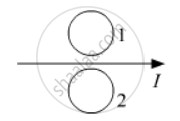
Concept: undefined >> undefined
Why does current in a steady state not flow in a capacitor connected across a battery? However momentary current does flow during charging or discharging of the capacitor. Explain.
Concept: undefined >> undefined
The following graph shows the variation of photocurrent for a photosensitive metal :
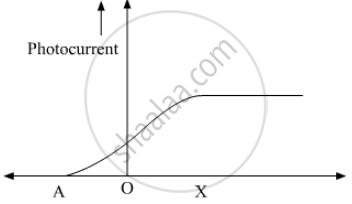
(a) Identify the variable X on the horizontal axis.
(b) What does the point A on the horizontal axis represent?
(c) Draw this graph for three different values of frequencies of incident radiation v1, v2 and v3 (v1 > v2 > v3) for same intensity.
(d) Draw this graph for three different values of intensities of incident radiation I1, I2 and I3 (I1 > I2 > I3) having same frequency.
Concept: undefined >> undefined
(i) Find the value of the phase difference between the current and the voltage in the series LCR circuit shown below. Which one leads in phase : current or voltage ?
(ii) Without making any other change, find the value of the additional capacitor C1, to be connected in parallel with the capacitor C, in order to make the power factor of the circuit unity.
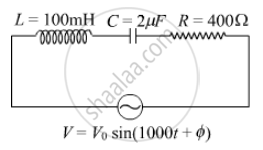
Concept: undefined >> undefined
A series LCR circuit is connected to a source having voltage v = vm sin ωt. Derive the expression for the instantaneous current I and its phase relationship to the applied voltage.
Obtain the condition for resonance to occur. Define ‘power factor’. State the conditions under which it is (i) maximum and (ii) minimum.
Concept: undefined >> undefined
Derive an expression for the average power consumed in a series LCR circuit connected to a.c. source in which the phase difference between the voltage and the current in the circuit is Φ.
Concept: undefined >> undefined
A short magnet is moved along the axis of a conducting loop. Show that the loop repels the magnet if the magnet is approaching the loop and attracts the magnet if it is going away from the loop.
Concept: undefined >> undefined
The battery discussed in the previous question is suddenly disconnected. Is a current induced in the other loop? If yes, when does it start and when does it end? Do the loops attract each other or repel?
Concept: undefined >> undefined
A pivoted aluminium bar falls much more slowly through a small region containing a magnetic field than a similar bar of an insulating material. Explain.
Concept: undefined >> undefined
Consider the situation shown in figure. If the switch is closed and after some time it is opened again, the closed loop will show ____________ .
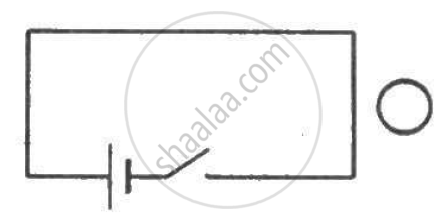
Concept: undefined >> undefined
A bar magnet is released from rest along the axis of a very long, vertical copper tube. After some time the magnet ____________ .
Concept: undefined >> undefined
Two circular loops of equal radii are placed coaxially at some separation. The first is cut and a battery is inserted in between to drive a current in it. The current changes slightly because of the variation in resistance with temperature. During this period, the two loops _______________ .
Concept: undefined >> undefined
A bar magnet is moved along the axis of a copper ring placed far away from the magnet. Looking from the side of the magnet, an anticlockwise current is found to be induced in the ring. Which of the following may be true?
(a) The south pole faces the ring and the magnet moves towards it.
(b) The north pole faces the ring and the magnet moves towards it.
(c) The south pole faces the ring and the magnet moves away from it.
(d) The north pole faces the ring and the magnet moves away from it.
Concept: undefined >> undefined
Can we find the mass of a photon by the definition p = mv?
Concept: undefined >> undefined
Is it always true that for two sources of equal intensity, the number of photons emitted in a given time are equal?
Concept: undefined >> undefined
