Advertisements
Advertisements
Sugar moiety in DNA and RNA molecules respectively are ______.
Concept: undefined >> undefined
Given below are two statements:
Statement I: H2O2 can act as both oxidising and reducing agent in basic medium.
Statement II: In the hydrogen economy, the energy is transmitted in the form of dihydrogen.
In the light of the above statements, choose the correct answer from the options given below:
Concept: undefined >> undefined
Advertisements
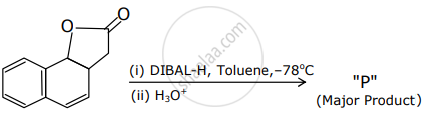
The product "P" in the above reaction is:
Concept: undefined >> undefined
The increasing order of the following compounds towards HCN addition is:
| (i) |  |
| (ii) |  |
| (iii) |  |
| (iv) |  |
Concept: undefined >> undefined
AB3 is an interhalogen T-shaped molecule. The number of lone pairs of electrons on A is ______. (Integer answer)
Concept: undefined >> undefined
Identify 'Z' in the reaction given below:
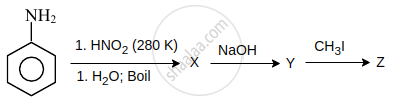
Concept: undefined >> undefined
In the following reaction
\[\ce{Carbonyl compound + MeOH <=>[HCl] acetal}\]
Rate of the reaction is the highest for ______.
Concept: undefined >> undefined
An aqueous KCl solution of density 1.20 g mL-1 has a molality of 3.30 mol kg-1. The molarity of the solution in mol L-1 is ______. (Nearest integer)
Concept: undefined >> undefined
Which one of the following is formed (mainly) when red phosphorus is heated in a sealed tube at 803 K?
Concept: undefined >> undefined
With increase of temperature, which of these changes?
Concept: undefined >> undefined
What quantity (in mL) of a 45% acid solution of a monoprotic strong acid must be mixed with a 20% solution of the same acid to produce 800 mL of a 29.875% acid solution?
Concept: undefined >> undefined
250 g solution of D-glucose in water contains 10.8% of carbon by weight. The molality of the solution is nearest to ______.
(Given: Atomic weights are H, 1u; C, 12u; O, 16u)
Concept: undefined >> undefined
Bonding in which of the following diatomic molecule(s) become(s) stronger, on the basis of MO Theory, by removal of an electron?
(A) NO
(B) N2
(C) O2
(D) C2
(E) B2
Choose the most appropriate answer from the options given below:
Concept: undefined >> undefined
Given below are the critical temperatures of some of the gases:
| Gas | Critical temperature (K) |
| He | 5.2 |
| CH4 | 190 |
| CO2 | 304.2 |
| NH3 | 405.5 |
The gas showing the least adsorption on a definite amount of charcoal is:
Concept: undefined >> undefined

Which among the above compound/s does/do not form Silver mirror when treated with Tollen's reagent?
Concept: undefined >> undefined
Among the following, the aromatic compounds are:
| (A) | 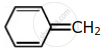 |
| (B) |  |
| (C) |  |
| (D) |  |
Choose the correct answer from the following options:
Concept: undefined >> undefined
The major products formed in the following reaction sequence A and B are:

Concept: undefined >> undefined
An organic compound neither reacts with neutral ferric chloride solution nor with Fehling solution. It however, reacts with Grignard reagent and gives positive iodoform test. The compound is:
Concept: undefined >> undefined
The correct set of products obtained in the following reactions:
- \[\ce{RCN ->[reduction]}\]
- \[\ce{RCN ->[(i) CH3MgBr][(ii) H2O]}\]
- \[\ce{RNC ->[hydrolysis]}\]
- \[\ce{RNH2 ->[HNO2]}\]
Concept: undefined >> undefined
Bonding in which of the following diatomic molecule(s) become(s) stronger, on the basis of MO Theory, by removal of an electron?
(A) NO
(B) N2
(C) O2
(D) C2
(E) B2
Choose the most appropriate answer from the options given below:
Concept: undefined >> undefined
