Please select a subject first
Advertisements
Advertisements
Two simple pendulums A and B have equal lengths, but their bobs weigh 50 gf and 100 gf, respectively. What would be the ratio of their time periods? Give reasons for your answer.
Concept: undefined >> undefined
State the numerical value of the frequency of oscillation of a second's pendulum. Does it depend on the amplitude of oscillations?
Concept: undefined >> undefined
Advertisements
A seconds pendulum is taken to a place where acceleration due to the gravity falls to one-fourth. How is the time period of the pendulum affected, if at all? Give reasons. What will be its new time period?
Concept: undefined >> undefined
When is a body said to be in motion?
Concept: undefined >> undefined
What do you mean by motion in one direction?
Concept: undefined >> undefined
Give an example of the motion of a body moving with a constant speed but with a variable velocity. Draw a diagram to represent such a motion.
Concept: undefined >> undefined
Give an example of motion in which the average speed is not zero but the average velocity is zero.
Concept: undefined >> undefined
Which of the quantity-velocity or acceleration-determines the direction of motion?
Concept: undefined >> undefined
Give one example of following motion :
Uniform velocity
Concept: undefined >> undefined
Give one example of following motion :
Variable velocity
Concept: undefined >> undefined
The diagram below shows the pattern of the oil on the road at a constant rate from a moving car. What information do you get from it about the motion of the car.
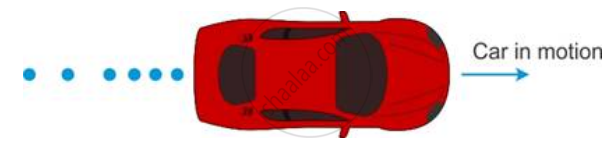
Concept: undefined >> undefined
The speed of a car is 72 km h-1. Express it in m s-1.
Concept: undefined >> undefined
Express 15 m s-1 in km h-1.
Concept: undefined >> undefined
Express the following in m s−1.
1 km h−1
Concept: undefined >> undefined
Express the following in m s-1.
18 km min-1
Concept: undefined >> undefined
Arrange the following speeds in increasing order.
10 m s-1, 1 km min-1 and 18 km h-1.
Concept: undefined >> undefined
A car travels the first 30 km with a uniform speed of 60 km h−1 and the next 30 km with a uniform speed of 40 km h−1. Calculate :
- The total time of journey,
- The average speed of the car.
Concept: undefined >> undefined
A train takes 2 h to reach station B from station A, and then 3 h to return from station B to station A. The distance between the two stations is 200 km. Find:
The average speed,
The average velocity of the train.
Concept: undefined >> undefined
A car moving on a straight path covers a distance of 1 km due east in 100 s. What is the speed of the car?
Concept: undefined >> undefined
A car moving on a straight path covers a distance of 1 km due east in 100 s. What is velocity of the car?
Concept: undefined >> undefined
