Advertisements
Advertisements
E is the mid-point of side AB and F is the mid-point of side DC of parallelogram ABCD. Prove that AEFD is a parallelogram.
Concept: undefined >> undefined
The diagonal BD of a parallelogram ABCD bisects angles B and D. Prove that ABCD is a rhombus.
Concept: undefined >> undefined
Advertisements
The alongside figure shows a parallelogram ABCD in which AE = EF = FC.
Prove that:
- DE is parallel to FB
- DE = FB
- DEBF is a parallelogram.

Concept: undefined >> undefined
In the alongside diagram, ABCD is a parallelogram in which AP bisects angle A and BQ bisects angle B.

Prove that:
- AQ = BP
- PQ = CD
- ABPQ is a parallelogram.
Concept: undefined >> undefined
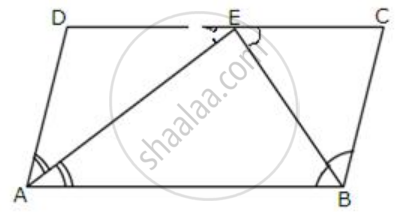
In the given figure, ABCD is a parallelogram.
Prove that: AB = 2 BC.
Concept: undefined >> undefined
Prove that the bisectors of opposite angles of a parallelogram are parallel.
Concept: undefined >> undefined
The following figure shows a trapezium ABCD in which AB is parallel to DC and AD = BC. 
Prove that:
(i) ∠DAB = ∠CBA
(ii) ∠ADC = ∠BCD
(iii) AC = BD
(iv) OA = OB and OC = OD.
Concept: undefined >> undefined
In parallelogram ABCD, the bisector of angle A meets DC at P and AB = 2 AD.
Prove that:
(i) BP bisects angle B.
(ii) Angle APB = 90o.
Concept: undefined >> undefined
Points M and N are taken on the diagonal AC of a parallelogram ABCD such that AM = CN. Prove that BMDN is a parallelogram.
Concept: undefined >> undefined
Construct a square ABCD, when: One side = 4.5 cm.
Concept: undefined >> undefined
Construct a square ABCD, when: One diagonal = 5.4 cm.
Concept: undefined >> undefined
Construct a square ABCD, when: Perimeter = 24 cm.
Concept: undefined >> undefined
The value of π up to 50 decimal place is
3.14159265358979323846264338327950288419716939937510
(i) Make a frequency distribution table of digits from 0 to 9 after the decimal place.
(ii) Which are the most and least occurring digits?
Concept: undefined >> undefined
Fill in the blank in the following table:
| Class interval | Frequency | Cumulative Frequency |
| 25 - 34 | ...... | 15 |
| 35 - 44 | ...... | 28 |
| 45 - 54 | 21 | ...... |
| 55 - 64 | 16 | ...... |
| 65 - 74 | ...... | 73 |
| 75 - 84 | 12 | ...... |
Concept: undefined >> undefined
Given below are the marks obtained by 30 students in an examination:
| 08 | 17 | 33 | 41 | 47 | 23 | 20 | 34 |
| 09 | 18 | 42 | 14 | 30 | 19 | 29 | 11 |
| 36 | 48 | 40 | 24 | 22 | 02 | 16 | 21 |
| 15 | 32 | 47 | 44 | 33 | 01 |
Taking class intervals 1-10, 11-20, ....., 41-50; make a frequency table for the above distribution.
Concept: undefined >> undefined
Construct the frequency distribution table from the following cumulative frequency table:
| Ages | No. of students |
| Below 4 | 0 |
| Below 7 | 85 |
| Below 10 | 140 |
| Below 13 | 243 |
| Below 16 | 300 |
(i) State the number of students in the age group 10 - 13.
(ii) State the age-group which has the least number of students.
Concept: undefined >> undefined
Construct a frequency table from the following data:
| Marks | No. of students |
| less than 10 | 6 |
| less than 20 | 15 |
| less than 30 | 30 |
| less than 40 | 39 |
| less than 50 | 53 |
| less than 60 | 70 |
Concept: undefined >> undefined
Construct a frequency distribution table from the following cumulative frequency distribution:
| Class Interval | Cumulative Frequency |
| 10 - 19 | 8 |
| 20 - 29 | 19 |
| 30- 39 | 23 |
| 40- 49 | 30 |
Concept: undefined >> undefined
Construct a cumulative frequency distribution table from the frequency table given below:
( i )
| Class Interval | Frequency |
| 0 - 8 | 9 |
| 8 - 16 | 13 |
| 16 - 24 | 12 |
| 24 - 32 | 7 |
| 32 - 40 | 15 |
( ii )
| Class Interval | Frequency |
| 1 - 10 | 12 |
| 11 - 20 | 18 |
| 21 - 30 | 23 |
| 31 - 40 | 15 |
| 41 - 50 | 10 |
Concept: undefined >> undefined
Construct a cumulative frequency distribution table from the frequency table given below:
| Class Interval | Frequency |
| 0 -8 | 9 |
| 8 - 16 | 13 |
| 16 - 24 | 12 |
| 24 - 32 | 7 |
| 32 - 40 | 15 |
Concept: undefined >> undefined
