Advertisements
Advertisements
A body floats in kerosene of density 0.8 x 10³ kg/m3 up to a certain mark. If the same body is placed in water of density 1.0 x 10³ kg/m3, will it sink more or less ? Give reason for your answer.
Concept: undefined >> undefined
When a golf ball is lowered into a measuring cylinder containing water, the water level rises by 30 cm3 when the ball is completely submerged. If the mass of ball in air is 33 g, find its density.
Concept: undefined >> undefined
Advertisements
A piece of steel has a volume of 12 cm3, and a mass of 96 g. What is its density in kg/m3 ?
Concept: undefined >> undefined
According to the third law of motion, action and reaction :
Concept: undefined >> undefined
An object is put in three liquids having different densities, one by one. The object floats with `1/9` , `2/11` and `3/7` parts of its volume outside the surface of liquids of densities d1, d2 and d3 respectively. Which of the following is the correct order of the densities of the three liquids?
Concept: undefined >> undefined
A metal in which even iron can float is :
Concept: undefined >> undefined
The relative densities of four liquids P, Q, R and S are 1.26, 1.0, 0.84 and 13.6 respectively. An object is floated in all these liquids, one by one. In which liquid the object will float with its maximum volume submerged under the liquid?
Concept: undefined >> undefined
A solid of density 900 kg/m3 floats in oil as shown in the given diagram. The oil floats on water of density 1000 kg/m3 as shown. The density of oil kg/m3 could be :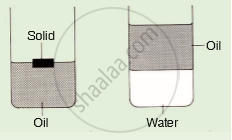
Concept: undefined >> undefined
The density of water is 1000 kg/m3 and the density of copper is 8900 kg/m3. Which of the following statements is incorrect?
Concept: undefined >> undefined
The diagrams represent four measuring cylinders containing liquids. The mass and volume of the liquid in each cylinder are stated. Which two measuring cylinder could contain an identical liquid?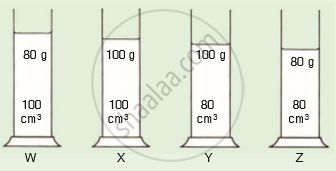
Concept: undefined >> undefined
A load of 100 kg is pulled up by 5 m. Calculate the work done. (g = 9.8 m/s2)
Concept: undefined >> undefined
Calculate the work done by the brakes of a car of mass 1000 kg when its speed is reduced from 20 m/s to 10 m/s?
Concept: undefined >> undefined
A body of mass 100 kg is lifted up by 10 m. Find :
(i) the amount of work done
(ii) potential energy of the body at that height (value of g = 10 m/s2)
Concept: undefined >> undefined
How much is the mass of a man if he has to do 2500 joules of work in climbing a tree 5 m tall? (g = 10 m s−2)
Concept: undefined >> undefined
Name the physical quantity whose unit is watt.
Concept: undefined >> undefined
What is the power of a body which is doing work at the rate of one joule per second?
Concept: undefined >> undefined
A body does 1200 joules of work in 2 minutes. Calculate its power.
Concept: undefined >> undefined
Fill in the blank with suitable word :
Power is the rate of doing ___________.
Concept: undefined >> undefined
Fill in the blanks with suitable words :
One watt is a rate of working of one ___________ per ___________.
Concept: undefined >> undefined
