Advertisements
Advertisements
Make noun from the word given below by adding –ness, ity, ty or y
honest ___________.
Concept: undefined >> undefined
Make noun from the word given below by adding –ness, ity, ty or y
kind ___________.
Concept: undefined >> undefined
Advertisements
Make noun from the word given below by adding –ness, ity, ty or y
cruel ___________.
Concept: undefined >> undefined
Make noun from the word given below by adding –ness, ity, ty or y
calm ___________.
Concept: undefined >> undefined
Make noun from the word given below by adding –ness, ity, ty or y
Sad ___________.
Concept: undefined >> undefined
Make noun from the word given below by adding –ness, ity, ty or y
Active ___________.
Concept: undefined >> undefined
Make noun from the word given below by adding –ness, ity, ty or y
Creative___________.
Concept: undefined >> undefined
Make noun from the word given below by adding –ness, ity, ty or y
Sincere ___________.
Concept: undefined >> undefined
Say what you feel about homework. (The words and phrases in the boxes may help you.) Do you think it is useful, even though you may not like it? Form pairs, and speak to each other.
For example:
You may say, “I am not fond of homework.”
Your partner may reply, “But my sister helps me with my lessons at home, and that gives a boost to my marks.”
(not) be fond of
(not) take to
(not) develop a liking for
(not) appeal to
(not) be keen on
(not) have a taste for
- support
- assist
- with the aid of
- help
- be a boon
- give a boost to
Concept: undefined >> undefined
Make noun from the word given below by adding –ness, ity, ty or y
Bitter ___________.
Concept: undefined >> undefined
Make noun from the word given below by adding –ness, ity, ty or y
Sensitive ___________.
Concept: undefined >> undefined
Make noun from the word given below by adding –ness, ity, ty or y
Great ___________.
Concept: undefined >> undefined
This story has a lot of rhyming words, as a poem does. Can you write out some parts of it like a poem, so that the rhymes come at the end of separate lines?
For example:
Patrick never did homework. “Too boring,” he said. He played baseball and hockey and Nintendo instead.
Concept: undefined >> undefined
Look at these sentences.
1. “Too boring,” he said.
2. Cleaned his room, did his chores.
When we speak, we often leave out words that can easily be guessed. We do not do this when we write unless we are trying to write as we speak (as in the story).
So, if we were to write carefully, we would say:
- “Homework is too boring,” he said.
- He cleaned his room and did his chores.
Concept: undefined >> undefined
There are twelve words hidden in this table. Six can be found horizontally and the remaining six vertically. All of them are describing words like ‘good’, ‘happy’, etc. The first letters of the words are given below:
Horizontal: H R F F S G
Vertical: A W S F L Q 2020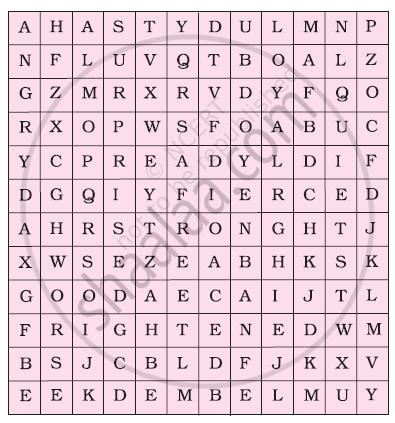
Concept: undefined >> undefined
What was Patrick’s chief interest?
Concept: undefined >> undefined
What warning did the teachers give to Patrick?
Concept: undefined >> undefined
How did Patrick get his wish granted by the elf?
Concept: undefined >> undefined
What made Patrick believe that he was lucky?
Concept: undefined >> undefined
Why did the little man’s face wrinkle and frown?
Concept: undefined >> undefined
