Advertisements
Advertisements
Read the following source carefully and answer the questions that follow:
|
Sanchi in the nineteenth century |
|
The most wonderful ancient buildings in the state of Bhopal are at Sanchi Kanakhera, a small village under the brow of a hill some 20 miles northeast of Bhopal which we visited yesterday. We inspected the stone sculptures and statues of the Buddha and an ancient gateway. The ruins appear to be the object of great interest to European gentlemen. Major Alexander Cunningham stayed several weeks in this neighbourhood and examined these ruins most carefully. He took drawings of the place, deciphered the inscription, and bored shafts down these domes. The results of his investigations were described by him in an English work. |
|
From SHAHJAHAN BEGUM, NAWAB OF BHOPAL (ruled 1868-1901), Taj-ul Iqbal Tarikh Bhopal (A History of Bhopal), translated by H.D. Barstow, 1876. |
- Why was Sanchi an interest to Alexander Cunningham?
- How was Sanchi related with Buddhism?
- How did Shahjahan Begum conserve Sanchi's stupa?
Concept: undefined >> undefined
Describe the three lists of Federalism provided by the Drafting Committee in the Constituent Assembly.
Concept: undefined >> undefined
Advertisements
Why was Vijayanagar named as Hampi? Select the appropriate option from the following:
Concept: undefined >> undefined
Which of the following pairs is correctly matched?
Concept: undefined >> undefined
Which one of the following statements regarding the Vedic tradition is incorrect?
Concept: undefined >> undefined
Assertion (A): Zamindars defaulted on payments in the Permanent Settlement.
Reason (R): Prices of the agricultural produce were low.
Concept: undefined >> undefined
Who among the following in the Constituent Assembly proposed 'horizontal tricolour National flag of saffron, white and green in equal proportion'?
Concept: undefined >> undefined
Read the given source and answer the questions that follow:
|
From the Fifth Reports Referring to the condition of zamindars and the auction of lands, the Fifth Report stated: The revenue was not realised with punctuality, and lands to a considerable extent were periodically exposed to sale by auction. In the native year 1203, corresponding with 1796-97, the land advertised for sale comprehended a jumma or assessment of sicca rupees 28,70,061, the extent of land actually sold bore a jumma or assessment of 14,18,756, and the amount of purchase money sicca rupees 17,90,416. In 1204, corresponding with 1797-98, the land advertised was for sicca rupees 26,66,191, the quantity sold was for sicca rupees 22,74,076, and the purchase money sicca rupees 21,47,580. Among the defaulters were some of the oldest families of the country. Such were the rajahs of Nuddea, Rajeshaye, Bishenpore (all districts of Bengal), … and others, the dismemberment of whose estates at the end of each succeeding year, threatened them with poverty and ruin, and in some instances presented difficulties to the revenue officers, in their efforts to preserve undiminished the amount of public assessment. |
- Examine the reason for calling it as a 'Fifth Report'.
- Why were activities of East India company closely debated in England?
- Analyse any two limitations of this report.
Concept: undefined >> undefined
'British, did not have an easy time in putting down the Revolt of 1857.' Explain the statement with examples.
Concept: undefined >> undefined
Consider the following statements regarding the early traditions of Bhakti and select the correct ones:
- Historians draw on hagiographies of saints for knowing traditions.
- Many beliefs and practices were shaped through 'great' and 'little' Sanskritic Puranic traditions.
- Bhakti tradition was classified into two broad categories Saguna and Nirguna.
- God was worshipped with attributes in the Nirguna bhakti.
Concept: undefined >> undefined
Identify the British official with the help of the following information and select the correct option:
|
Concept: undefined >> undefined
Match the following:
| Column-I (Leaders) |
Column-II - (Role in the Constituent Assembly) |
||
| A. | Jawaharlal Nehru | i. | President of the Constituent Assembly |
| B. | B.R. Ambedkar | ii. | Constitutional Advisor |
| C. | Rajendra Prasad | iii. | Chairman of the Drafting Committee |
| D. | B.N. Rau | iv. | Worked on the 'Objective Resolution' |
Concept: undefined >> undefined
Who among the following rulers worked on the preservation of Sanchi Stupa?
Concept: undefined >> undefined
Consider the given statements regarding Constituent Assembly and select the correct from the following options:
- Motilal Nehru moved resolution of National flag in the Constituent Assembly.
- G.B. Pant was the Legal Advisor.
- Sardar Patel was the Constitutional Advisor.
- K.M. Munshi was called as Frontier Gandhi.
Concept: undefined >> undefined
Analyse the role of Indian Sanskritist V.S. Suthankar and his team in the preparation of critical edition of Mahabharata.
Concept: undefined >> undefined
Examine the sources to know about Mughal rural society.
Concept: undefined >> undefined
Which of the following issues did not contribute to the spread of the Revolt of 1857?
Concept: undefined >> undefined
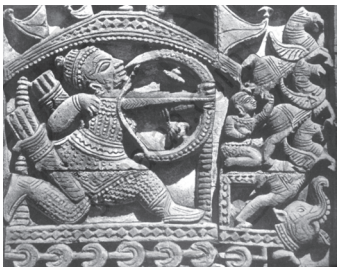
Identify the picture from the given options.
Concept: undefined >> undefined
With reference to the role of the British officers in India, match Column-B with column-A, by using the codes given below.
| Column-A | Column-B |
| A. Lord Cornwallis | 1. Observer |
| B. Augustus Cleveland | 2. Economist |
| C. Francis Buchanan | 3. Governor General of Benga |
| D. David Ricardo | 4. Policy of Pacification |
Concept: undefined >> undefined
Who among the following led the Flag of the Revolt 1857 against the British in Bihar?
Concept: undefined >> undefined
