Advertisements
Advertisements
Acetone reacts with Grignard reagent to form:
Concept: undefined >> undefined
Advertisements
A unit cell of BaCl2 (fluorite structure) is made up of ____________.
Concept: undefined >> undefined
The fraction of the total volume occupied by the atoms present in a simple cube is ____________.
Concept: undefined >> undefined
How many lithium atoms are present in a unit cell with edge length 3.5 Å and density 0.53 g cm−3? (Atomic mass of Li = 6.94):
Concept: undefined >> undefined
The distance between Na– and Cl– ions in NaCl with a density 2.165 g cm–3 is __________.
Concept: undefined >> undefined
Identify ‘C’ in the following:

Concept: undefined >> undefined
Given below are two statements labelled as Assertion (A) and Reason (R).
Assertion (A): Alkyl halides are insoluble in water.
Reason (R): Alkyl halides have halogen attached to sp3 hybrid carbon.
Select the most appropriate answer from the options given below:
Concept: undefined >> undefined
Assertion: Total number of octahedral voids present in unit cell of cubic close packing including the one that is present at the body centre, is four.
Reason: Besides the body centre there is one octahedral void present at the centre of each of the six faces of the unit cell and each of which is shared between two adjacent unit cells.
Concept: undefined >> undefined
At high pressure the following reaction is zero order.
\[\ce{2NH3(g) ->[1130 K][Platinum catalyst] N2(g) + 3H2(g)}\]
Which of the following options are correct for this reaction?
(i) Rate of reaction = Rate constant.
(ii) Rate of the reaction depends on concentration of ammonia.
(iii) Rate of decomposition of ammonia will remain constant until ammonia disappears completely.
(iv) Further increase in pressure will change the rate of reaction.
Concept: undefined >> undefined
Which of the following graphs is correct for a zero order reaction?
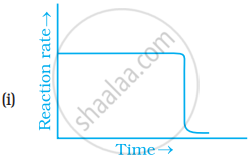

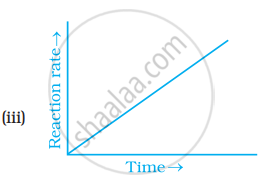

Concept: undefined >> undefined
Write the rate equation for the reaction `2A + B -> C` if the order of the reaction is zero.
Concept: undefined >> undefined
Derive an expression to calculate time required for completion of zero order reaction.
Concept: undefined >> undefined
For a zero order reaction will the molecularity be equal to zero? Explain.
Concept: undefined >> undefined
Which of the following curves is in accordance with Freundlich adsorption isotherm?
Concept: undefined >> undefined
Freundlich adsorption isotherm is given by the expression `x/m = kp^(1/n)` which of the following conclusions can be drawn from this expression.
(i) When `1/n` = 0, the adsorption is independent of pressure.
(ii) When `1/n` = 0, the adsorption is directly proportional to pressure.
(iii) When n = 0, `x/m` vs p graph is a line parallel to x-axis.
(iv) When n = 0, plot of `x/m` vs p is a curve.
Concept: undefined >> undefined
Which of the following statements is correct about the role of substances added in the froth floation process?
(i) Collectors enhance the non-wettability of the mineral particles.
(ii) Collectors enhance the wettability of gangue particles.
(iii) By using depressants in the process two sulphide ores can be separated.
(iv) Froth stabilisers decrease wettability of gangue.
Concept: undefined >> undefined
In the Froth Floatation process, zinc sulphide and lead sulphide can be separated by:
(i) using collectors.
(ii) adjusting the proportion of oil to water.
(iii) using depressant.
(iv) using froth stabilisers.
Concept: undefined >> undefined
Which of the following ores are concentrated by froth floation?
(i) Haematite
(ii) Galena
(iii) Copper pyrites
(iv) Magnetite
Concept: undefined >> undefined
How do we separate two sulphide ores by Froth Floatation Method? Explain with an example.
Concept: undefined >> undefined
