Please select a subject first
Advertisements
Advertisements
Histone proteins are ______.
Concept: undefined >> undefined
The structure in chromatin seen as ‘beads-on string’ when viewed under electron microscope are called ______.
Concept: undefined >> undefined
Advertisements
Find out the wrong statement about heterochromatin.
Concept: undefined >> undefined
The external genitalia of the human female is called ______.
Concept: undefined >> undefined
The opening of the vagina is often covered partially by a membrane called ______.
Concept: undefined >> undefined
The finger-like projections, called fimbriae, help in the collection of ovum into the fallopian tube following ovulation.
Concept: undefined >> undefined
Endometrium undergoes cyclical changes and help in uterine movements.
Concept: undefined >> undefined
Figure A shows the front view of the human female reproductive system and Figure B shows the development of a fertilized human egg cell
Figure A
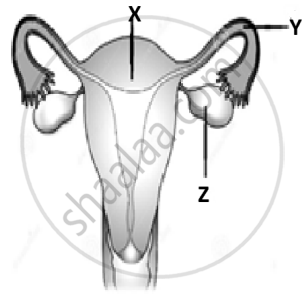
Figure B

Identify the correct stage of development of the human embryo (Figure B) that takes place at the sites X, Y, and Z respectively in the human female reproductive system (Figure A).
Choose the correct option from the table below:
| X | Y | Z | |
| A | Morula | Fertilized egg | Blastocyst |
| B | Unfertilized egg | Fertilized egg | Morula |
| C | Blastocyst | Fertilized egg | Unfertilized egg |
| D | Fertilized egg | Morula | Blastocyst |
Concept: undefined >> undefined
Which of the following is correct about mature RNA in eukaryotes?
Concept: undefined >> undefined
To produce 400 seeds, the number of meiotic divisions required will be ______
Concept: undefined >> undefined
The total number of nucleotide sequences of DNA that code for a hormone is 1530. The proportion of different bases in the sequence is found to be Adenine = 34%, Guanine = 19%, Cytosine = 23%, Thymine = 19%.
Applying Chargaff’s rule, what conclusion can be drawn?
Concept: undefined >> undefined
A stretch of euchromatin has 200 nucleosomes. How many bp will there be in the stretch and what would be the length of the typical euchromatin?
Concept: undefined >> undefined
To answer the question, study the graphs below for Subjects 1 and 2 showing different levels of certain hormones.
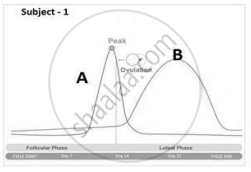
If the peak of Hormone A does not appear in the study for Subject 1, which of the following statement is true?
Concept: undefined >> undefined
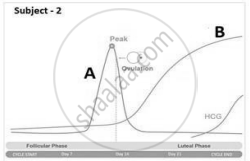
To answer the question, study the graphs below for Subjects 1 and 2 showing different levels of certain hormones.
Which structure in the ovary will remain functional in subject 2?
Concept: undefined >> undefined
To answer the question, study the graphs below for Subjects 1 and 2 showing different levels of certain hormones.
For subject 2 it is observed that the peak for hormone B has reached the plateau stage. After approximately how much time will the curve for hormone B descend?
Concept: undefined >> undefined
To answer the question, study the graphs below for Subjects 1 and 2 showing different levels of certain hormones.
Which of the following statements is true about the subjects?
Concept: undefined >> undefined
Read the following and answer from given below:
During copulation, semen is released by the penis into the vegina. The motile sperms swim rapidly, fuse with the ovum in the ampullary region, resulting in fertilization. The haploid nucleus of sperm fuses with that of the ovum to form a diploid zygote.
In the female genital tract, sperms are made capable of fertilizing the egg. This phenomenon of sperm activation is called ______
Concept: undefined >> undefined
Read the following and answer from given below:
During copulation, semen is released by the penis into the vegina. The motile sperms swim rapidly, fuse with the ovum in the ampullary region, resulting in fertilization. The haploid nucleus of sperm fuses with that of the ovum to form a diploid zygote.
Select the correct sequence of various physical and chemical events that take place during fertilisation.
P. Fusion of cortical granules with the plasma membrane of secondary oocyte.
Q. Formation of fertilization cone to receive sperm.
R. Release of sperm lysin from acrosome.
S. Mixing up of chromosomes of a sperm and an ovum.
Concept: undefined >> undefined
Read the following and answer from given below:
During copulation, semen is released by the penis into the vegina. The motile sperms swim rapidly, fuse with the ovum in the ampullary region, resulting in fertilization. The haploid nucleus of sperm fuses with that of the ovum to form a diploid zygote.
What is the signifacance of fertilisation?
Concept: undefined >> undefined
