Advertisements
Advertisements
Write any two factors which justify the need for modulating a signal ?
Concept: undefined >> undefined
Draw a diagram showing an amplitude modulated wave by superposing a modulating signal over a sinusoidal carrier wave.
Concept: undefined >> undefined
Advertisements
A proton and an electron have same kinetic. Which one has greater de-Broglie wavelength and why?
Concept: undefined >> undefined
The ground state energy of hydrogen atom is −13.6 eV. If and electron make a transition from the energy level −0.85 eV to −3.4 eV, calculate spectrum does his wavelength belong?
Concept: undefined >> undefined
Explain briefly the principle on which a transistor-amplifier works as an oscillator. Draw the necessary circuit diagram and explain its working ?
Concept: undefined >> undefined
A proton and an electron have same velocity. Which one has greater de-Broglie wavelength and why?
Concept: undefined >> undefined
The ground state energy of hydrogen atom is −13.6 eV. If an electron make a transition from an energy level −0.85 eV to −1.51 eV, calculate the wavelength of the spectral line emitted. To which series of hydrogen spectrum does this wavelength belong?
Concept: undefined >> undefined
Show on a graph the variation of the de Broglie wavelength (λ) associated with an electron, with the square root of accelerating potential (V) ?
Concept: undefined >> undefined
When monochromatic light is incident on a surface separating two media, why does the refracted light have the same frequency as that of the incident light?
Concept: undefined >> undefined
Obtain the conditions for the bright and dark fringes in diffraction pattern due to a single narrow slit illuminated by a monochromatic source.
Explain clearly why the secondary maxima go on becoming weaker with increasing.
Concept: undefined >> undefined
Using de Broglie’s hypothesis, explain with the help of a suitable diagram, Bohr’s second postulate of quantization of energy levels in a hydrogen atom.
Concept: undefined >> undefined
Write briefly any two factors which demonstrate the need for modulating a signal. Draw a suitable diagram to show amplitude modulation using a sinusoidal signal as the modulating signal.
Concept: undefined >> undefined
State Huygen’s principle. Using this principle explain how a diffraction pattern is obtained on a screen due to a narrow slit on which a narrow beam coming from a `=> n = (vlamda)/(vlamda_omega)`monochromatic source of light is incident normally.
Concept: undefined >> undefined
If a monochromatic source of light is replaced by white light, what change would you observe in the diffraction pattern?
Concept: undefined >> undefined
An electron is accelerated through a potential difference of 64 volts. What is the de-Broglie wavelength associated with it? To which part of the electromagnetic spectrum does this value of wavelength correspond?
Concept: undefined >> undefined
An electron, an alpha particle and a proton have the same kinetic energy.
Which one of these particles has the largest de-Broglie wavelength?
Concept: undefined >> undefined
Which of the following sources provides the best monochromatic light?
Concept: undefined >> undefined
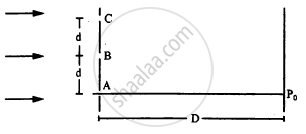
The following figure shows three equidistant slits being illuminated by a monochromatic parallel beam of light. Let \[B P_0 - A P_0 = \lambda/3\text{ and }D > > \lambda.\] (a) Show that in this case \[d = \sqrt{2\lambda D/3}.\] (b) Show that the intensity at P0 is three times the intensity due to any of the three slits individually.
Concept: undefined >> undefined
Consider the situation shown in the figure. The two slits S1 and S2 placed symmetrically around the central line are illuminated by a monochromatic light of wavelength λ. The separation between the slits is d. The light transmitted by the slits falls on a screen ∑1placed at a distance D from the slits. The slit S3 is at the central line and the slit S4 is at a distance z from S3. Another screen ∑2 is placed a further distance D away from ∑1.Find the ratio of the maximum to minimum intensity observed on ∑2 if z is equal to
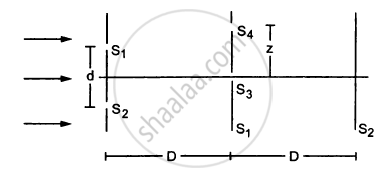
(a) \[z = \frac{\lambda D}{2d}\]
(b) \[\frac{\lambda D}{d}\]
(c) \[\frac{\lambda D}{4d}\]
Concept: undefined >> undefined
"Monochromatic light should be used to produce pure spectrum". Comment on this statement.
Concept: undefined >> undefined
