Advertisements
Advertisements
Which is the equilibrium condition of circular flow in the four sector model?
Concept: undefined >> undefined
Which one is included in the four-sector model?
Concept: undefined >> undefined
Advertisements
Read the following hypothetical text and answer the given question:
The performance of Indian economy during the period of first seven five year plans (1950-1990) was satisfactory if not very impressive. On the eve of independence, India was an industrially backward country, but during this period of first seven plans our industries became far more diversified, with the stress being laid on the public investments in the industrial sector. The policy of import substitution led to protection of the domestic industries against the foreign producers but we failed to promote a strong export surplus. Although public sector expanded to a large extent but it could not bring desired level of improvement in the secondary sector. Excessive government regulations prevented the natural trajectory of growth of entrepreneurship as there was no competition, no innovation and no modernization on the front of the industrial sector. Many Public Sector Undertakings (PSU’s) incurred huge losses due to operational inefficiencies, red-tapism, poor technology and other similar reasons. These PSU’s continued to function because it was difficult to close a government undertaking even it is a drain on country’s limited resources. On the Agricultural front, due to the measures taken under the Green Revolution, India more or less became self-sufficient in the production of food grains. So the needs for reform of economic policy was widely felt in the context of changing global economic scenario to achieve desired growth in the country.
State whether the given statement is true or false:
Mechanization of the Indian agriculture was one of thecause of Green Revolution in India.
Concept: undefined >> undefined
State and discuss any two precautions to be considered while estimating national income by Expenditure Method.
Concept: undefined >> undefined
‘Land ceiling promotes equity.’ Support the given statement with valid explanation.
Concept: undefined >> undefined
Discuss briefly, how institutional reforms (land reforms) have played a significant role in transforming Indian agriculture.
Concept: undefined >> undefined
Read the following text carefully and answer the given questions on the basis of the same and common understanding:
|
The Green Revolution in India began in the mid-1960s marking a transition from traditional agriculture in India to high-yielding varieties of seeds and the associated modern agricultural techniques. The need for introduction of Green Revolution in India arose due to a shortage of food-grains in the post-independent period. he government in the post-independent India wanted to ensure self-dependence in terms of food-grain production. Such efforts coincided with the development of high-yielding varieties of seeds of wheat developed by Dr. Norman Borlung and his associates in Mexico. These seeds also necessitated changes in farming techniques such as the addition of fertilizers, pesticides and better irrigation facilities. High yielding varieties of seeds were first introduced in India in the states of Punjab, Haryana and parts of western Uttar Pradesh. In the early period of the green revolution in India, the focus was to acclimatise the new system with the more resource-intensive agricultural methods. The argument for introducing the new crop varieties was to increase agricultural production in terms of higher crop yields. The seeds introduced during the early period of the green revolution in Punjab were not highyielding by themselves. These high yields were possible due to the seeds being highly responsive to certain inputs such as irrigation water and fertilizers. The green revolution in India, thus, necessitated a resource-intensive process whereby, those who could make significant capital investments could benefit, whereas, those others became more marginalized in regions affected by practices of the green revolution in India. On one hand, the results derived from the green revolution helped farmers to increase their yield and income and on the other hand, it helped the government to procure and preserve more food grains through agencies like Food Corporation of India. These food grain reserves were helpful in creation of buffer stocks in India, which helped in the situations of adversities. |
- Why was Green revolution implemented and how did it benefit the farmers?
- Justify the following statement with valid explanation:
‘Green revolution enabled the government to procure sufficient food grains to build its stocks that could be used during time of shortage’.
Concept: undefined >> undefined
Which of the following was NOT the benefit accruing from 'Golden Revolution'?
Concept: undefined >> undefined
"Recently the Government of India has taken numerous steps towards increasing the farmer's income through agricultural diversification."
In light of the above statement, explain any two advantages of diversification in agriculture.
Concept: undefined >> undefined
Discuss any two merits and demerits of the Green Revolution in the agricultural sector in the Indian economy.
Concept: undefined >> undefined
The shackles of agriculture during the colonial rule were permanently broken by the Green Revolution that resulted from the application of ______.
- High Yielding Varieties (HYV)
- Mechanization of Agriculture
- Chemical Fertilizers and Pesticides
- Organic Fertilizers and Pesticides
Concept: undefined >> undefined
Study the following picture and answer the given question:
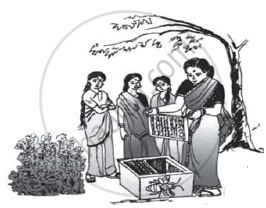
Women in rural households take up bee-keeping as an entrepreneurial activity. Such kind of activities may be envisaged under ______ as diversification activity.
Concept: undefined >> undefined
“Green revolution transformed India from a subsistent food grain economy to a food surplus economy.”
Justify the statement, giving reasons in support of your answer.
Concept: undefined >> undefined
“In India, after 1947 land reforms were introduced on a large scale.”
In the light of the given statement, discuss any one such land reform.
Concept: undefined >> undefined
“The debate over farm subsidies in India is enraged at different platforms.”
Discuss any two arguments in favour of continuing farm subsidies.
Concept: undefined >> undefined
In the first phase of Green Revolution, output was restricted mainly to ______.
Concept: undefined >> undefined
'Agriculture sector has been adversely affected by the Economic reform process.’ Comment.
Concept: undefined >> undefined
Given normal income, how can we find real income? Explain.
Concept: undefined >> undefined
Explain non-monetary exchanges as a limitation of using the gross domestic product as an index of the welfare of a country
Concept: undefined >> undefined
What is sectoral composition of an economy? Is it necessary that the service sector should contribute maximum to GDP of an economy? Comment.
Concept: undefined >> undefined
