Advertisements
Advertisements
A manufacturer produces two Models of bikes-Model X and Model Y. Model X takes a 6 man-hours to make per unit, while Model Y takes 10 man-hours per unit. There is a total of 450 man-hour available per week. Handling and Marketing costs are Rs 2000 and Rs 1000 per unit for Models X and Y respectively. The total funds available for these purposes are Rs 80,000 per week. Profits per unit for Models X and Y are Rs 1000 and Rs 500, respectively. How many bikes of each model should the manufacturer produce so as to yield a maximum profit? Find the maximum profit.
Concept: undefined >> undefined
In order to supplement daily diet, a person wishes to take some X and some wishes Y tablets. The contents of iron, calcium and vitamins in X and Y (in milligrams per tablet) are given as below:
| Tablets | Iron | Calcium | Vitamin |
| X | 6 | 3 | 2 |
| Y | 2 | 3 | 4 |
The person needs atleast 18 milligrams of iron, 21 milligrams of calcium and 16 milligrams of vitamin. The price of each tablet of X and Y is Rs 2 and Rs 1 respectively. How many tablets of each should the person take in order to satisfy the above requirement at the minimum cost?
Concept: undefined >> undefined
Advertisements
A company makes 3 model of calculators: A, B and C at factory I and factory II. The company has orders for at least 6400 calculators of model A, 4000 calculator of model B and 4800 calculator of model C. At factory I, 50 calculators of model A, 50 of model B and 30 of model C are made every day; at factory II, 40 calculators of model A, 20 of model B and 40 of model C are made everyday. It costs Rs 12000 and Rs 15000 each day to operate factory I and II, respectively. Find the number of days each factory should operate to minimise the operating costs and still meet the demand.
Concept: undefined >> undefined
The corner points of the feasible region determined by the system of linear constraints are (0, 0), (0, 40), (20, 40), (60, 20), (60, 0). The objective function is Z = 4x + 3y ______.
Compare the quantity in Column A and Column B
| Column A | Column B |
| Maximum of Z | 325 |
Concept: undefined >> undefined
The feasible solution for a LPP is shown in Figure. Let Z = 3x – 4y be the objective function. Minimum of Z occurs at ______.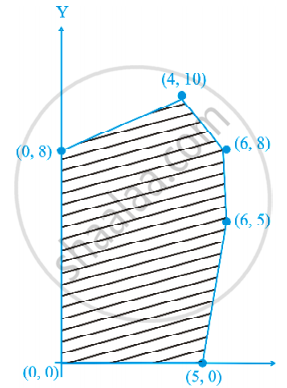
Concept: undefined >> undefined
Refer to Question 27. Maximum of Z occurs at ______.
Concept: undefined >> undefined
Refer to Question 27. (Maximum value of Z + Minimum value of Z) is equal to ______.
Concept: undefined >> undefined
The feasible region for an LPP is shown in the figure. Let F = 3x – 4y be the objective function. Maximum value of F is ______.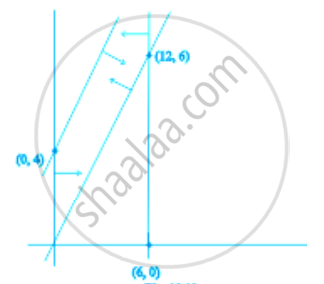
Concept: undefined >> undefined
Refer to Question 30. Minimum value of F is ______.
Concept: undefined >> undefined
Corner points of the feasible region for an LPP are (0, 2), (3, 0), (6, 0), (6, 8) and (0, 5). Let F = 4x + 6y be the objective function. The Minimum value of F occurs at ______.
Concept: undefined >> undefined
Refer to Question 32, Maximum of F – Minimum of F = ______.
Concept: undefined >> undefined
In a LPP, the linear inequalities or restrictions on the variables are called ____________.
Concept: undefined >> undefined
In a LPP, the objective function is always ______.
Concept: undefined >> undefined
If the feasible region for a LPP is ______ then the optimal value of the objective function Z = ax + by may or may not exist.
Concept: undefined >> undefined
In a LPP if the objective function Z = ax + by has the same maximum value on two corner points of the feasible region, then every point on the line segment joining these two points give the same ______ value.
Concept: undefined >> undefined
A feasible region of a system of linear inequalities is said to be ______ if it can be enclosed within a circle.
Concept: undefined >> undefined
A corner point of a feasible region is a point in the region which is the ______ of two boundary lines.
Concept: undefined >> undefined
The feasible region for an LPP is always a ______ polygon.
Concept: undefined >> undefined
If the feasible region for a LPP is unbounded, maximum or minimum of the objective function Z = ax + by may or may not exist.
Concept: undefined >> undefined
Maximum value of the objective function Z = ax + by in a LPP always occurs at only one corner point of the feasible region.
Concept: undefined >> undefined
