Advertisements
Advertisements
A gas mixture consists of molecules of types A, B and C with masses mA > mB > mC. Rank the three types of molecules in decreasing order of rms speeds.
Concept: undefined >> undefined
An insulated container containing monoatomic gas of molar mass m is moving with a velocity vo. If the container is suddenly stopped, find the change in temperature.
Concept: undefined >> undefined
Advertisements
Explain why there is no atmosphere on moon.
Concept: undefined >> undefined
Consider a rectangular block of wood moving with a velocity v0 in a gas at temperature T and mass density ρ. Assume the velocity is along x-axis and the area of cross-section of the block perpendicular to v0 is A. Show that the drag force on the block is `4ρAv_0 sqrt((KT)/m)`, where m is the mass of the gas molecule.
Concept: undefined >> undefined
Motion of an oscillating liquid column in a U-tube is ______.
Concept: undefined >> undefined
A body is performing S.H.M. Then its ______.
- average total energy per cycle is equal to its maximum kinetic energy.
- average kinetic energy per cycle is equal to half of its maximum kinetic energy.
- mean velocity over a complete cycle is equal to `2/π` times of its π maximum velocity.
- root mean square velocity is times of its maximum velocity `1/sqrt(2)`.
Concept: undefined >> undefined
Displacement versus time curve for a particle executing S.H.M. is shown in figure. Identify the points marked at which (i) velocity of the oscillator is zero, (ii) speed of the oscillator is maximum.

Concept: undefined >> undefined
Draw a graph to show the variation of P.E., K.E. and total energy of a simple harmonic oscillator with displacement.
Concept: undefined >> undefined
Find the displacement of a simple harmonic oscillator at which its P.E. is half of the maximum energy of the oscillator.
Concept: undefined >> undefined
A mass of 2 kg is attached to the spring of spring constant 50 Nm–1. The block is pulled to a distance of 5 cm from its equilibrium position at x = 0 on a horizontal frictionless surface from rest at t = 0. Write the expression for its displacement at anytime t.
Concept: undefined >> undefined
A body of mass m is attached to one end of a massless spring which is suspended vertically from a fixed point. The mass is held in hand so that the spring is neither stretched nor compressed. Suddenly the support of the hand is removed. The lowest position attained by the mass during oscillation is 4 cm below the point, where it was held in hand.
What is the amplitude of oscillation?
Concept: undefined >> undefined
Water waves produced by a motor boat sailing in water are ______.
Concept: undefined >> undefined
The displacement of a string is given by y (x, t) = 0.06 sin (2πx/3) cos (120 πt) where x and y are in m and t in s. The length of the string is 1.5 m and its mass is 3.0 × 10⁻² kg.
- It represents a progressive wave of frequency 60 Hz.
- It represents a stationary wave of frequency 60 Hz.
- It is the result of superposition of two waves of wavelength 3 m, frequency 60 Hz each travelling with a speed of 180 m/s in opposite direction.
- Amplitude of this wave is constant.
Concept: undefined >> undefined
The transverse displacement of a string (clamped at its both ends) is given by y(x, t) = 0.06 sin (2πx/3) cos (120 πt). All the points on the string between two consecutive nodes vibrate with ______.
- same frequency
- same phase
- same energy
- different amplitude.
Concept: undefined >> undefined
Which of the following statements are true for a stationary wave?
- Every particle has a fixed amplitude which is different from the amplitude of its nearest particle.
- All the particles cross their mean position at the same time.
- All the particles are oscillating with same amplitude.
- There is no net transfer of energy across any plane.
- There are some particles which are always at rest.
Concept: undefined >> undefined
A sonometer wire is vibrating in resonance with a tuning fork. Keeping the tension applied same, the length of the wire is doubled. Under what conditions would the tuning fork still be is resonance with the wire?
Concept: undefined >> undefined
An organ pipe of length L open at both ends is found to vibrate in its first harmonic when sounded with a tuning fork of 480 Hz. What should be the length of a pipe closed at one end, so that it also vibrates in its first harmonic with the same tuning fork?
Concept: undefined >> undefined
A pipe 20 cm long is closed at one end. Which harmonic mode of the pipe is resonantly excited by a source of 1237.5 Hz? (sound velocity in air = 330 ms–1)
Concept: undefined >> undefined
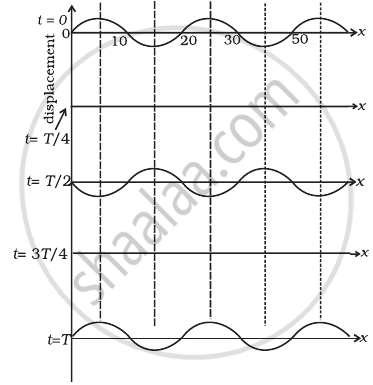
The wave pattern on a stretched string is shown in figure. Interpret what kind of wave this is and find its wavelength.
Concept: undefined >> undefined
The pattern of standing waves formed on a stretched string at two instants of time are shown in figure. The velocity of two waves superimposing to form stationary waves is 360 ms–1 and their frequencies are 256 Hz.
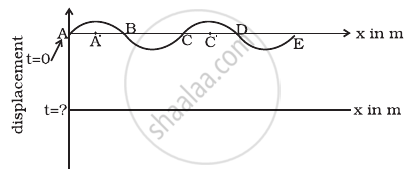
- Calculate the time at which the second curve is plotted.
- Mark nodes and antinodes on the curve.
- Calculate the distance between A′ and C′.
Concept: undefined >> undefined
