Advertisements
Advertisements
Question
The displacement of a string is given by y (x, t) = 0.06 sin (2πx/3) cos (120 πt) where x and y are in m and t in s. The length of the string is 1.5 m and its mass is 3.0 × 10⁻² kg.
- It represents a progressive wave of frequency 60 Hz.
- It represents a stationary wave of frequency 60 Hz.
- It is the result of superposition of two waves of wavelength 3 m, frequency 60 Hz each travelling with a speed of 180 m/s in opposite direction.
- Amplitude of this wave is constant.
Advertisements
Solution
b and c
Explanation:
We know that the standard equation of stationary wave is `y(x, t) = a sin(kx) cos(ωt)`
Given equation is `y(x, t) = 0.06 sin((2πx)/3) cos(120 πt)`
a. Comparing with a standard equation of stationary wave `y(x, t) = a sin(kx) cos(ωt)` Clearly, the given equation belongs to stationary wave. Hence, option (a) is not correct.
b. By comparing,
ω = 120 π
⇒ 2πf = 120 π
⇒ f = 60 Hz
c. k = `(2π)/3 = (2π)/λ`
⇒ λ = wavelength = 3m
Frequency = f = 60 Hz
Speed = v = fλ = (60 Hz) (3m) = 180 m/s
d. Since in stationary waves, all particles of the medium execute SHM with varying amplitude nodes.
APPEARS IN
RELATED QUESTIONS
A pipe 20 cm long is closed at one end. Which harmonic mode of the pipe is resonantly excited by a 430 Hz source? Will the same source be in resonance with the pipe if both ends are open? (Speed of sound in air is 340 m s–1).
A bat is flitting about in a cave, navigating via ultrasonic beeps. Assume that the sound emission frequency of the bat is 40 kHz. During one fast swoop directly toward a flat wall surface, the bat is moving at 0.03 times the speed of sound in air. What frequency does the bat hear reflected off the wall?
A 2 m long string fixed at both ends is set into vibrations in its first overtone. The wave speed on the string is 200 m s−1 and the amplitude is 0⋅5 cm. (a) Find the wavelength and the frequency. (b) Write the equation giving the displacement of different points as a function of time. Choose the X-axis along the string with the origin at one end and t = 0 at the instant when the point x = 50 cm has reached its maximum displacement.
Two wires of same material are vibrating under the same tension. If the first overtone of first wire is equal to the second overtone of second wire and radius of first wire is twice the radius of the second then the ratio of length of first wire to second wire is
The number of possible natural oscillations of the air column in a pipe closed at one end of length 85 cm whose frequencies lie below 1250 Hz? (v = 340 m/s)
Water waves produced by a motor boat sailing in water are ______.
The transverse displacement of a string (clamped at its both ends) is given by y(x, t) = 0.06 sin (2πx/3) cos (120 πt). All the points on the string between two consecutive nodes vibrate with ______.
- same frequency
- same phase
- same energy
- different amplitude.
The wave pattern on a stretched string is shown in figure. Interpret what kind of wave this is and find its wavelength.
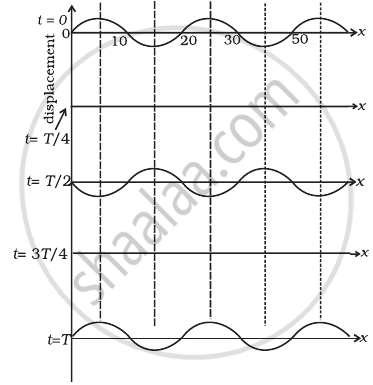
The pattern of standing waves formed on a stretched string at two instants of time are shown in figure. The velocity of two waves superimposing to form stationary waves is 360 ms–1 and their frequencies are 256 Hz.
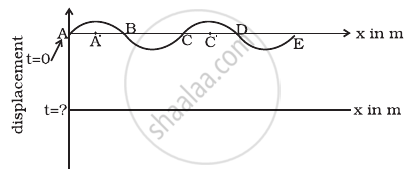
- Calculate the time at which the second curve is plotted.
- Mark nodes and antinodes on the curve.
- Calculate the distance between A′ and C′.
A tuning fork vibrating with a frequency of 512 Hz is kept close to the open end of a tube filled with water (Figure). The water level in the tube is gradually lowered. When the water level is 17 cm below the open end, maximum intensity of sound is heard. If the room temperature is 20°C, calculate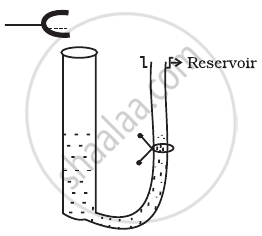
- speed of sound in air at room temperature
- speed of sound in air at 0°C
- if the water in the tube is replaced with mercury, will there be any difference in your observations?
Two identical strings X and Z made of same material have tension Tx and Tz in them If their fundamental frequencies are 450 Hz and 300 Hz, respectively, then the ratio `"T"_x/"T"_"z"` is ______.
Shown in the figure is rigid and uniform one meter long rod AB held in horizontal position by two strings tied to its ends and attached to the ceiling. The rod is of mass 'm' and has another weight of mass 2m hung at a distance of 75 cm from A. The tension in the string at A is :


A wire of length 2L is made by joining two wires A and B of the same length but different radii r and 2r, and made of the same material. It is vibrating at a frequency such that the joint of the two wires forms a node. If the number of antinodes in wire A is p and that in B is q then the ratio p : q is ______.
Two closed end pipes when sounded together produce 5 beat per second. If their length are in the ratio 100 : 101, then fundamental notes produced by them are ______.
A tuning fork of frequency 480 Hz is used in an experiment for measuring the speed of sound (ν) in the air by resonance tube method. Resonance is observed to occur at two successive lengths of the air column, l1 = 30 cm and l2 = 70 cm. Then, ν is equal to ______.
A pipe open at both ends has a fundamental frequency f in air. The pipe is now dipped vertically in a water drum to half of its length. The fundamental frequency of the air column is now equal to ______.
