Advertisements
Advertisements
Some of the most profound statements on the nature of science have come from Albert Einstein, one of the greatest scientists of all time. What do you think did Einstein mean when he said : “The most incomprehensible thing about the world is that it is comprehensible”?
Concept: undefined >> undefined
“Every great physical theory starts as a heresy and ends as a dogma”. Give some examples from the history of science of the validity of this incisive remark
Concept: undefined >> undefined
Advertisements
“Politics is the art of the possible”. Similarly, “Science is the art of the soluble”. Explain this beautiful aphorism on the nature and practice of science.
Concept: undefined >> undefined
India has had a long and unbroken tradition of great scholarship — in mathematics, astronomy, linguistics, logic and ethics. Yet, in parallel with this, several superstitious and obscurantistic attitudes and practices flourished in our society and unfortunately continue even today — among many educated people too. How will you use your knowledge of science to develop strategies to counter these attitudes ?
Concept: undefined >> undefined
“It is more important to have beauty in the equations of physics than to have them agree with experiments”. The great British physicist P. A. M. Dirac held this view. Criticize this statement. Look out for some equations and results in this book which strike you as beautiful.
Concept: undefined >> undefined
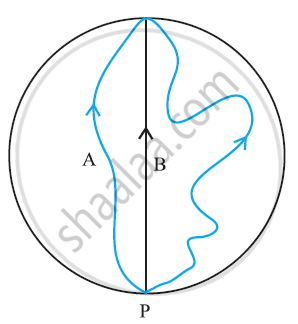
Three girls skating on a circular ice ground of radius 200 m start from a point P on the edge of the ground and reach a point Q diametrically opposite to P following different paths as shown in the figure. What is the magnitude of the displacement vector for each? For which girl is this equal to the actual length of the path skated?
Concept: undefined >> undefined
Answer the following:
You can shield a charge from electrical forces by putting it inside a hollow conductor. Can you shield a body from the gravitational influence of nearby matter by putting it inside a hollow sphere or by some other means?
Concept: undefined >> undefined
Answer the following:
An astronaut inside a small space ship orbiting around the earth cannot detect gravity. If the space station orbiting around the earth has a large size, can he hope to detect gravity?
Concept: undefined >> undefined
If you compare the gravitational force on the Earth due to the Sun to that due to the Moon, you would find that the Sun’s pull is greater than the Moon’s pull. (You can check this yourself using the data available in the succeeding exercises). However, the tidal effect of the Moon’s pull is greater than the tidal effect of Sun. Why?
Concept: undefined >> undefined
Choose the correct alternative:
Acceleration due to gravity increases/decreases with increasing altitude.
Concept: undefined >> undefined
Choose the correct alternative:
Acceleration due to gravity increases/decreases with increasing depth. (assume the earth to be a sphere of uniform density).
Concept: undefined >> undefined
Choose the correct alternative:
Acceleration due to gravity is independent of mass of the earth/mass of the body.
Concept: undefined >> undefined
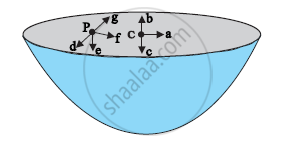
The gravitational intensity at the centre of a hemispherical shell of uniform mass density has the direction indicated by the arrow (see Fig 8.12) (i) a, (ii) b, (iii) c, (iv) 0.
Concept: undefined >> undefined
Choose the correct answer from among the given ones:
For the problem 8.10, the direction of the gravitational intensity at an arbitrary point P is indicated by the arrow (i) d, (ii) e, (iii) f, (iv) g.
Concept: undefined >> undefined
A rocket is fired from the earth towards the sun. At what distance from the earth’s centre is the gravitational force on the rocket zero? Mass of the sun = 2 ×1030 kg, mass of the earth = 6 × 1024 kg. Neglect the effect of other planets etc. (orbital radius = 1.5 × 10¹¹ m).
Concept: undefined >> undefined
How will you ‘weigh the sun’, that is estimate its mass? The mean orbital radius of the earth around the sun is 1.5 × 10⁸ km.
Concept: undefined >> undefined
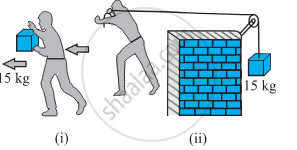
In figure (i) the man walks 2 m carrying a mass of 15 kg on his hands. In Figure (ii), he walks the same distance pulling the rope behind him. The rope goes over a pulley, and a mass of 15 kg hangs at its other end. In which case is the work done greater?
Concept: undefined >> undefined
Give the magnitude and direction of the net force acting on a cork of mass 10 g floating on water.
Concept: undefined >> undefined
Give the magnitude and direction of the net force acting on a kite skillfully held stationary in the sky.
Concept: undefined >> undefined
Give the magnitude and direction of the net force acting on a car moving with a constant velocity of 30 km/h on a rough road.
Concept: undefined >> undefined
