Please select a subject first
Advertisements
Advertisements
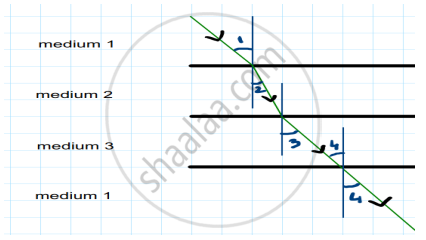
In the above diagram light is travelling through different media. It is noted by a scientist that ∠1= ∠3 = ∠4 but ∠2 < ∠1. Which of the following statement would be correct?
Concept: undefined >> undefined
Noor, a young student, was trying to demonstrate some properties of light in her Science project work. She kept ‘X’ inside the box (as shown in the figure) and with the help of a laser pointer made light rays pass through the holes on one side of the box. She had a small butter-paper screen to see the spots of light being cast as they emerged.

Her friend noted the following observations from this demonstration:
- Glass is optically rarer than air.
- Air and glass allow light to pass through them with the same velocity.
- Air is optically rarer than glass.
- Speed of light through a denser medium is faster than that of a rarer medium.
- The ratio: sin of angle of incidence in the first medium to the ratio of sin of angle of refraction in the second medium, gives the refractive index of the second material with respect to the first one.
Which one of the combinations of the above statements given below is correct.
Concept: undefined >> undefined
Advertisements
Which of the following does not belong to the same homologous series?
Concept: undefined >> undefined
The first member of alkyne homologous series is
Concept: undefined >> undefined
Name the following :-
The cell organelle where photosynthesis occurs
Concept: undefined >> undefined
A pencil when dipped in water in a glass tumbler appears to be bent at the interface of air and water. Will the pencil appear to be bent to the same extent, if instead of water we use liquids like, kerosene or turpentine. Support your answer with reason.
Concept: undefined >> undefined
An electric kettle consumes 1 kW of electric power when operated at 220 V. A fuse wire of what rating must be used for it?
Concept: undefined >> undefined
How does use of a fuse wire protect electrical appliances?
Concept: undefined >> undefined
Why is parallel arrangement used in domestic wiring?
Concept: undefined >> undefined
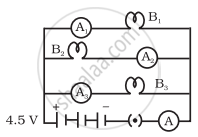
B1, B2 and B3 are three identical bulbs connected as shown in Figure. When all the three bulbs glow, a current of 3A is recorded by the ammeter A.
- What happens to the glow of the other two bulbs when the bulb B1 gets fused?
- What happens to the reading of A1, A2, A3 and A when the bulb B2 gets fused?
- How much power is dissipated in the circuit when all the three bulbs glow together?
Concept: undefined >> undefined
Three incandescent bulbs of 100 W each are connected in series in an electric circuit. In another circuit another set of three bulbs of the same wattage are connected in parallel to the same source.
- Will the bulb in the two circuits glow with the same brightness? Justify your answer.
- Now let one bulb in both the circuits get fused. Will the rest of the bulbs continue to glow in each circuit? Give reason.
Concept: undefined >> undefined
What is Joule’s heating effect? How can it be demonstrated experimentally? List its four applications in daily life.
Concept: undefined >> undefined
A carbon compound ‘A’ having melting point 156K and boiling point 351K, with molecular formula C2H6O is soluble in water in all proportions.
- Identify ‘A’ and draw its electron dot structure.
- Give the molecular formulae of any two homologues of ‘A’.
Concept: undefined >> undefined
It would cost a man Rs. 3.50 to buy 1.0 kW h of electrical energy from the Main Electricity Board. His generator has a maximum power of 2.0 kW. The generator produces energy at this maximum power for 3 hours. Calculate how much it would cost to buy the same amount of energy from the Main Electricity Board.
Concept: undefined >> undefined
A student boils water in an electric kettle for 20 minutes. Using the same mains supply he wants to reduce the boiling time of water. To do so should he increase or decrease the length of the heating element? Justify your answer.
Concept: undefined >> undefined
Two students decided to investigate the effect of water and air on iron object under identical experimental conditions. They measured the mass of each object before placing it partially immersed in 10 ml of water. After a few days, the object were removed, dried and their masses were measured. The table shows their results.
| Student | Object | Mass of Object before Rusting in g |
Mass of the coated object in g |
| A | Nail | 3.0 | 3.15 |
| B | Thin plate | 6.0 | 6.33 |
What might be the reason for the varied observations of the two students?
Concept: undefined >> undefined
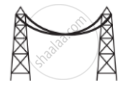
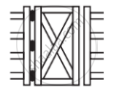
In which of the following applications of Iron, rusting will occur most? Support your answer with valid reason.
| A | B | C | D |
 |
 |
 |
 |
Concept: undefined >> undefined
In a set up the students coated iron nails with zinc metal and noted that, iron nails coated with zinc prevents rusting. They also observed that zinc initially acts as a physical barrier, but an extra advantage of using zinc is that it continues to prevent rusting even if the layer of zinc is damaged. Name this process of rust prevention and give any two other methods to prevent rusting.
Concept: undefined >> undefined
An electric kettle consumes 1 kW of electric power when operated at 220 V. A fuse wire of what rating must be used for it?
Concept: undefined >> undefined
An electric kettle of 2 kW is used for 2h. Calculate the energy consumed in
- kilowatt hour and
- joules.
Concept: undefined >> undefined
