Advertisements
Advertisements
Assume there are four families in a country. The average per capita income of these families is Rs 5000. If the income of three families is Rs 4000, Rs 7000 and Rs 3000 respectively, what is the income of the fourth family?
Concept: undefined >> undefined
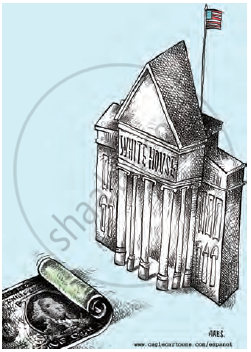
This cartoon represents a challenge to democracy. Please describe what that challenge is. Also place it in one of the three categories mentioned below.
- foundational challenge to democracy
- challenge of expansion of democracy
- challenge of deepening of democracy

Concept: undefined >> undefined
Advertisements
This cartoon represents a challenge to democracy. Please describe what that challenge is. Also place it in one of the three categories mentioned below.
- foundational challenge to democracy
- challenge of expansion of democracy
- challenge of deepening of democracy
Concept: undefined >> undefined
Why do we use averages? Are there any limitations to their use? Illustrate with your own examples related to development.
Concept: undefined >> undefined
Kerala, with lower per capita income, has a better human development ranking than Punjab. Hence, per capita income is not a useful criterion at all and should not be used to compare states. Do you agree? Discuss.
Concept: undefined >> undefined
Write a description of the challenges for democracy in the following situations.
|
Case and Context
|
Your description of the challenges for democracy in that situation |
|
Chile: General Pinochet's government was defeated, but military was still in control of many institutions. |
|
|
Poland: After the first success of solidarity, the government imposed martial law and banned solidarity. |
|
|
Ghana: Just attained independence, Nkrumah elected the President.
|
|
|
Mynamar: Suu Kyi under house arrest for more than 15 years, army rulers getting global acceptance.
|
|
|
International Organisations: US as the only superpower disregards the UN and takes unilateral action. |
|
|
Mexico: Second free election after the defeat of PRI in 2000; defeated candidates alleges rigging. |
|
|
China: The Communist party adopts economic reforms but maintains a monopoly over political power. |
|
|
Pakistan: General Musharraf holds referendum, allegations of fraud in the voter's list. |
|
|
Iraq: Widespread sectarian violence as the new government fails to establish its authority. |
|
|
South Africa: Mandela retires from active politics; pressure on his successor Mbeki to withdraw some concessions given to the white minority. |
|
|
US, Guantanamo Bay: UN Secretary General calls this a violation of international law; US refused to respond. |
|
|
Saudi Arabia: Women were not allowed to take part in public activities, no freedom of religion for the minority. |
|
|
Yugoslavia: Ethnic tension between Serbs and Albanians on the rise in the province of Kosovo; Yugoslavia disintegrated. |
|
|
Belgium: One round of constitutional change taken place, but the Dutch speakers not satisfied; they want more autonomy. |
|
|
Sri Lanka: Peace talks between the government and LTTE breaks down, renewed violence. |
|
|
US, Civil Rights: Blacks have won equal rights, but they are still poor, less educated and marginalised. |
|
|
Northern Ireland: The civil war has ended but Catholics and Protestants yet to develop trust. |
|
|
Nepal: Constituent Assembly about to be elected; unrest in Taraiareas; Maoists have not surrendered arms. |
|
|
Bolivia: Morales, a supporter of water struggle, becomes the Prime Minister, MNC's threaten to leave the country. |
Concept: undefined >> undefined
Given below are some spheres or sites of democratic politics. You may place against each of these the specific challenges that you noted for one or more countries or cartoons in the previous section. In addition to that write one item for India for each of these spheres. In case you find that some challenges do not fit into any of the categories given below, you can create new categories and put some items under that.
|
Constitutional design |
|
|
Democratic rights |
|
|
Working of institutions |
|
|
Elections |
|
|
Federalism, decentralization |
|
|
Accommodation of diversity |
|
|
Political Organisation |
|
|
Religious and equality |
Concept: undefined >> undefined
Let us group these again, this time by the nature of these challenges as per the classification suggested in the first section. For each of these categories, find at least one example from India as well.
|
Foundational Challenge |
|
|
Challenge of Expansion |
|
|
Challenge of deepening |
Concept: undefined >> undefined
For each of the items given in the following, find out which country is at the top and which is at the bottom.
|
TABLE 1.6 SOME DATA REGARDING INDIA AND ITS NEIGHBOURS FOR 2004 |
|||||
|
Country |
Per Capita Income in US$ |
Life Expectancy at birth |
Literacy Rate for 15+ yrs population |
Gross Enrolment Ratio for three levels |
HDI Rank in the world |
|
Sri Lanka India Myanmar Pakistan Nepal Bangladesh |
4390 3139 1027 2225 1490 1870 |
74 64 61 63 62 63 |
91 61 90 50 50 41 |
69 60 48 35 61 53 |
93 126 130 134 138 137v |
Concept: undefined >> undefined
Now let us think only about India. Think of all the challenges that democracy faces in contemporary India. List those five that should be addressed first of all. The listing should be in order of priority, i.e, the challenge you find most important or pressing should be mentioned at number 1, and so on. Give one example of that challenge and your reasons for assigning it the priority.
| Priority |
Challenges to democracy |
Example |
Reasons for Preference |
| 1 | |||
| 2 | |||
| 3 | |||
| 4 | |||
| 5 |
Concept: undefined >> undefined
Fill in the blank using the correct option given in the bracket:
Employment in the service sector ______ increased to the same extent as production. (has/has not)
Concept: undefined >> undefined
Here are some challenges that require political reforms. Discuss these challenges in detail study the reform options offered here and give your preferred solution with reasons. Remember that none of the options offered here is ‘right’ or ‘wrong’. You can opt for a mix of more than one options, or come up with something that is not offered here. But you must give your solution in details and offer reasons for your choice.
| Doctors’ absenteeism Challenge: |
Political funding Challenge: |
| Uttar Pradesh government got a survey done and found out that most of the doctors posted in the rural primary health centres are simply not there. They live in a town, carry out private practice and visit the village where they are posted only once or twice in the entire month. Villagers have to travel to towns and pay very high fee to private doctors even for common ailments. Reform proposals: • The government should make it compulsory for the doctors to live in the village where they are posted, otherwise their service should be terminated. • District administration and police should carry out surprise raids to check the attendance of the doctors. • Village panchayat should be given the power to write the annual report of the doctor which should be read out in the gram sabha meeting. • Problems like this can be solved only if Uttar Pradesh is split into several smaller states which can be administered more efficiently. |
On an average, every candidate who contested the last Lok Sabha elections owned a property of more than Rs one crore. There is a fear that only wealthy people or those with their support can afford to fight elections. Most of the political parties are dependent on money given by big business houses. The worry is that the role of money in politics will reduce whatever little voice the poor have in our democracy. Reform proposals: • The financial accounts of every political party should be made public. These accounts should be examined by government auditors. • There should be state funding of elections. Parties should be given some money by the government to meet their election expenditure. • Citizens should be encouraged to give more donations to parties and to political workers. Such donations should be exempt from income tax. |
Any other problem of your choice
Challenge:
Reform proposals:
•
•
•
Concept: undefined >> undefined
Fill in the blank using the correct option given in the bracket:
Workers in the ______ sector do not produce goods. (tertiary/agricultural)
Concept: undefined >> undefined
Fill in the blank using the correct option given in the bracket:
The activities in primary, secondary and tertiary sectors are ______. (independent/interdependent)
Concept: undefined >> undefined
Write a description of the challenges for democracy in the following situations.
|
Case and Context
|
Your description of the challenges for democracy in that situation |
|
Mexico: Second free election after the defeat of PRI in 2000; defeated candidates alleges rigging. |
|
|
China: The Communist party adopts economic reforms but maintains a monopoly over political power. |
|
|
Pakistan: General Musharraf holds referendum, allegations of fraud in the voter's list. |
|
|
Iraq: Widespread sectarian violence as the new government fails to establish its authority. |
|
|
South Africa: Mandela retires from active politics; pressure on his successor Mbeki to withdraw some concessions given to the white minority. |
|
|
US, Guantanamo Bay: UN Secretary General calls this a violation of international law; US refused to respond. |
|
|
Saudi Arabia: Women were not allowed to take part in public activities, no freedom of religion for the minority. |
|
|
Yugoslavia: Ethnic tension between Serbs and Albanians on the rise in the province of Kosovo; Yugoslavia disintegrated. |
|
|
Belgium: One round of constitutional change taken place, but the Dutch speakers not satisfied; they want more autonomy. |
|
|
Sri Lanka: Peace talks between the government and LTTE breaks down, renewed violence. |
|
|
US, Civil Rights: Blacks have won equal rights, but they are still poor, less educated and marginalised. |
|
|
Northern Ireland: The civil war has ended but Catholics and Protestants yet to develop trust. |
|
|
Nepal: Constituent Assembly about to be elected; unrest in Taraiareas; Maoists have not surrendered arms. |
|
|
Bolivia: Morales, a supporter of water struggle, becomes the Prime Minister, MNC's threaten to leave the country. |
Concept: undefined >> undefined
In terms of GVA the share of tertiary sector in 2017-18 is between ______ per cent.
Concept: undefined >> undefined
Match the following:
| Problems faced by farming sector | Some possible measures |
| 1. Unirrigated land | (a) Setting up agro-based mills |
| 2. Low prices for crops | (b) Cooperative marketing societies |
| 3. Debt burden | (c) Procurement of food grains by government |
| 4. No job in the offseason | (d) Construction of canals by the government |
| 5. Compelled to sell their grains to the local traders soon after harvest | (e) Banks to provide credit with low interest |
Concept: undefined >> undefined
How do banks mediate between those who have surplus money and those who need money?
Concept: undefined >> undefined
“Tertiary sector is not playing any significant role in the development of Indian economy.” Do you agree? Give reasons in support of your answer.
Concept: undefined >> undefined
Why do we need to expand formal sources of credit in India?
Concept: undefined >> undefined
