Advertisements
Advertisements

In the above figure `square`ABCD is a rectangle. If AB = 5, AC = 13, then complete the following activity to find BC.
Activity: ΔABC is a `square` triangle.
∴ By Pythagoras theorem
AB2 + BC2 = AC2
∴ 25 + BC2 = `square`
∴ BC2 = `square`
∴ BC = `square`
Concept: Pythagoras Theorem
If a and b are natural numbers and a > b If (a2 + b2), (a2 – b2) and 2ab are the sides of the triangle, then prove that the triangle is right-angled. Find out two Pythagorean triplets by taking suitable values of a and b.
Concept: Pythagorean Triplet
Construct two concentric circles with centre O with radii 3 cm and 5 cm. Construct a tangent to a smaller circle from any point A on the larger circle. Measure and write the length of the tangent segment. Calculate the length of the tangent segment using Pythagoras' theorem.
Concept: Pythagoras Theorem
In the right-angled triangle ABC, Hypotenuse AC = 10 and side AB = 5, then what is the measure of ∠A?
Concept: Pythagoras Theorem
If tan θ = `12/5`, then 5 sin θ – 12 cos θ = ?
Concept: Pythagoras Theorem
From the information in the figure, complete the following activity to find the length of the hypotenuse AC.
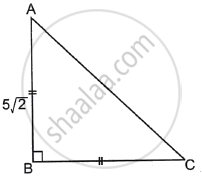
AB = BC = `square`
∴ ∠BAC = `square`
Side opposite angle 45° = `square/square` × Hypotenuse
∴ `5sqrt(2) = 1/square` × AC
∴ AC = `5sqrt(2) xx square = square`
Concept: Pythagoras Theorem
ΔPQR, is a right angled triangle with ∠Q = 90°, QR = b, and A(ΔPQR) = a. If QN ⊥ PR, then prove that QN = `(2ab)/sqrt(b^4 + 4a^2)`
Concept: Theorem of Similarity in Right Angled Triangle
If m and n are real numbers and m > n, if m2 + n2, m2 – n2 and 2 mn are the sides of the triangle, then prove that the triangle is right-angled. (Use the converse of the Pythagoras theorem). Find out two Pythagorian triplets using convenient values of m and n.
Concept: Pythagorean Triplet
AB, BC and AC are three sides of a right-angled triangle having lengths 6 cm, 8 cm and 10 cm, respectively. To verify the Pythagoras theorem for this triangle, fill in the boxes:
ΔABC is a right-angled triangle and ∠ABC = 90°.
So, by the Pythagoras theorem,
`square` + `square` = `square`
Substituting 6 cm for AB and 8 cm for BC in L.H.S.
`square` + `square` = `square` + `square`
= `square` + `square`
= `square`
Substituting 10 cm for AC in R.H.S.
`square` = `square`
= `square`
Since, L.H.S. = R.H.S.
Hence, the Pythagoras theorem is verified.
Concept: Pythagoras Theorem
In a ΔABC, ∠CAB is an obtuse angle. P is the circumcentre of ∆ABC. Prove that ∠CAB – ∠PBC = 90°.
Concept: Application of Pythagoras Theorem
There is a ladder of length 32 m which rests on a pole. If the height of pole is 18 m, determine the distance between the foot of ladder and the pole.
Concept: Pythagoras Theorem
In the figure, ΔPQR is right angled at Q, seg QS ⊥ seg PR. Find x, y.

Concept: Theorem of Geometric Mean
In the given figure, triangle ABC is a right-angled at B. D is the mid-point of side BC. Prove that AC2 = 4AD2 – 3AB2.

Concept: Apollonius Theorem
A person starts his trip from home. He moves 24 km in south direction and then starts moving towards east. He travels 7 km in that direction and finally reaches his destination. How far is the destination from his home?
Concept: Pythagoras Theorem
In ∆RST, ∠S = 90°, ∠T = 30°, RT = 12 cm, then find RS.
Concept: Property of 30°- 60°- 90° Triangle Theorem
In the adjoining figure, O is the centre of the circle. From point R, seg RM and seg RN are tangent segments touching the circle at M and N. If (OR) = 10 cm and radius of the circle = 5 cm, then
- What is the length of each tangent segment?
- What is the measure of ∠MRO?
- What is the measure of ∠MRN?
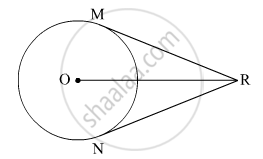
Concept: Tangent Segment Theorem
Seg RM and seg RN are tangent segments of a circle with centre O. Prove that seg OR bisects ∠MRN as well as ∠MON with the help of activity.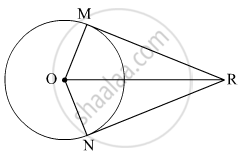
Concept: Tangent Segment Theorem
In the given figure, ∆QRS is an equilateral triangle. Prove that,
- arc RS ≅ arc QS ≅ arc QR
- m(arc QRS) = 240°.
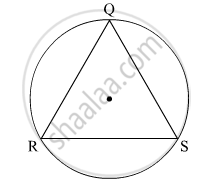
Concept: Property of Sum of Measures of Arcs
In the given figure, in a circle with centre O, length of chord AB is equal to the radius of the circle. Find measure of each of the following.
(1) ∠ AOB (2)∠ ACB
(3) arc AB (4) arc ACB.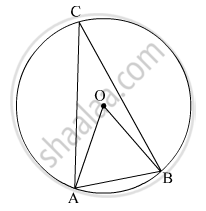
Concept: Property of Sum of Measures of Arcs
In the given figure, O is the centre of the circle and B is a point of contact. seg OE ⊥ seg AD, AB = 12, AC = 8, find (1) AD (2) DC (3) DE.

Concept: Tangent Segment Theorem
