Please select a subject first
Advertisements
Advertisements
Which of the following is not true with regards to a switch statement?
Concept: Introduction of Conditional Statements in Java
Rewrite the following code using single if statement.
if(code=='g')
System.out.println("GREEN");
else if(code=='G')
System.out.println("GREEN");Concept: Introduction of Conditional Statements in Java
A student executes the following program segment and gets an error. Identify the statement which has an error, correct the same to get the output as WIN.
boolean x=true;
switch(x)
{     case 1:System.out.println("WIN");break;
      case 2;System.out.println("LOOSE");
}Concept: Introduction of Conditional Statements in Java
Consider the following program segment and answer the questions below:
class calculate
{
     int a;double b;
     calculate()
     {
     a=0;
     b=0.0;
     }
     calculate(int x, double y)
     {
     a=x;
     b=y;
     }
   void sum()
   {
     System.out.println(a*b);
}}
Name the type of constructors used in the above program segment.
Concept: Features of a Constructor
Identify and name the following tokens:
(i) public
(ii) ‘a’
(iii) ==
(iv) {}
Concept: Introduction to Encapsulation
Using the switch-case statement, write a menu driven program to do the following :
(a) To generate and print Letters from A to Z and their Unicode Letters Unicode

(b) Display the following pattern using iteration (looping) statement: 1

Concept: Introduction of Iterative Constructs in Java
Define Encapsulation.
Concept: Scope of Variables in Java
Name any two types of access specifiers.
Concept: Introduction to Encapsulation
Write two separate programs to generate the following patterns using iteration (loop) statement:
(a)
Concept: Introduction of Iterative Constructs in Java
Write two separate programs to generate the following patterns using iteration (loop) statement:
(b)
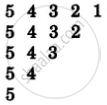
Concept: Introduction of Iterative Constructs in Java
Study the method and answer the given questions.
public void sampleMethod()
{ for (int i=0; i < 3; i++)
{ for (int j = 0; j<2; j++)
{int number = (int) (Math.random() * 10);
System.out.println(number); } } }
(i) How many times does the loop execute ?
(ii) What is the range of possible values stored in the variable number ?
Concept: Introduction to Encapsulation
Study the method and answer the given questions.
public void sampleMethod()
{ for (int i=0; i < 3; i++)
{ for (int j = 0; j<2; j++)
{int number = (int) (Math.random() * 10);
System.out.println(number); } } }
(i) How many times does the loop execute ?
(ii) What is the range of possible values stored in the variable number ?
Concept: Introduction to Encapsulation
The access modifier that gives the most accessibility is ______
Concept: Introduction to Encapsulation
State the type of loop in the given program segment
for (int i = 5;i! = 0; i = 2)
System.out.println(i);
Concept: Entry Controlled Loop
The access specifier that gives least accessibility is ______.
Concept: Introduction to Encapsulation
Which of the following are entry-controlled loops?
- for
- while
- do..while
- switch
Concept: Entry Controlled Loop
To execute a loop 10 times, which of the following is correct?
Concept: Entry Controlled Loop
How many times will the following loop execute? Write the output of the code:
int x=10;
while(true) {
System.out.println(x++*2);
if(x%3==0)
break;
}Concept: Entry Controlled Loop
Define a class to accept a number and check whether it is a SUPERSPY number or not. A number is called SUPERSPY if the sum of the digits equals the number of the digits.
Example1:
Input: 1021
Output: SUPERSPY number [SUM OF THE DIGITS = 1+0+2+1 = 4, NUMBER OF DIGITS = 4]
Example2:
Input: 125
Output: Not an SUPERSPY number [1+2+5 is not equal to 3]
Concept: Introduction of Iterative Constructs in Java
Give the output of following code and mention how many times the loop will execute?
int i;
for(i=5; i> =l;i~)
{
if(i%2 ==1)
continue;
System.out.print(i+ ”
}
Concept: Introduction of Nested Loop
