Advertisements
Advertisements
Water in lakes and ponds do not freeze at once in cold countries. Give a reason is support of your answer.
Concept: Specific Heat Capacity
A refrigerator converts 100 g of water at 20°C to ice at -10°C in 35 minutes. Calculate the average rate of heat extraction in terms of watts.
Given: Specific heat capacity of ice = 2.1 J g-1°C-1
Specific heat capacity of water = 4.2 J g-1°C-1
Specific latent heat of fusion of ice = 336 J g-1
Concept: Specific Heat Capacity
50 g of metal piece at 27°C requires 2400 J of heat energy so as to attain a temperature of 327°C . Calculate the specific heat capacity of the metal.
Concept: Specific Heat Capacity
Heat energy is supplied at a constant rate to 100g of ice at 0 °C. The ice is converted into water at 0° C in 2 minutes. How much time will be required to raise the temperature of water from 0 °C to 20 °C? [Given: sp. heat capacity of water = 4.2 J g-1 °C-1, sp. latent heat of ice = 336 J g-1].
Concept: Specific Heat Capacity
Specific heat capacity of substance A is 3.8 J g-1K-1 whereas the specific heat capacity of substance B is 0.4 J g-1 K-1
(i) Which of the two is a good conductor of heat?
(ii) How is one led to the above conclusion?
(iii) If substances A and B are liquids then which one would be more useful in car radiators?
Concept: Specific Heat Capacity
A liquid X has the maximum specific heat capacity and is used as a coolant in Car Radiators. Name the liquid X.
Concept: Specific Heat Capacity
A solid metal weighing 150 g melts at its melting point of 800 °C by providing heat at the rate of 100 W. The time taken for it to completely melt at the same temperature is 4 min. What is the specific latent heat of fusion of the metal?
Concept: Specific Heat Capacity
Heat supplied to a solid change it into liquid. What is this change in the phase called?
Concept: Specific Heat Capacity
During the phase change does the average kinetic energy of the molecules of the substance increase?
Concept: Specific Heat Capacity
State two differences between "Heat Capacity" and "Specific Heat Capacity".
Concept: Heat Capacity vs Specific Heat Capacity
Give a mathematical relation between Heat Capacity and Specific Heat Capacity.
Concept: Specific Heat Capacity
The temperature of 170 g of water at 50°C is lowered to 5°C by adding a certain amount of ice to it. Find the mass of ice added.
Given: Specific heat capacity of water = 4200 J kg-1 °C-1 and specific latent heat of ice = 336000 J kg-1.
Concept: Specific Heat Capacity
(i) State whether the specific heat capacity of a substance remains the same when its state changes from solid to liquid.
(ii) Give one example to support your answer.
Concept: Specific Heat Capacity
104g of water at 30°C is taken in a calorimeter made of copper of mass 42 g. When a certain mass of ice at 0°C is added to it, the final steady temperature of the mixture after the ice has melted, was found to be 10°C. Find the mass of ice added. [Specific heat capacity of water = 4.2 Jg–1°C–1 ; Specific latent heat of fusion of ice = 336 Jg–1; Specific heat capacity of copper = 0.4 Jg–1°C–1] .
Concept: Specific Heat Capacity
The meaning of the statement ‘Specific heat capacity of water is 4200 J kg-1 K-1’ is:
Concept: Natural Phenomena and Consequences of High Specific Heat Capacity of Water
The diagram below shows a cooling curve for 200 g of water. The heat is extracted at the rate of 100 Js-1. Answer the questions that follow:
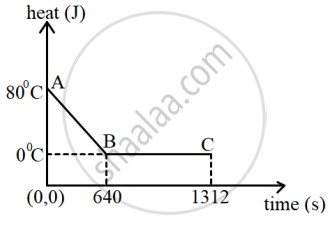
- Calculate specific heat capacity of water.
- Heat released in the region BC.
Concept: Specific Heat Capacity
Two metals A and B have specific heat capacities in the ratio 2 : 3. If they are supplied the same amount of heat then
Which metal piece will show a greater rise in temperature given their masses is the same?
Concept: Specific Heat Capacity
Two metals A and B have specific heat capacities in the ratio 2:3. If they are supplied same amount of heat then
Which metal piece will have greater mass if the rise in temperature is the same for both metals?
Concept: Specific Heat Capacity
Two metals A and B have specific heat capacities in the ratio 2:3. If they are supplied same amount of heat then
If the mass ratio of metal A and metal B is 3:5 then calculate the ratio in which their temperatures rise.
Concept: Specific Heat Capacity
Two metals A and B have specific heat capacities in the ratio 2:3. If they are supplied same amount of heat then
If specific heat capacity of metal A is 0.26 Jg-1 0C-1 then calculate the specific heat capacity of metal B.
Concept: Specific Heat Capacity
