Advertisements
Advertisements
In what ratio does the point P(−4, y) divides the line segment joining the points A(−6, 10) and B(3, −8)? Hence find the value of y.
Concept: Distance Formula
The distance of the point P(–6, 8) from the origin is ______.
Concept: Distance Formula
The distance of the point (–6, 8) from x-axis is ______.
Concept: Co-ordinate Geometry
If cot θ = `7/8` evaluate `((1+sin θ )(1-sin θ))/((1+cos θ)(1-cos θ))`.
Concept: Trigonometric Ratios
Prove the identity (sin θ + cos θ)(tan θ + cot θ) = sec θ + cosec θ.
Concept: Trigonometric Identities (Square Relations)
Prove that `(sinθ - cosθ + 1)/(sinθ + cosθ - 1) = 1/(secθ - tanθ)`
Concept: Trigonometric Identities (Square Relations)
Find A if tan 2A = cot (A-24°).
Concept: Trigonometric Identities (Square Relations)
Express (sin 67° + cos 75°) in terms of trigonometric ratios of the angle between 0° and 45°.
Concept: Trigonometric Identities (Square Relations)
Prove that: 2(sin6 θ + cos6 θ) – 3 (sin4 θ + cos4 θ) + 1 = 0.
Concept: Trigonometric Identities (Square Relations)
A moving boat is observed from the top of a 150 m high cliff moving away from the cliff. The angle of depression of the boat changes from 60° to 45° in 2 minutes. Find the speed of the boat in m/min.
Concept: Trigonometric Identities (Square Relations)
There are two poles, one each on either bank of a river just opposite to each other. One pole is 60 m high. From the top of this pole, the angle of depression of the top and foot of the other pole are 30° and 60° respectively. Find the width of the river and height of the other pole.
Concept: Trigonometric Identities (Square Relations)
`(1 + tan^2 "A")/(1 + cot^2 "A")` is equal to ______.
Concept: Trigonometric Ratios
If 1 + sin2θ = 3 sin θ cos θ, then prove that tan θ = 1 or `1/2`.
Concept: Trigonometric Identities (Square Relations)
`(cos^2 θ)/(sin^2 θ) - 1/(sin^2 θ)`, in simplified form, is ______.
Concept: Trigonometric Identities (Square Relations)
Evaluate: 5 cosec2 45° – 3 sin2 90° + 5 cos 0°.
Concept: Trigonometric Ratios
A toy is in the form of a cone of radius 3.5 cm mounted on a hemisphere of same radius. The total height of the toy is 15.5 cm. Find the total surface area of the toy [Use π =`22/7`]
Concept: Surface Area of a Combination of Solids
If the radius of the base of a right circular cylinder is halved, keeping the height the same, then the ratio of the volume of the cylinder thus obtained to the volume of original cylinder is:
Concept: Surface Area of a Combination of Solids
In Fig. 6, OABC is a square of side 7 cm. If OAPC is a quadrant of a circle with centre O, then find the area of the shaded region. `[\text\ User=22/7]`
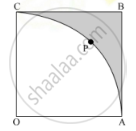
Concept: Surface Area of a Combination of Solids
From a solid cylinder of height 7 cm and base diameter 12 cm, a conical cavity of same height and same base diameter is hollowed out. Find the total surface area of the remaining solid. [User `pi22/7`]
Concept: Surface Area of a Combination of Solids
A cone of height 24 cm and radius of base 6 cm is made up of modelling clay. A child reshapes it in the form of a sphere. Find the radius of the sphere and hence find the surface area of this sphere.
Concept: Surface Area of a Combination of Solids
