Definitions [1]
When an equation, involving trigonometrical ratios of an angle A, is true for all values of A, the equation is called a trigonometric identity.
Formulae [4]
\[sineA=\frac{\text{Perpendicular}}{\text{Hypotenuse}}\]
\[cosineA=\frac{\mathrm{Base}}{\text{Hypotenuse}}\]
\[tangentA=\frac{\text{Perpendicular}}{\mathrm{Base}}\]
\[cotangent A = \frac{\text{Base}}{\text{Perpendicular}}\]
\[secantA=\frac{\text{Hypotenuse}}{\mathrm{Base}}\]
\[cosecantA=\frac{\text{Hypotenuse}}{\text{Perpendicular}}\]
\[\sin\mathrm{A}=\frac{1}{\mathrm{cosec~A}}\quad\mathrm{and}\quad\mathrm{cosec~A}=\frac{1}{\sin\mathrm{A}}\]
\[\cos\mathrm{A}=\frac{1}{\sec\mathrm{A}}\quad\mathrm{and}\quad\mathrm{sec}\mathrm{A}=\frac{1}{\cos\mathrm{A}}\]
\[\tan\mathrm{A}=\frac{1}{\cot\mathrm{A}}\quad\mathrm{and}\quad\cot\mathrm{A}=\frac{1}{\tan\mathrm{A}}\]
-
sinθ⋅cosecθ = 1
-
cosθ⋅secθ = 1
-
tanθ⋅cotθ = 1
\[tanA=\frac{\sin A}{\cos A}\]
\[cotA=\frac{\cos A}{\sin A}\]
For an acute angle A,
- sin (90° - A) = cos A
- cos (90° - A) = sin A
- tan (90° - A) = cot A
- cot (90° - A) = tan A
- sec (90° - A) = cosec A
- cosec (90° - A) = sec A
Theorems and Laws [128]
If `cot theta = 3/4`, prove that `sqrt((sec theta - cosec theta)/(sec theta + cosec theta)) = 1/sqrt7`
`cot theta = "𝑎𝑑𝑗𝑎𝑐𝑒𝑛𝑡 𝑠𝑖𝑑𝑒"/"𝑜𝑝𝑝𝑜𝑠𝑖𝑡𝑒 𝑠𝑖𝑑𝑒"`
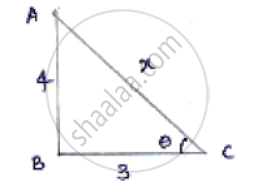
Let x be the hypotenuse by applying Pythagoras theorem.
𝐴𝐶2 = 𝐴𝐵2 + 𝐵𝐶2
𝑥2 = 16 + 9
`x^2 = 25 => x = 5`
`sec theta = (AC)/(BC) = 5/3`
`cosec theta = (AC)/(AB) = 5/4`
On substituting in equation we get
`sqrt((sec theta - cosec theta)/(sec theta + cosec theta)) = sqrt((5/3 - 5/4)/(5/3 + 5/4))`
`= sqrt(((20 - 15)/12)/((20 + 15)/12)) = sqrt(5/35) = 1/sqrt7`
If `sin θ = 3/4` prove that `sqrt(("cosec"^2θ - cot^2θ)/(sec^2θ - 1)) = sqrt(7)/3`.
We have `sin theta = 3/4`
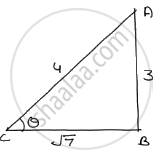
In ΔABC
`AC^2 = AB^2 + BC^2`
`=> (4)^2 = (3)^2 + BC^2`
`=> BC^2= 16 - 9`
`=> BC^2 = 7`
`=> BC = sqrt7`
`:. cosec theta = 4/3, sec theta = 4/sqrt7 and cot theta = sqrt7/3`
Now
L.H.S `sqrt((cosec^2 theta - cot^2 theta)/(sec^2 theta - 1))`
`= sqrt(((4/3)^2 - (sqrt7/3)^2)/((4/sqrt7)^2 - 1)`
`= sqrt((16/9 - 7/9)/(16/7 - 1)`
`=sqrt((9/9)/((16 - 7)/7 ))`
`= sqrt(7/9)`
`= sqrt7/3`
= R.H.S
If `tan θ = a/b` then prove that `((a sin theta - b cos theta)/(a sin theta + b cos theta)) = ((a^2 - b^2))/((a^2 + b^2))`.
Let `(a sin theta - b cos theta)/(a sin theta + b cos theta)`
Divide both Nr and Dr with cos θ of (a)
`((a sin theta - b cos theta)/cos theta)/((a sin theta + b cos theta)/cos theta)`
`= (tan theta - b)/(a tan theta + b)`
`=(a xx (a/b) - b)/(a xx (a/b) + b)`
`= (a^2 - b^2)/(a^2 + b^2)`
If cos θ + cos2 θ = 1, prove that sin12 θ + 3 sin10 θ + 3 sin8 θ + sin6 θ + 2 sin4 θ + 2 sin2 θ − 2 = 1
Given `cos theta + cos^2 theta = 1`
We have to prove sin12 θ + 3 sin10 θ + 3 sin8 θ + sin6 θ + 2 sin4 θ + 2 sin2 θ − 2 = 1
From the given equation, we have
`cos theta + cos^2 theta = 1`
`=> cos theta = 1 - cos^2 theta`
`=> cos theta = sin^2 theta`
`=> sin^2 theta = cos theta`
Therefore, we have
sin12 θ + 3 sin10 θ + 3 sin8 θ + sin6 θ + 2 sin4 θ + 2 sin2 θ − 2
`= (sin^12 theta + 3 sin^10 theta + 3 sin^8 theta + sin^6 theta) + (2 sin^4 theta + 2 sin^2 theta) - 2`
`= {(sin^4 theta)^3 + 3(sin^4 theta)^2 sin^2 theta + 3 sin^4 theta(sin^2 theta)^2 + (sin^2 theta)^3} + 2(sin^4 theta + sin^2 theta) - 2`
`= (sin^4 theta + sin^2 theta)^3 + 2 (sin^4 theta + sin^2 theta) - 2`
`= (cos^2 theta + cos theta)^3 + 2 (cos^2 theta + cos theta) - 2`
`= (1)^3 + 2(1) - 2`
= 1
Hence proved
Prove the following trigonometric identities.
`(1 + tan^2 A) + (1 + 1/tan^2 A) = 1/(sin^2 A - sin^4 A)`
We need to prove `(1 + tan^2 A) + (1 + 1/tan^2 A) = 1/(sin^2 A - sin^4 A)`
Using the property `1 + tan^2 theta = sec^2 theta` we get
`(1 + tan^2 A)+(1 + 1/tan^2 A) = sec^2 A = ((tan^2 A + 1)/tan^2 A)`
`= sec^2 A + (sec^2 A)/(tan^2 A)`
Now using `sec theta = 1/cos theta` and `tan theta = sin theta/cos theta` we get
`sec^2 A + ((sec^2 A)/(tan^2 A)) = 1/cos^2 A + ((1/cos^2 A)/((sin^2 A)/(cos^2 A)))`
`= 1/cos^2 A + (1/cos^2A xx cos^2 A/sin^2 A)`
` = 1/cos^2 A + 1/sin^2 A`
`= (sin^2 A + cos^2 A)/(cos^2 A(sin^2 A))`
Further, using the property, `sin^2 theta + cos^2 theta = 1` we get
`(sin^2 A + cos^2 A)/(cos^2 A(sin^2 A)) = 1/(cos^2 A (sin^2 A))`
`= 1/((1 - sin^2 A)(sin^2 A))` (using `cos^2 theta = 1 - sin^2 theta`)
`= 1/(sin^2 A - sin^4 A)`
Hence proved
Prove the following trigonometric identities.
`cot^2 A cosec^2B - cot^2 B cosec^2 A = cot^2 A - cot^2 B`
L.H.S = `cot^2 A cosec^2B - cot^2 B cosec^2 A`
`= cot^2 A(1+ cot^2 B) - cot^2 B(1 + cot^2 A)` (∵ `1 + cot^2 theta = cosec^2 theta`)
`= cot^2 A + cot^2 A cot^2 B - cot^2 B - cot^2 A cot^2 B`
`= cot^2 A - cot^2 B`
Hence proved
Prove the following trigonometric identities.
`(tan^3 theta)/(1 + tan^2 theta) + (cot^3 theta)/(1 + cot^2 theta) = sec theta cosec theta - 2 sin theta cos theta`
`(tan^3 theta)/(1 + tan^2 theta) + (cot^3 theta)/(1 + cot^2 theta) ` [`∵ sec^2 theta - tan^2 theta = 1 - cosec^2 theta - cot^2 theta = 1`]
`= tan theta + cos^2 theta = cot^3 theta xx sin^3 theta`
`[∵ 1/sec^2 theta = cos^2 theta, 1/cosec^2 theta = 1 + cot^2 theta]`
`sin^3 theta/cos^3 theta xx cos^2 theta + cos^3 theta/sin^3 theta xx sin^2 theta`
`sin^3 theta/cos theta + cos^3 theta/sin theta`
`= (sin^4 theta + cos^4 theta)/(sin theta cos theta)`
` (1 - 2sin^2 theta cos^2 theta)/(sin theta cos theta)`
`1/(sin theta cos theta) - (2 sin^2 theta cos^2 theta)/(sin theta cos theta)`
`sec theta cosec theta - 2sin theta cos theta`.
Prove the following trigonometric identities.
`tan A/(1 + tan^2 A)^2 + cot A/((1 + cot^2 A)) = sin A cos A`
We have to prove `tan A/(1 + tan^2 A)^2 + cot A/((1 + cot^2 A)) = sin A cos A`
We know that `sin^2 A + cos^2 A = 1`
So
`tan A/(1 + tan^2 A)^2 + cot A/(1 + cot^2 A)^2`
`= tan A/(sec^2 A)^2 + cot A/(cosec^2 A)^2`
`= tan A/sec^4 A + cot A/(cosec^4 A)`
`= (sin A/cos A)/(1/cos^4 A) + (cos A/sin A)/(1/sin^4 A)`
`= (sin A cos^4 A)/cos A + (cos A sin^4 A)/sin A`
`= sin A cos^3 A + cos A sin^3 A`
`= sin A cos A (cos^2 A + sin^2 A)`
= sin A cos A
Hence proved.
If `a cos^3 theta + 3a cos theta sin^2 theta = m, a sin^3 theta + 3 a cos^2 theta sin theta = n`, prove that `(m + n)^(2/3) + (m - n)^(2/3) = 2a^(2/3)`
`= (a cos^3 theta + 3a cos theta sin^2 theta + a sin^3 theta + 3a cos^2 theta sin theta)^(3/2) + (a cos^3 theta + 3a cos theta sin^2 theta - a sin^3 theta - 3a cos^2 theta sin theta)^(2/3)`
`= a^(1/3) (cos^3 theta + 3 cos theta sin^2 theta + sin^3 theta + 3 cos^2 theta sin theta)^(2/3) + a^(2/3) (cos^3 theta + 3 cos theta sin^2 theta + sin^3 theta - 3 cos^2 theta sin theta)^(2/3)`
`= a^(1/3) [(cos theta + sin theta)^3]^(2/3) + a^(2/3) (cos theta - sin theta)^3]^(2/3)`
`= a^(2/3) [(cos theta + sin theta)^2] + a^(2/3) (cos theta - sin theta)^2`
`= a^(2/3) [cos^2 theta + sin^2 theta - 2sin theta cos theta]`
`= a^(2/3) [cos^2 theta + sin^2 theta + 2 sin theta cos theta] +_ a^(2/3) [cos^2 theta + sin^2 theta - 2 sin theta cos theta]`
`= a^(2/3) [1 + 2 sin theta cos theta] + a^(2/3)[1 - 2 sin theta cos theta]`
`= a^(2/3) [1 + 2 sin theta cos theta + 1 - 2 sin theta cos theta]`
`= a^(1/3) (1 + 1) = 2a^(2/3)`
R.H.S
Prove that `(cos^2θ)/(sinθ) + sin θ = "cosec" θ`.
L.H.S. = `(cos^2θ)/(sinθ) + sin θ`
= `(cos^2θ + sin^2θ)/(sin θ)`
= `1/(sin θ)` ...[∵ sin2θ + cos2θ = 1]
= cosec θ
= R.H.S.
∴ `(cos^2θ)/(sin θ) + sin θ = "cosec" θ`
Prove the following trigonometric identities.
sec A (1 − sin A) (sec A + tan A) = 1
We have to prove sec A(1 − sin A)(sec A + tan A) = 1
We know that sec2 A − tan2 A − 1
So,
sec A(1 − sin A)(sec A + tan A) = {sec A(1 − sin A)}(sec A + tan A)
= (sec A − sec A sin A)(sec A + tan A)
= `(sec A - 1/cos A sin A) (sec A + tan A)` ...`(∵ sec theta = 1/costheta)`
= `(sec A - sin A/cos A) (sec A + tan A)` ...`(∵ tan theta = sin theta/costheta)`
= (sec A − tan A)(sec A + tan A)
= sec2 A − tan2 A
= 1 = R.H.S. ... (∵ sec2 θ = 1 tan2 θ)
Prove that sec2θ + cosec2θ = sec2θ × cosec2θ.
L.H.S. = sec2θ + cosec2θ
= `1/(cos^2θ) + 1/(sin^2θ)`
= `(sin^2θ + cos^2θ)/(cos^2θ.sin^2θ)`
= `1/(cos^2θ.sin^2θ)` ...[∵ sin2θ + cos2θ = 1]
= `1/(cos^2θ) xx 1/(sin^2θ)`
= sec2θ × cosec2θ
= R.H.S.
∴ sec2θ + cosec2θ = sec2θ × cosec2θ
Prove the following identities:
`secA/(secA + 1) + secA/(secA - 1) = 2cosec^2A`
L.H.S. = `secA/(secA + 1) + secA/(secA - 1)`
= `(sec^2A - secA + sec^2A + secA)/(sec^2A - 1`
= `(2sec^2A)/tan^2A` ...(∵ sec2 A – 1 = tan2 A)
= `(2/cos^2A)/(sin^2A/cos^2A)`
= `2/sin^2A`
= 2 cosec2 A = R.H.S.
`(cos^3 θ + sin^3 θ)/(cos θ + sin θ) + (cos ^3 θ - sin^3 θ)/(cos θ - sin θ) = 2`
LHS= `(cos^3 θ + sin^3 θ)/(cos θ + sin θ) + (cos ^3 θ - sin^3 θ)/(cos θ - sin θ) `
=` ((cos θ + sin θ)(cos^2 θ - cos θ sin θ + sin^2 θ))/((cos θ + sin θ)) + ((cos θ - sin θ)(cos^2 θ + cos θ sin θ + sin^2 θ))/((cos θ - sin θ))`
= (cos2 θ + sin2 θ − cos θ sin θ) + (cos2 θ + sin2 θ + cos θ sin θ)`
= (1 − cos θ sin θ) + (1 + cos θ sin θ)
= 2
= RHS
Hence, LHS = RHS
Prove that `(sin θ + tan θ)/(cos θ) = tan θ (1 + sec θ)`.
L.H.S. = `(sin θ + tan θ)/(cos θ)`
= `(sin θ)/(cos θ) + (tan θ)/(cos θ)`
= tan θ + tan θ sec θ
= tan θ (1 + sec θ)
= R.H.S.
∴ `(sin θ + tan θ)/(cos θ) = tan θ (1 + sec θ)`
Prove that `(cosθ)/(1 + sinθ) = (1 - sinθ)/(cosθ)`.
L.H.S. = `(cosθ)/(1 + sinθ)`
= `(cosθ)/(1 + sinθ) xx (1 - sinθ)/(1 - sinθ)` ...[On rationalising the denominator]
= `(cosθ(1 - sinθ))/(1 - sin^2θ)`
= `(cosθ(1 - sinθ))/(cos^2θ)` ...`[(∵ sin^2θ + cos^2θ = 1),(∴ 1 -sin^2θ = cos^2θ)]`
= `(1 - sinθ)/(cosθ)`
= R.H.S.
∴ `(cosθ)/(1 + sinθ) = (1 - sinθ)/(cosθ)`
Prove the following trigonometric identities.
`"cosec" theta sqrt(1 - cos^2 theta) = 1`
We know that `sin^2 theta + cos^2 theta = 1`
So,
LHS = `"cosec" theta sqrt(1 - cos^2 theta)`
= `"cosec" theta sqrt (sin^2 theta)`
= cosec θ . sin θ
`1/sin theta xx sin theta`
= 1
= RHS hence proved.
`1 + (tan^2 θ)/((1 + sec θ)) = sec θ`
LHS = `1 + (tan^2 θ)/((1 + sec θ))`
=` 1 + ((sec^2 θ - 1))/((sec theta + 1))`
=`1 + ((sec theta + 1)(sec theta - 1))/((sec theta + 1))`
=`1 + (sec theta - 1)`
= sec θ
LHS = RHS
`1/((1+ sin θ)) + 1/((1 - sin θ)) = 2 sec^2 θ`
LHS =`1/((1+ sin θ)) + 1/((1 - sin θ))`
= `((1 - sin θ) + (1 + sin θ))/((1 + sin θ)(1 - sin θ))`
= `2/(1 - sin^2 θ)`
= `2/(cos^2 θ)`
= 2 sec2 θ
= RHS
Hence Proved.
Prove the following identities.
cot θ + tan θ = sec θ cosec θ
L.H.S. = cot θ + tan θ
L.H.S. = `costheta/sintheta + sintheta/costheta`
L.H.S. = `(cos^2theta + sin^2theta)/(sintheta costheta)`
[cos2 θ + sin2 θ = 1]
L.H.S. = `1/(sintheta costheta)`
Use Reciprocal Identities:
The expression can be split into `(1/sin θ) xx (1/cos θ)`.
`1/sin θ` = cosec θ
`1/cos θ` = sec θ
L.H.S. = cosec θ.sec θ
L.H.S. = sec θ.cosec θ
∴ L.H.S. = R.H.S.
`sqrt((1 + sin θ)/(1 - sin θ)) = sec θ + tan θ`
LHS = `sqrt((1 + sin θ)/(1 - sin θ))`
=`sqrt(((1 + sin θ))/(1 - sin θ) xx ((1 + sin θ))/(1 + sin θ))`
=` sqrt(((1 + sin θ)^2)/(1 - sin^2 θ))`
=`sqrt(((1 + sin θ)^2)/(cos^2 θ))`
=`(1 + sin θ)/cos θ`
=`1/cos θ + (sin θ)/(cos θ)`
= sec θ + tan θ
= RHS
Prove that
`sqrt((1 + sin θ)/(1 - sin θ)) + sqrt((1 - sin θ)/(1 + sin θ)) = 2 sec θ`
`"LHS" = sqrt((1 + sin θ)/(1 - sin θ)) + sqrt((1 - sin θ)/(1 + sin θ))`
Taking L.H.S and rationalizing the numerator and denominator with its respective conjugates, we get,
`"LHS" = sqrt((1 + sin θ)/(1 - sin θ) × (1 + sin θ)/(1 + sin θ)) + sqrt((1 - sin θ)/(1 + sin θ) × (1 - sin θ)/(1 - sin θ))`
`"LHS" = sqrt((1 + sin θ)^2/(1 - sin^2 θ)) + sqrt((1 - sin θ)^2/(1 - sin^2 θ))`
`"LHS" = sqrt((1 + sin^2θ)/(1 - sin^2 θ)) + sqrt((1 - sin^2θ)/(1 - sin^2 θ))`
`"LHS" = sqrt((1 + sin^2θ)/(cos^2 θ)) + sqrt((1 - sin^2θ)/(cos^2 θ))`
`"LHS" = (1 + sin θ)/(cos θ) + (1 - sin θ)/(cos θ)`
`"LHS" = (1 + cancel(sin θ) + 1 -cancel(sin θ))/(cos θ)`
LHS = `2/(cos θ)`
LHS = 2. `1/(cos θ)`
LHS = 2. sec θ
RHS = 2. sec θ
LHS = RHS
Hence proved.
Prove that: `(sin θ - 2sin^3 θ)/(2 cos^3 θ - cos θ) = tan θ`.
LHS = `(sin θ - 2sin^3 θ)/(2 cos^3 θ - cos θ)`
= `(sin θ(1 - 2sin^2 θ))/(cos θ(2 cos^2 θ - 1))`
= `(tan θ(1 - 2(1 - cos^2 θ)))/(2 cos^2θ - 1 )`
= `(tan θ(1 - 2 + 2 cos^2 θ))/(2 cos^2θ - 1 )`
= `(tan θ(2 cos^2 θ - 1))/(2 cos^2θ - 1 )`
= tan θ
= RHS
Hence proved.
Prove the following trigonometric identities.
tan2 θ − sin2 θ = tan2 θ sin2 θ
LHS = tan2 θ − sin2 θ
= `sin^2 θ/cos^2 θ - sin^2 θ` `[∵ tan^2 θ = sin^2 θ/cos^2 θ]`
`=> sin^2 θ [1/cos^2 θ- 1]`
`sin^2 θ [(1 - cos^2 θ)/cos^2 θ]`
`=> sin^2 θ. sin^2 θ/cos^2 θ = sin^2 θ tan^2 θ `
LHS = RHS
Hence proved
Prove that `sqrt((1 - sin θ)/(1 + sin θ)) = sec θ - tan θ`.
L.H.S. = `sqrt(((1 - sin θ)(1 - sin θ))/((1 + sin θ)(1 - sin θ)))`
= `sqrt((1 + sin^2θ - 2sinθ)/(1 - sin^2θ)`
= `sqrt((1 + sin^2θ - 2sinθ)/(cos^2θ)`
= `sqrt( 1/cos^2θ + sin^2θ/cos^2θ - (2sin θ)/cos θ xx 1/cosθ`
= `sqrt( sec^2θ + tan^2 θ - 2 tan θ . sec θ)`
= `sqrt((sec θ - tan θ)^2)`
= sec θ – tan θ
= R.H.S.
Hence proved.
L.H.S. = `sqrt((1 - sin θ)/(1 + sin θ))`
= `sqrt(((1 - sin θ)(1 - sin θ))/((1 + sin θ)(1 - sin θ))`
= `sqrt(((1 - sin θ)^2)/(1 - sin^2θ)`
= `sqrt(((1 - sin θ)^2)/(cos^2θ)`
= `(1 - sin θ)/(cos θ)`
= `1/(cos θ) - (sin θ)/(cos θ)`
= sec θ – tan θ
= R.H.S.
Hence Proved.
Prove the following identities:
`(cos theta "cosec" theta - sin theta sec theta )/(cos theta + sin theta) = "cosec" theta - sec theta`
LHS = `(cos theta cosec theta - sin theta sec theta )/(costheta + sin theta)`
=`((cos theta sin theta)/(sin theta cos theta))/(cos theta + sin theta)`
=`(cos^2 theta - sin^2 theta)/(cos theta sin theta ( cos theta + sin theta))`
=`((cos theta + sin theta )( cos theta - sin theta))/(cos theta sin theta ( cos theta + sin theta))`
=`((cos theta - sin theta ))/(cos theta sin theta)`
=`1/ sin theta - 1/ cos theta`
=`cosec theta - sec theta`
= RHS
Hence, LHS = RHS
Prove that:
`tanA/(1 - cotA) + cotA/(1 - tanA) = secA "cosec" A + 1`
L.H.S. = `tanA/(1 - cotA) + cotA/(1 - tanA)`
= `tanA/(1 - 1/tanA) + (1/tanA)/(1 - tanA)`
= `tan^2A/(tanA - 1) + 1/(tanA(1 - tanA))`
= `(tan^3A - 1)/(tanA(1 - tanA))`
= `((tanA - 1)(tan^2A + 1 + tanA))/(tanA(tanA - 1)`
= `(sec^2A + tanA)/tanA`
= `(1/cos^2A)/(sinA/cosA) + 1`
= `1/(sinAcosA) + 1`
= sec A cosec A + 1 = R.H.S.
If (cot θ + tan θ) = m and (sec θ – cos θ) = n, prove that `(m^2 n)^(2//3) - (mn^2)^(2//3) = 1`.
We have `(cot theta + tan theta ) = m and ( sec theta - cos theta )=n`
Now, `m^2 n = [(cot theta + tan theta )^2 (sec theta - cos theta )]`
=`[(1/tan theta + tan theta )^2 (1/cos theta- cos theta )]`
=`(1+tan^2 theta)^2/tan^2 theta xx ((1-cos^2 theta))/costheta`
=`sec^4 theta/tan^2 theta xx sin^2 theta/ cos theta`
=`sec ^4 theta /(sin^2 theta/cos^2 theta) xx sin^2 theta / cos theta`
=`(cos^2 xxsec^4 theta)/costheta`
=`cos theta sec^4 theta`
=`1/ sec theta xx sec ^4 theta = sec^3 theta`
∴`(m^2 n)^(2/3) =(sec^3 theta )^(2/3) = sec^2 theta`
Again, `mn^2 = [(cot theta + tan theta )( sec theta - cos theta )^2 ]`
=`[(1/tan theta + tan theta).(1/ cos theta - cos theta)^2]`
=`((1+ tan^2 theta))/tan theta xx ((1- cos^2 theta)^2)/cos^2 theta `
=`sec^2 theta/tan theta xx sin^4 theta/cos^2 theta`
=`sec^2 theta/(sintheta/costheta) xx sin^4 theta/ cos^2 theta`
=`(sec^2 xx sin^3 theta)/cos theta`
=`1/ cos^2 theta xx sec^3 theta/ cos theta = tan^3 theta `
∴ `(mn^2)^(2/3) = (tan ^3 theta )^(2/3) = tan^2 theta`
Now,` (m^2n)^(2/3) - (mn^2)^(2/3)`
=`sec^2 theta - tan^2 theta =1 `
=RHS
Hence proved.
If (cosec θ – sin θ) = a3 and (sec θ – cos θ) = b3, prove that a2b2(a2 + b2) = 1.
We have `( cosec theta - sin theta ) = a^3`
= > ` a^3 = (1/ sin theta - sin theta)`
= > `a^3 = ((1- sin^2 theta))/sin theta = cos^2 theta / sin theta`
∴ `a=(cos^(2/3) theta)/(sin ^(1/3) theta)`
Again, `(sec theta - cos theta ) = b^3`
= >`b^3 = (1/cos theta - cos theta )`
=` ((1-cos^2 theta))/ cos theta`
=` (sin^2 theta)/cos theta`
∴ b =` (sin ^(2/3) theta)/(cos ^(1/3) theta)`
Now , LHS = `a^2 b^2 (a^2 + b^2 ) `
=` a^3 (ab^2) + ( a^2 b^2 ) b^3 `
=`a^3 ( ab^2 ) + ( a^2 b^2 ) b^3 `
=`(cos^2 theta)/(sin theta) xx [(cos ^(2/3) theta)/(sin^(1/3) theta) xx (sin ^(4/3)theta)/(cos ^(2/3) theta)] + [ ( cos ^(4/3) theta theta)/(sin ^(2/3) theta)xx(sin^(2/3)theta)/(cos ^(1/3)theta)] xx sin^2 theta/ cos theta`
=`cos^2 theta / sin theta xx sin theta + cos theta xx sin^2theta / costheta`
=`cos^2 theta + sin^2 theta = 1`
= RHS
Hence, proved
cosec4 θ − cosec2 θ = cot4 θ + cot2 θ
LHS = cosec4 θ − cosec2 θ
LHS = cosec2 θ (cosec2 θ − 1)
LHS = (cot2 θ + 1)cot2 θ ...`{(cot^2 θ + 1 = cosec^2 θ),(∵ cot^2 θ = cosec^2 θ - 1):}`
LHS = cot4 θ + cot2 θ
RHS = cot4 θ + cot2 θ
RHS = LHS
Hence proved.
RHS = cot4 θ + cot2 θ
RHS = cot2 θ (cot2 θ + 1)
RHS = (cosec2 θ − 1)cosec2 θ ...`{(cot^2 θ + 1=cosec^2 θ),(∵ cot^2θ = cosec^2 θ - 1):}`
RHS = cosec4 θ − cosec2 θ
LHS = cosec4 θ − cosec2 θ
RHS = LHS
Hence proved.
Prove the following identities:
`(1 + tan theta + cot theta)(sin theta - cos theta) = ((sec theta)/("cosec"^2 theta) - ("cosec" theta)/(sec^2 theta))`
LHS = `(1 + tan theta + cot theta )(sintheta - cos theta) `
= `sin theta + tan theta sin theta + cot theta sin theta - cos theta - tan theta cos theta - cot theta cos theta `
= `sin theta + tan theta sin theta + cos theta/sin theta xx sin theta - cos theta - sin theta/cos theta xx cos theta - cot theta cos theta`
= `sin theta + tan theta sin theta + cos theta - cos theta - sin theta - cot theta cos theta`
= `tan theta sin theta - cot theta cos theta`
= `sin theta/cos theta xx 1/(cosec theta) - cos theta/sin theta xx 1/sec theta`
= `1/(cosec theta) xx 1/(cosec theta) xx sec theta - 1/sec theta xx 1/sec theta xx cosec theta`
= `sec theta/(cosec^2 theta) - (cosec theta)/sec^2 theta`
= RHS
Hence, LHS = RHS
Prove the following trigonometric identities:
sin2 A cot2 A + cos2 A tan2 A = 1
We have to prove `sin^2 A cot^2 A + cos^2 A tan^2 A = 1`
We know that `sin^2 A + cos^2 A = 1`
So,
`sin^2 A cot^2 A + cos^2 A tan^2 A = sin^2 A (cos^2 A)/(sin^2 A) + cos^2 A(sin^2 A)/(cos^2 A)`
`= cos^2 A + sin^2 A`
= 1
If (tan θ + sin θ) = m and (tan θ – sin θ) = n, prove that (m2 – n2)2 = 16 mn.
We have `(tan theta + sin theta ) = m and ( tan theta - sin theta )=n`
Now,LHS = `(m^2-n^2)^2`
=`[(tan^2 theta + sin theta )^2 - "( tan theta - sin theta )^2]^2`
=`[(tan^2 theta + sin^2 theta + 2 tan theta sin theta )-( tan^2 theta + sin^2 theta -2 tan theta sin theta )]^2`
=`[(tan^2 theta +sin^2 theta + 2 tan theta sin theta - tan^2 theta - sin^2 theta+ 2 tan theta sin theta )]^2`
=`(4 tan theta sin theta )^2`
=`16 tan^2 theta sin^2 theta`
=`16 (sin ^2 theta )/(cos^2 theta ) sin^2 theta`
=`16 ((1- cos^2 theta) sin ^2 theta)/ cos^2 theta`
=` 16 [ tan^2 theta (1- cos^2 theta)]`
=`16 (tan^2 theta - tan^2 theta cos^2 theta)`
=`16 (tan^2 theta -(sin^2 theta)/(cos^2 theta) xx cos^2 theta )s`
=`16 ( tan^2 theta - sin^2 theta )`
=`16 (tan theta + sin theta ) ( tan theta - sin theta)`
=`16 mn [(tan theta + sin^theta )( tan theta - sin theta ) =mn]`
=`∴ (m^2 - n^2 )(m^2 - n^2 )^2 = 16 mn`
If x = a sec θ + b tan θ and y = a tan θ + b sec θ, prove that (x2 – y2) = (a2 – b2).
We have `x^2 - y^2 = [( a sec theta + b tan theta )^2 - ( a tan theta + b sec theta )^2]`
= `(a^2 sec^2 theta + b^2 tan^2 theta + 2 ab sec theta tan theta) - (a^2 tan^2 theta + b^2 sec^2 theta + 2 ab tan theta sec theta)`
= `a^2 sec^2 theta + b^2 tan^2 theta - a^2 tan^2 theta - b^2 sec^2 theta`
= `(a^2 sec^2 theta - a^2 tan^2 theta)-( b^2 sec^2 theta - b^2 tan ^2 theta)`
= `a^2 ( sec^2 theta - tan^2 theta )-b^2 ( sec^2 theta - tan^2 theta)`
= `a^2 - b^2 [∵ sec^2 theta - tan^2 theta =1]`
Hence, `x^2 - y^2 = a^2 - b^2`
Prove the following identities:
`(1 + cos theta + sin theta)/(1 + cos theta - sin theta) = (1 + sin theta )/(cos theta)`
LHS =` (1+ cos theta + sin theta)/(1+ cos theta-sin theta)`
=` ({(1+cos theta)+ sin theta}{(1+ cos theta)+ sin theta})/({(1+ cos theta )-sin theta}{(1+ cos theta )+ sin theta}) {"Multiplying the numerator and denominator by "(1 + costheta +sin theta}`
=`({(1+ cos theta)+ sin theta}^2)/({(1+ cos theta )^2-sin ^2 theta})`
=`(1+ cos^2 theta + 2 cos theta + sin ^2 theta + 2 sin theta (1+ cos theta))/(1+ cos^2 theta + 2 cos theta - sin ^2 theta)`
=`(2+2 cos theta + 2 sin theta (1+ cos theta))/(1+ cos ^2 theta + 2 cos theta -(1-cos^2 theta))`
=`(2(1+ cos theta)+2sin theta (1+ cos theta))/(2 cos^2 theta+2 cos theta)`
=`(2(1+ cos theta) (1+ sin theta))/( 2 cos theta (1+ cos theta))`
=`(1+sin theta)/cos theta`
= RHS
Prove the following identities:
`(sec theta + tan theta)/(sec theta - tan theta) = (sec theta + tan theta)^2 = 1 + 2 tan^2 theta + 2 sec theta tan theta`
Here, `(sec theta + tan theta ) /( sec theta - tan theta)`
=`((sec theta + tan theta ) ( sec theta + tan theta))/(( sec theta - tan theta ) ( sec theta + tan theta ))`
=` ((sec theta + tan theta )^2) /( sec^2 theta - tan^2 theta)`
=`((sec theta + tan theta )^2)/1`
=`(sec theta + tan theta )^2`
Again , `(sec theta + tan theta )2`
=` sec^2 theta + tan^2 theta + 2 sec theta tan theta `
=` 1+ tan^2 theta + tan^2 theta + 2 sec theta tan theta`
=`1+2 tan^2 theta + 2 sec theta tan theta `
If a cos θ + b sin θ = m and a sin θ – b cos θ = n, prove that (m2 + n2) = (a2 + b2).
We have `m^2 + n^2 = [(a cos theta + b sin theta)^2 + (a sin theta - b cos theta)^2]`
= `(a^2 cos^2 theta + b^2 sin ^2 theta + 2 ab cos theta sin theta) + (a^2 sin^2 theta + b^2 cos^2 theta -2ab cos theta sin theta)`
= `a^2 cos^2 theta + b^2 sin^2 theta + a^2 sin^2 theta + b^2 cos^2 theta`
= `(a^2 cos^2 theta + b^2 sin^2 theta) + (b^2 cos^2 theta + b^2 sin^2 theta)`
= `a^2 (cos^2 theta + sin^2 theta ) + b^2 (cos^2 theta + sin^2 theta)`
= `a^2 + b^2 [∵ sin^2 + cos^2 = 1]`
Hence, `m^2 + n^2 = a^2 + b^2`
Prove the following identities:
`(cot^2 theta (sec theta - 1))/((1 + sin theta)) + (sec^2 theta(sin theta - 1))/((1 + sec theta)) = 0`
LHS = `(cot^2 theta ( sec theta - 1))/((1+ sin theta))+ (sec^2 theta(sin theta-1))/((1+ sec theta))`
= `(cos^2 theta/sin^2 theta(1/costheta-1))/((+ sin theta)) + (1/cos^2 theta(sin theta -1))/((1+ 1/cos theta))`
= `((cos^2 theta)/(sin^2 theta )((1- cos theta)/(cos theta)))/((1+sin theta))+ (((sin theta -1 ))/(cos ^2theta ))/(((cos theta + 1 )/(cos theta)))`
= `(cos^2 theta (1- cos theta))/(sin^2 theta cos theta (1+ sin theta))+ ((sin theta -1) cos theta)/((cos theta +1 ) cos^2 theta)`
= `(cos theta (1-cos theta))/((1- cos^2 theta)(1+ sin theta)) + ((sin theta -1)cos theta)/((costheta + 1 ) (1- sin^2 theta))`
= `(cos theta (1-cos theta))/((1- cos theta )( 1+ cos theta )(1+ sin theta)) + (-(1 sin theta ) cos theta)/((cos theta +1)(1-sin theta )(1+ sin theta))`
= `cos theta/((1+ cos theta )(1+ sin theta)) - cos theta/((1 + cos theta)(1+ sin theta))`
= 𝜃
= RHS
Prove the following trigonometric identities.
If cos A + cos2 A = 1, prove that sin2 A + sin4 A = 1
Given : `cos A + cos^2 A = 1`
we have to prove `sin^2 A + sin^4 A = 1`
Now
`cos A + cos^2 A = 1`
`=>cos A = 1 - cos^2 A`
`=> cos A = sin^2 A`
`=> sin^2 A = cos A`
Therefore, we have
`sin^2 A + sin^4 A = cos A + (cos A)^2`
`= cos A + cos^2 A`
= 1
Hence proved.
If a cos θ + b sin θ = m and a sin θ – b cos θ = n, prove that a2 + b2 = m2 + n2
We have `m^2 + n^2 = [(a cos theta + b sin theta)^2 + (a sin theta - b cos theta)^2]`
`= (a^2 cos^2 theta + b^2 sin^2 theta + 2ab cos theta sin theta) + (a^2sin^2 theta + b^2cos^2 theta - 2ab sin theta cos theta)`
`= a^2 cos^2 theta + b^2 sin^2 theta + a^2 sin^2 theta + b^2 cos^2 theta`
`= (a^2 cos^2 theta + a^2 sin^2 theta) + (b^2 cos^2 theta + b^2 sin^2 theta)`
`= a^2(cos^2 theta + sin^2 theta) + b^2(cos^2 theta + sin^2 theta)`
`=a^2 + b^2` [∵ `sin^2 theta + cos^2 theta = 1]`
Hence, m2 + n2 = a2 + b2
Prove the following identities:
`(sin theta + 1 - cos theta)/(cos theta - 1 + sin theta) = (1 + sin theta)/(cos theta)`
LHS= `(sin theta+1cos theta)/(cos theta-1+sin theta) `
=`((sin theta+1-cos theta)(sin theta+cos theta+1))/((cos theta -1 + sin theta)(sin theta + cos theta +1))`
=`((sin theta + 1 )^2 - cos^2 theta)/((sin theta + cos theta )^2 -1^2)`
=`(sin^2 theta +1+2 sin theta - cos^2 theta)/(sin^2 + cos^2 theta+2 sin theta cos theta -1)`
=`(sin^2 theta + sin^2 theta + cos^2 theta +2sin theta - cos^2 theta)/(2 sin theta cos theta)`
=`(2 sin ^2 theta + 2 sin theta)/(2 sin theta cos theta)`
=`(2 sin theta (1+ sin theta))/(2 sin theta cos theta)`
=`(1+sin theta)/cos theta`
= RHS
Prove the following trigonometric identities.
`((1 + sin theta - cos theta)/(1 + sin theta + cos theta))^2 = (1 - cos theta)/(1 + cos theta)`
In the given question, we need to prove `((1 + sin theta - cos theta)/(1 + sin theta + cos theta))^2 = (1 - cos theta)/(1 + cos theta)`
Taking `sin theta` common from the numerator and the denominator of the L.H.S, we get
`((1 + sin theta - cos theta)/(1 + sin theta + cos theta))^2 = (((sin theta)(cosec theta + 1 -cot theta))/((sin theta)(cosec theta + 1 + cot theta)))^2`
`= ((1 + cosec theta - cot theta)/(1 + cosec theta + cot theta))^2`
Now, using the property `1 + cot^2 theta = cosec^2 theta` we get
`((1 + cosec theta - cot theta)/(1 + cosec theta + cot theta))^2 = (((cosec^2 theta - cot^2 theta) +cosec theta - cot theta)/(1 + cosec theta + cot theta))^2`
Using `a^2 - b^2 = (a + b)(a - b) we get
`(((cosec^2 theta - cot^2 theta)(cosec theta - cot theta))/(1 + cosec theta + cot theta))^2 = (((cosec theta - cot theta)(cosec theta + cot theta + 1))/(1 + cosec theta + cot theta))^2`
`= (cosec theta - cot theta)^2`
Using `cot theta = cos theta/sin theta` and `cosec = 1/sin theta` we get
`(cosec theta - cot theta)^2 = (1/sin theta - cos theta/sin theta)^2`
`= ((1 - cos theta)/sin theta)^2`
Now, using the property `sin^2 theta + cos^2 theta = 1` we get
`(1 - cos theta)^2/sin^2 theta = (1 - cos theta)/(1 - cos^2 theta)`
`= (1 - cos theta)^2/((1 + cos theta)(1 - cos theta))`
`= (1 - cos theta)/(1 + cos theta)`
Hence proved.
Prove that: `sqrt((sec theta - 1)/(sec theta + 1)) + sqrt((sec theta + 1)/(sec theta - 1)) = 2 cosec theta`
LHS = `sqrt((1/cos theta - 1)/(1/cos theta + 1)) + sqrt((1/cos theta +1)/(1/cos theta - 1))`
`= sqrt(((1 - cos theta)/cos theta)/((1+ cos theta)/cos theta)) + sqrt(((1 + cos theta)/cos theta)/((1 - cos theta)/cos theta)`
`= sqrt((1 - cos theta)/(1 + cos theta)) +sqrt((1 + cos theta)/(1 - cos theta))`
`= sqrt((1 - cos theta)/(1 + cos theta) xx (1 - cos theta)/(1 - cos theta)) + sqrt((1 + cos theta)/(1 - cos theta) xx (1 + cos theta)/(1 + cos theta))`
`= sqrt((1 - cos theta)^2/(1 - cos^2 theta)) + sqrt((1 + cos theta)^2/(1 - cos^2 theta))`
`=(1 - cos theta)/sin theta + (1 + cos theta)/sin theta`
`= (1 - cos theta + 1 + cos theta)/sin theta`
`= 2/sin theta`
= 2 cosec
Prove that: `sqrt((1 - cos θ)/(1 + cos θ)) = "cosec" θ - cot θ`.
LHS = `sqrt((1 - cos θ)/(1 + cos θ) xx (1 - cos θ)/(1 - cos θ))`
= `sqrt((1 - cos θ)^2/(1 - cos^2θ))`
= `(1 - cos θ)/(sqrt(1 - cos^2θ))`
= `(1 - cos θ)/(sqrt(sin^2θ))`
= `(1 - cos θ)/(sin θ)`
= `(1)/(sin θ) - (cos θ)/(sin θ)`
= cosec θ − cot θ
= RHS
Hence proved.
Prove the following trigonometric identities.
`(sec A - tan A)/(sec A + tan A) = (cos^2 A)/(1 + sin A)^2`
We need to prove `(sec A - tan A)/(sec A + tan A) = (cos^2 A)/(1 + sin A)^2`
Here, we will first solve the LHS.
Now using `sec theta = 1/cos theta` and `tan theta = sin theta/cos theta`, we get
`(sec A - tan A)/(sec A + tan A) = (1/cos A - sin A/cos A)/(1/cos A + sin A/cos A)`
`= ((1 - sin A)/cos A)/((1 + sin A)/cos A)`
`= (1 - sin A)/(1 + sin A)`
Further, multiplying both numerator and denominator by 1 + sin A we get
`(1 - sin A)/(1 + sin A) = ((1 - sin A)/(1 + sin A))((1 + sin A)/(1 = sin A))`
`= ((1 -sin A)(1 + sin A))/(1 + sin A)^2`
`= (1 - sin^2 A)/(1 + sin A)^2`
Now, using the property `cos^2 theta + sin^2 theta = 1`, we get
So,
`(1 - sin^2 A)/(1 + sin A)^2 = cos^2 A/(1 + sin A)^2` = RHS.
Hence proved
If tan A = n tan B and sin A = m sin B, prove that `cos^2A = (m^2 - 1)/(n^2 - 1)`
Given that, tan A = n tan B and sin A = m sin B.
`=> n = tanA/tanB` and `m = sinA/sinB`
∴ `(m^2 - 1)/(n^2 - 1) = ((sinA/sinB)^2 - 1)/((tanA/tanB)^2 - 1)`
= `(sin^2A/sin^2B - 1/1)/(tan^2A/(tan^2B) - 1)`
= `((sin^2A - sin^2B).tan^2B)/(sin^2B.(tan^2A - tan^2B))`
= `((sin^2A - sin^2B)/tan^2B)/((tan^2A - tan^2B)/sin^2B)`
= `((sin^2A - sin^2B)sin^2B)/((sin^2A/cos^2A-sin^2B/cos^2B)cos^2Bsin^2B)`
= `(sin^2A - sin^2B)/(((sin^2A.cos^2B - sin^2B.cos^2A)/(cos^2A.cos^2B)) cos^2B)`
= `((sin^2A - sin^2B)cos^2A)/(sin^2A.cos^2B - sin^2B.cos^2A)`
= `((sin^2A - sin^2B)cos^2A)/(sin^2A(1 - sin^2B) - sin^2B (1 - sin^2A))`
= `((sin^2A - sin^2B)cos^2A)/(sin^2A - sin^2A.sin^2B - sin^2B + sin^2B.sin^2A)`
= `((sin^2A - sin^2B)cos^2A)/(sin^2A -sin^2B)`
= cos2 A
Prove the following trigonometric identities:
`(1 - cos theta)/sin theta = sin theta/(1 + cos theta)`
We have to prove `(1 - cos theta)/sin theta = sin theta/(1 + cos theta)`
We know that, `sin^2 theta + cos^2 theta = 1`
Multiplying both numerator and denominator by `(1 + cos theta)`, we have
`(1 - cos theta)/sin theta = ((1 - cos theta)(1 + cos theta))/(sin theta(1 + cos theta))`
`= (1 - cos^2 theta)/(sin theta(1 + cos theta))`
` = (sin^2 theta)/(sin theta(1 + cos theta))`
`= sin theta/(1 + cos theta)`
Prove that `sin A/(sec A + tan A - 1) + cos A/("cosec" A + cot A - 1) = 1`.
LHS = `(sec A)/(sec A + tan A - 1) + cos A/(cosec A + cot A - 1)`
= `(sin A)/(1/cos A + sin A/cos A - 1) + cos A/(1/sin A + cos A/sin A - 1)`
= `(sin A/(1 + sin A - cos A))/cos A + ((cos A)/(1 + cos A - sin A))/(sin A)`
= `(sin A.cos A)/(1 + sin A - cos A) + (sin A. cos A)/(1 + cos A - sin A)`
= `(sin A. cos A( 1 + cos A - sin A + 1 + sin A - cos A))/([ 1 + (sin A - cos A)][1 - (sin A - cos A)])`
= `(2sin A. cos A)/((1)^2 - (sin A - cos A)^2)`
= `(2sin A. cos A)/(1 - (sin^2 A + cos^2 A - 2 sin A.cos A))`
= `(2 sin A. cos A)/(1 - 1 + 2 sin A. cos A)`
= `2/2 = 1`
= RHS
Hence proved.
Prove the following trigonometric identities.
`(1 + sin θ)/cos θ+ cos θ/(1 + sin θ) = 2 sec θ`
We have to prove `(1 + sin θ)/cos θ + cos θ/(1 + sin θ) = 2 sec θ`
We know that, `sin^2 θ + cos^2 θ = 1`
Multiplying the denominator and numerator of the second term by (1 − sin θ), we have
= `(1 + sin θ)/cos θ + cos θ/(1 + sin θ)`
`(1 + sin θ)/cos θ = (cos θ(1 - sin θ))/((1 + sin θ)(1 - sin θ))`
`(1 + sin θ)/cos θ = (cos θ (1 - sin θ))/(1-sin θ)`
= `(1 + sin θ)/cos θ + (cos θ(1 - sin θ))/cos^2 θ`
= `(1 + sin θ)/cos θ + (1 - sin θ)/cos θ`
= `(1 + sin θ + 1 - sin θ)/cos θ`
`= 2/cos θ`
= 2 sec θ
LHS = `(1 + sin θ)/cos θ + cos θ/(1 + sin θ)`
= `(( 1 + sin θ)^2 + cos^2 θ)/(cos θ(1 + sin θ))`
= `(1 + sin^2 θ + 2 sin θ + cos^2 θ)/(cos θ(1 + sin θ ))`
= `(1 + (sin^2θ + cos^2 θ) + 2 sin θ)/(cos θ(1 + sin θ))`
= `(1 + 1 + 2sin θ)/(cos θ(1 + sin θ))`
= `(2(1 + sin θ))/(cos θ(1 + sin θ))`
= 2 sec θ
Hence proved.
Prove the following trigonometric identities.
`tan theta + 1/tan theta` = sec θ.cosec θ
We know that `sec^2 theta - tan^2 theta = 1`
So,
`tan theta + 1/tan theta = (tan^2 theta + 1)/tan theta`
`= sec^2 theta/tan theta`
`= sec theta sec theta/tan theta`
`= sec theta = (1/cos theta)/(sin theta/cos theta)`
`= sec theta cosec theta`
Prove that `(cos(90^circ - A))/(sin A) = (sin(90^circ - A))/(cos A)`.
L.H.S. = `(cos(90^circ - A))/(sin A)`
= `(sin A)/(sin A)`
= 1
R.H.S. = `(sin(90^circ - A))/(cos A)`
= `(cos A)/(cos A)`
= 1
∴ L.H.S. = R.H.S.
Prove that: `(sec θ - tan θ)/(sec θ + tan θ ) = 1 - 2 sec θ.tan θ + 2 tan^2θ`
LHS = `(sec θ - tan θ)/(sec θ + tan θ )`
= `(sec θ - tan θ)/(sec θ + tan θ ) xx (sec θ - tan θ)/(sec θ - tan θ )`
= `(sec θ - tan θ)^2/(sec^2θ - tan^2θ )`
= `(sec^2θ + tan^2θ - 2sec θ.tan θ )/1`
= 1 + 2 tan2θ − 2 sec θ. tan θ
= R.H.S.
Hence proved.
Prove the following trigonometric identities.
`(tan^2 A)/(1 + tan^2 A) + (cot^2 A)/(1 + cot^2 A) = 1`
In the given question, we need to prove `(tan^2 A)/(1 + tan^2 A) + (cot^2 A)/(1 + cot^2 A) = 1`
Here, we will first solve the LHS.
Now using `tan theta = sin theta/cos theta` and `cot theta = cos theta/sin theta` we get
`tan^2 A/(1 + tan^2 A) + cot^2 A/(1 + cot^2 A) = ((sin^2 A/cos^2 A))/((1 + sin^2 A/cos^2 A)) + ((cos^2 A/sin^2 A))/((1 + cos^2 A/sin^2 A))`
`= ((sin^2 A/cos^2 A))/(((cos^2 + sin^2 A)/cos^2 A)) + ((cos^2 A/sin^2 A))/(((sin^2 A + cos^2 A)/sin^2 A))`
`= ((sin^2 A/cos^2 A))/((1/cos^2 A)) + ((cos^2 A/sin^2 A))/((1/(sin^2 A)))` (using `sin^2 theta + cos^2 theta = 1`)
On further solving by taking the reciprocal of the denominator, we get,
`(sin^2 A/cos^2 A)/(1/cos^2 A) + (cos^2 A/sin^2 A)/(1/sin^2 A) = ((sin^2 A)/(cos^2 A)) (cos^2 A/1) + (cos^2 A/sin^2 A)(sin^2 A/1)`
`= sin^2 A + cos^2 A` (Using `sin^2 theta + cos^2 theta = 1`)
= 1
Hence proved.
If cos θ + cot θ = m and cosec θ – cot θ = n, prove that mn = 1
LHS = mn
`= (cosec theta + cot theta) (cosec theta - cot theta)`
`= cosec^2 theta - cot^2 theta`
= 1 [∵ `(a + b)(a - b) = a^2 - b^2 cosec^2 theta - cot^2 theta = 1`]
= RHS Proved
Prove the following trigonometric identities.
`1/(sec A + tan A) - 1/cos A = 1/cos A - 1/(sec A - tan A)`
In the given question, we need to prove `1/(sec A + tan A) - 1/cos A = 1/cos A - 1/(sec A - tan A)`
Here, we will first solve the L.H.S.
Now using `sec theta = 1/cos theta` and `tan theta = sin theta/cos theta`, we get
`1/(sec A + tan A) - 1/cos A = 1/(1/cos A + sin A/cos A) - (1/cos A)`
`= 1/(((1 + sin A)/cos A)) - (1/cos A)`
`= (cos A/(1 + sin A)) - (1/cos A)`
`= (cos^2 A - (1 + sin A))/((1 + sin A)(cos A))`
On further solving, we get
`(cos^2 A -(1 + sin A))/((1 + sin A)(cos A)) = (cos^2 A - 1 - sin A)/((1 + sin A)(cos A))`
`= (-sin^2 A - sin A)/((1 + sin A)(cos A))` (Using `sin^2 theta = 1 - cos^2 theta)`
`= (-sin A(sin A + 1))/((1 + sin A)(cos A))`
`= (-sin A)/cos A`
= − tan A
Similarly, we solve the R.H.S.
`((1 - sin A) - cos^2 A)/((cos A)(1 - sin^2 A)) = (1 - sin A - cos^2 A)/((cos A)(1 - sin A))`
`= (sin^2 A - sin A)/((cos A)(1 - sin A))` (Using `sin^2 theta = 1- cos^2 theta`)
`= (-sin A(1 - sin A))/((cos A)(1 - sin A))`
`= (-sin A)/cos A`
= − tan A
So, L.H.S = R.H.S
Hence proved.
Prove the following trigonometric identities:
`sin theta/(1 - cos theta) = cosec theta + cot theta`
We have to prove `sin theta/(1 - cos theta) = cosec theta + cot theta`
We know that `sin^2 theta + cos^2 theta = 1`
`sin theta/(1 - cos theta) = (sin theta (1 + cos theta))/(1 - cos^2 theta)`
`= (sin theta (1 + cos theta))/(1 - cos^2 theta)`
`= (sin theta (1 + cos theta))/(sin^2 theta)`
`= (1 + cos theta)/sin theta`
`= 1/sin theta + cos theta/sin theta`
`= cosec theta + cot theta`
Prove the following trigonometric identities.
(sec2 θ − 1) (cosec2 θ − 1) = 1
We know that
sec2 θ − tan2 θ = 1
cosec2 θ − cot2 θ = 1
So,
(sec2 θ − 1)(cosec2 θ − 1) = tan2 θ × cot2 θ
= (tan θ × cot θ)
= `(tan θ xx 1/tan θ)^2`
= (1)2
= 1
Prove the following trigonometric identities.
sec6 θ = tan6 θ + 3 tan2 θ sec2 θ + 1
We need to prove `sec^6 theta = tan^6 theta + 3 tan^2 theta sec^2 theta + 1`
Solving the L.H.S, we get
`sec^6 theta = (sec^2 theta)^3`
`= (1 + tan^2 theta)^3`
Further using the identity `(a + b)^3 = a^3 + b^3 + 3a^2b + 3ab^2`, we get
`(1 + tan^2 theta)^3 = 1 + tan^6 theta + 3(1)^2 (tan^2 theta) + 3(1)(tan^2 theta)^2`
`= 1 + tan^6 theta + 3 tan^2 theta + 3 tan^4 theta`
`= 1 + tan^6 theta + 3 tan^2 theta + 3 tan^4 theta`
`= 1 + tan^6 theta + 3 tan^2 theta (1 + tan^2 theta)`
`= 1 + tan^6 theta + 3 tan^2 theta sec^2 theta` (using `1 + tan^2 theta = sec^2 theta`)
Hence proved.
Prove the following trigonometric identities.
`tan θ/(1 - cot θ) + cot θ/(1 - tan θ) = 1 + tan θ + cot θ`
We need to prove `tan θ/(1 - cot θ) + cot θ/(1 - tan θ) = 1 + tan θ + cot θ`
Now using cot θ = `1/tan θ` in the LHS, we get
`tan θ/(1 - cot θ) + cot θ/(1 - tan θ) = tan θ/(1 - 1/tan θ) + (1/tan θ)/(1 - tan θ)`
`= tan θ/(((tan θ - 1)/tan θ)) + 1/(tan θ(1 - tan θ))`
`= (tan θ)/(tan θ - 1)(tan θ) + 1/(tan θ(1 - tan θ)`
`= tan^2 θ/(tan θ - 1) - 1/(tan θ(tan θ - 1))`
`= (tan^3 θ - 1)/(tan θ(tan θ - 1))`
Further using the identity `a^3 - b^3 = (a - b)(a^2 + ab + b^2)`, we get
`(tan^3 θ - 1)/(tan(tan θ - 1)) = ((tan θ - 1)(tan^2 θ + tan θ + 1))/(tan θ (tan θ - 1))`
`= (tan^2 θ + tan θ + 1)/(tan θ)`
`= tan^2 θ/tan θ+ tan θ/tan θ + 1/tan θ`
= tan θ + 1 + cot θ
Hence `tan θ/(1 - cot θ) + cot θ/(1 - tan θ) = 1 + tan θ + cot θ`
Prove the following trigonometric identities.
`(1 - sin θ)/(1 + sin θ) = (sec θ - tan θ)^2`
We have to prove `(1 - sin θ)/(1 + sin θ) = (sec θ - tan θ)^2`
We know that, sin2 θ + cos2 θ = 1
Multiplying both numerator and denominator by (1 − sin θ), we have
`(1 - sin θ)/(1 + sin θ) = ((1 - sin θ)(1 - sin θ))/((1 + sin θ)(1 - sin θ))`
`= (1 - sin θ)^2/(1 - sin^2 θ)`
`= ((1 - sin θ)/cos θ)^2`
`= (1/cos θ - sin θ/cos θ)^2`
`= (sec θ - tan θ)^2`
Prove the following trigonometric identities:
(1 + tan2 θ) (1 − sin θ) (1 + sin θ) = 1
We have to prove `(1 + tan^2 theta)(1 - sin theta)(1 + sin theta) = 1`
We know that
`sin^2 theta + cos^2 theta = 1`
`sec^2 theta - tan^2 theta = 1`
So
`(1 + tan^2 theta)(1 - sin theta) = (1 + tan^2 theta){(1 - sin theta)(1 + sin theta)}`
` = (1 + tan^2 theta)(1 - sin^2 theta)`
`= sec^2 theta cos^2 theta`
` = 1/cos^2 theta cos^2 theta`
= 1
Prove the following trigonometric identities.
`(1 + cos θ + sin θ)/(1 + cos θ - sin θ) = (1 + sin θ)/cos θ`
`(1 + cos θ + sin θ)/(1 + cos θ - sin θ) = (1 + sin θ)/cos θ`
Consider the LHS = `(1 + cos θ + sin θ)/(1 + cos θ - sin θ)`
`= ((1 + cos θ + sin θ)/(1 + cos θ - sin θ))((1 + cos θ + sin θ)/(1 + cos θ + sin θ))`
`= (1 + cos θ + sin θ)^2/((1 + cos θ)^2 sin^2 θ)`
`= (2 + 2(cos θ + sin θ + sin θ cos θ))/(2 cos^2 θ+ 2 cos θ)`
`= (2(1 + cos θ)(1 + sin θ))/(2 cos θ (1 + cos θ))`
`= (1 + sin θ)/cos θ`
= RHS
Hence proved
Prove that `(tan θ + sin θ)/(tan θ - sin θ) = (sec θ + 1)/(sec θ - 1)`
LHS = `(sin θ/cos θ + sin θ)/(sin θ/cos θ - sin θ)`
= `(sin θ (1/cos θ + 1))/(sin θ (1/cos θ - 1))`
= `(sec θ + 1)/(sec θ - 1)`
= RHS
Hence proved.
Prove that `sqrt((1 + sin A)/(1 - sin A))` = sec A + tan A.
LHS = `sqrt((1 + sin A)/(1 - sin A))`
= `sqrt((1 + sin A)/(1 - sin A) xx (1 + sin A)/(1 + sin A)`
= `sqrt((1 + sin A)^2/(1 - sin^2 A))`
= `sqrt((1 + sin A)^2/cos^2 A)`
= `(1 + sin A)/cos A`
= sec A + tan A = RHS
Prove that `"cosec" θ xx sqrt(1 - cos^2θ) = 1`.
L.H.S. = `"cosec" θ xx sqrt(1 - cos^2θ)`
= `"cosec" θ xx sqrt(sin^2θ)` ...`[(∵ sin^2θ + cos^2θ = 1),(therefore 1 - cos^2θ = sin^2θ)]`
= cosec θ × sin θ
= 1 ...[∵ sin θ × cosec θ = 1]
= R.H.S.
Prove that:
`sqrt(( secθ - 1)/(secθ + 1)) + sqrt((secθ + 1)/(secθ - 1)) = 2 "cosec"θ`
LHS = `sqrt(( secθ - 1)/(secθ + 1)) + sqrt((secθ + 1)/(secθ - 1))`
= `(sqrt( secθ - 1) sqrt( secθ - 1) + sqrt( secθ + 1)sqrt( secθ + 1))/(sqrt(secθ - 1)sqrt(secθ + 1))`
= `((sqrt( secθ - 1))^2 + (sqrt( secθ + 1))^2)/(sqrt(secθ - 1)sqrt(secθ + 1))`
= `(secθ - 1 + secθ + 1)/(sqrt(sec^2 - 1))`
= `(2secθ)/sqrt(tan^2θ)`
= `(2secθ)/(tanθ)`
= `(2 1/cosθ)/(sinθ/cosθ)`
= `(2 1/sinθ)`
= 2 cosecθ.
If x = h + a cos θ, y = k + b sin θ.
Prove that `((x - h)/a)^2 + ((y - k)/b)^2 = 1`.
Given: x = h + a cos θ
x − h = a cos θ ...(i)
y = k + b sin θ
y − k = b sin θ ...(ii)
The given equation is
`((x - h)/a)^2 + ((y - k)/(b))^2 = 1`
LHS = `((a cos θ)/a)^2 + ((b sin θ)/b)^2 ` ...[Putting the values of (i) and (ii)]
= cos2θ + sin2θ
= 1
= RHS
Hence proved.
If sinθ + sin2 θ = 1, prove that cos2 θ + cos4 θ = 1
We have,
sinθ + sin2 θ = 1
⇒ sinθ = 1 – sin2 θ
⇒ sin θ = cos2 θ ......[∵ sin2 θ + cos2 θ = 1]
(sinθ)2 = (cos2 θ)2
sin2 θ = cos4 θ
= cos2 θ + cos4 θ
= sin θ + sin2 θ
cos2 θ + cos4 θ = 1
Prove that sin6A + cos6A = 1 – 3sin2A . cos2A.
L.H.S. = sin6A + cos6A
= (sin2A)3 + (cos2A)3
= (1 – cos2A)3 + (cos2A)3 ...`[(∵ sin^2A + cos^2A = 1),(∴ 1 - cos^2A = sin^2A)]`
= 1 – 3cos2A + 3(cos2A)2 – (cos2A)3 + cos6A ...[∵ (a – b)3 = a3 – 3a2b + 3ab2 – b3]
= 1 – 3 cos2A (1 – cos2A) – cos6A + cos6A
= 1 – 3 cos2A sin2A
= R.H.S.
∴ sin6A + cos6A = 1 – 3sin2A . cos2A
Prove that (1 – cos2A) . sec2B + tan2B (1 – sin2A) = sin2A + tan2B.
L.H.S. = (1 – cos2A) . sec2B + tan2B (1 – sin2A)
= `sin^2A * 1/(cos^2B) + (sin^2B)/(cos^2B) (1 - sin^2A)` ...`[(∵ sin^2A + cos^2A = 1),(∴ 1 - cos^2A = sin^2A)]`
= `(sin^2A)/(cos^2B) + (sin^2B)/(cos^2B) - (sin^2A sin^2B)/(cos^2B)`
= `(sin^2A)/(cos^2B) - (sin^2A sin^2B)/(cos^2B) + (sin^2B)/(cos^2B)`
= `(sin^2A)/(cos^2B) (1 - sin^2B) + tan^2B`
= `(sin^2A)/(cos^2B) (cos^2B) + tan^2B`
= sin2A + tan2B
= R.H.S.
∴ (1 – cos2A) . sec2B + tan2B (1 – sin2A) = sin2A + tan2B
tan2θ – sin2θ = tan2θ × sin2θ. For proof of this complete the activity given below.
Activity:
L.H.S. = `square`
= `square (1 - (sin^2θ)/(tan^2θ))`
= `tan^2θ (1 - square/((sin^2θ)/(cos^2θ)))`
= `tan^2θ (1 - (sin^2θ)/1 xx (cos^2θ)/square)`
= `tan^2θ (1 - square)`
= `tan^2θ xx square` ...[1 – cos2θ = sin2θ]
= R.H.S.
L.H.S. = \[\boxed{\text{tan}^2θ - \text{sin}^2θ}\]
= \[\boxed{\text{tan}^2θ} \left(1 - \frac{\text{sin}^2θ}{\text{tan}^2θ}\right)\]
= \[\tan^2\theta\left(1-\frac{\boxed{\sin^2\theta}}{\frac{\sin^2\theta}{\cos^2\theta}}\right)\]
= \[\tan^{2}\theta\left(1-\frac{\sin^{2}\theta}{1}\times\frac{\cos^{2}\theta}{\boxed{\sin^{2}\theta}}\right)\]
= \[\text{tan}^2θ \left(1 - \boxed{\text{cos}^2θ}\right)\]
= \[\text{tan}^2θ × \boxed{\text{sin}^2θ}\] ...[1 – cos2θ = sin2θ]
= R.H.S.
Prove that `(sin θ + "cosec" θ)/(sin θ) = 2 + cot^2θ`.
L.H.S. = `(sin θ + "cosec" θ)/(sin θ)`
= `(sin θ)/(sin θ) + ("cosec" θ)/(sin θ)`
= 1 + cosec θ × cosec θ ...`[∵ "cosec" θ = 1/(sin θ)]`
= 1 + cosec2θ
= 1 + 1 + cot2θ ...[∵ 1 + cot2θ = cosec2θ]
= 2 + cot2θ
= R.H.S.
∴ `(sin θ + "cosec" θ)/(sin θ) = 2 + cot^2θ`
Prove that cot2θ × sec2θ = cot2θ + 1.
L.H.S. = cot2θ × sec2θ
= `(cos^2θ)/(sin^2θ) xx 1/(cos^2θ)`
= `1/(sin^2θ)`
= cosec2θ
= 1 + cot2θ ...[∵ 1 + cot2θ = cosec2θ]
= R.H.S.
∴ cot2θ × sec2θ = cot2θ + 1
Prove that `(1 + sin θ)/(1 - sin θ) = (sec θ + tan θ)^2`.
L.H.S. = `(1 + sin θ)/(1 - sin θ)`
= `((1 + sinθ)/(cosθ))/((1 - sinθ)/(cosθ))` ...[Dividing numerator and denominator by cos θ]
= `(1/cosθ + (sinθ)/(cosθ))/(1/cosθ - (sinθ)/(cosθ)`
= `(secθ + tanθ)/(secθ - tanθ)`
= `(secθ + tanθ)/(secθ - tanθ) xx (secθ + tanθ)/(secθ + tanθ)` ...[On rationalising the denominator]
= `(secθ + tanθ)^2/(sec^2θ - tan^2θ)`
= `(secθ + tanθ)^2/1` ...`[(∵ 1 + tan^2θ = sec^2θ),(∴ sec^2θ - tan^2θ = 1)]`
= (sec θ + tan θ)2
= R.H.S.
∴ `(1 + sinθ)/(1 - sinθ) = (sec θ + tan θ)^2`
Prove that `(cot A)/(1 - cot A) + (tan A)/(1 - tan A) = -1`.
L.H.S. = `(cot A)/(1 - cot A) + (tan A)/(1 - tan A)`
= `(cot A)/(1 - 1/(tan A)) + (tan A)/(1 - tan A)`
= `(cot A)/((tan A - 1)/(tan A)) + (tan A)/(1 - tan A)`
= `(cot A tan A)/(tan A - 1) + (tan A)/(1 - tan A)`
= `1/(tan A - 1) + (tan A)/(1 - tan A)` ...[∵ cot A tan A = 1]
= `- 1/(1 - tan A) + (tan A)/(1 - tan A)`
= `- (1/(1 - tan A) - (tan A)/(1 - tan A))`
= `-((1 - tan A)/(1 - tan A))`
= –1
= R.H.S.
∴ `(cot A)/(1 - cot A) + (tan A)/(1 - tan A) = -1`
Prove that 2(sin6A + cos6A) – 3(sin4A + cos4A) + 1 = 0.
sin6A + cos6A = (sin2A)3 + (cos2A)3
= (1 – cos2A)3 + (cos2A)3 ...`[(∵ sin^2A + cos^2A = 1),(∴ 1 - cos^2A = sin^2A)]`
= 1 – 3 cos2A + 3(cos2A)2 – (cos2A)3 + cos6A ...[∵ (a – b)3 = a3 – 3a2b + 3ab2 – b3]
= 1 – 3 cos2A(1 – cos2A) – cos6A + cos6A
= 1 – 3 cos2A sin2A
sin4A + cos4A = (sin2A)2 + (cos2A)2
= (1 – cos2A)2 + (cos2A)2
= 1 – 2 cos2A + (cos2A)2 + (cos2A)2 ...[∵ (a – b)2 = a2 – 2ab + b2]
= 1 – 2 cos2A + 2 cos4A
= 1 – 2 cos2A(1 – cos2A)
= 1 – 2 cos2A sin2A
L.H.S. = 2(sin6A + cos6A) – 3(sin4A + cos4A) + 1
= 2(1 – 3 cos2A sin2A) – 3(1 – 2 cos2A sin2A) + 1
= 2 – 6 cos2A sin2A – 3 + 6 cos2A sin2A + 1
= 0
= R.H.S.
∴ 2(sin6A + cos6A) – 3(sin4A + cos4A) + 1 = 0
Prove that `(1 + sin B)/(cos B) + (cos B)/(1 + sin B) = 2 sec B`.
L.H.S = `(1 + sin B)/(cos B) + (cos B)/(1 + sin B)`
= `((1 + sin B)^2 + cos^2B)/(cos B(1 + sin B))`
= `(1 + 2 sin B + sin^2B + cos^2B)/(cos B(1 + sin B))` ...[∵ (a + b)2 = a2 + 2ab + b2]
= `(1 + 2 sin B + 1)/(cos B(1 + sin B))` ...[∵ sin2B + cos2B = 1]
= `(2 + 2 sin B)/(cos B(1 + sin B))`
= `(2(1 + sin B))/(cos B(1 + sin B))`
= `2/(cos B)`
= 2 sec B
= R.H.S.
∴ `(1 + sin B)/(cos B) + (cos B)/(1 + sin B) = 2 sec B`
If cosec A – sin A = p and sec A – cos A = q, then prove that `(p^2q)^(2/3) + (pq^2)^(2/3) = 1`.
cosec A – sin A = p ...[Given]
∴ `1/(sin A) - sin A = p`
∴ `(1 - sin^2A)/(sin A) = p`
∴ `(cos^2A)/(sin A) = p` ...(i) `[(∵ sin^2A + cos^2A = 1),(∴ 1 - sin^2A = cos^2A)]`
sec A – cos A = q ...[Given]
∴ `1/(cos A) - cos A = q`
∴ `(1 - cos^2A)/(cos A) = q`
∴ `(sin^2A)/(cos A) = q` ...(ii) `[(∵ sin^2A + cos^2A = 1),(∴ 1 - cos^2A = sin^2A)]`
L.H.S. = `(p^2q)^(2/3) + (pq^2)^(2/3)`
= `[((cos^2A)/(sin A))^2 ((sin^2A)/(cos A))]^(2/3) + [((cos^2A)/(sin A))((sin^2A)/(cos A))^2]^(2/3)` ...[From (i) and (ii)]
= `((cos^4A)/(sin^2A) xx (sin^2A)/(cos A))^(2/3) + ((cos^2A)/(sin A) xx (sin^4A)/(cos^2A))^(2/3)`
= `(cos^3A)^(2/3) + (sin^3A)^(2/3)`
= cos2A + sin2A
= 1
= R.H.S.
∴ `(p^2q)^(2/3) + (pq^2)^(2/3) = 1`
Prove that `sqrt((1 + cos A)/(1 - cos A)) = "cosec" A + cot A`.
L.H.S. = `sqrt((1 + cos A)/(1 - cos A))`
= `sqrt((1 + cos A)/(1 - cos A) xx (1 + cos A)/(1 + cos A))` ...[On rationalising the denominator]
= `sqrt((1 + cos A)^2/(1 - cos^2 A))`
= `sqrt((1 + cos A)^2/(sin^2 A)` ...`[(∵ sin^2A + cos^2A = 1),(∴ 1 - cos^2A = sin^2A)]`
= `(1 + cos A)/(sin A)`
= `1/(sin A) + (cos A)/(sin A)`
= cosec A + cot A
= R.H.S.
∴ `sqrt((1 + cos A)/(1 - cos A)) = "cosec" A + cot A`
Prove that sec2θ – cos2θ = tan2θ + sin2θ.
L.H.S. = sec2θ – cos2θ
= sec2θ – (1 – sin2θ) ...`[(∵ sin^2θ + cos^2θ = 1),(∴ 1 - sin^2θ = cos^2θ)]`
= sec2θ – 1 + sin2θ
= tan2θ + sin2θ ...`[(∵ 1 + tan^2θ = sec^2θ),(∴ tan^2θ = sec^2θ - 1)]`
= R.H.S.
∴ sec2θ – cos2θ = tan2θ + sin2θ
Prove that cosec θ – cot θ = `(sin θ)/(1 + cos θ)`.
L.H.S. = cosec θ – cot θ
= `1/(sin θ) - (cos θ)/(sin θ)`
= `(1 - cos θ)/(sin θ)`
= `(1 - cos θ)/(sin θ) xx (1 + cos θ)/(1 + cos θ)` ...[On rationalising the numerator]
= `(1 - cos^2θ)/(sinθ(1 + cosθ))`
= `(sin^2θ)/(sinθ(1 + cosθ))` ...`[(∵ sin^2θ + cos^2θ = 1),(∴ 1 - cos^2θ = sin^2θ)]`
= `(sin θ)/(1 + cos θ)`
= R.H.S.
∴ cosec θ – cot θ = `(sin θ)/(1 + cos θ)`
Prove that `(cot A + "cosec" A - 1)/(cot A - "cosec" A + 1) = (1 + cos A)/(sin A)`.
L.H.S. = `(cot A + "cosec" A - 1)/(cot A - "cosec" A + 1)`
= `(cot A + "cosec" A - ("cosec"^2A - cot^2A))/(cot A - "cosec" A + 1)` ...`[(∵ 1 + cot^2A = "cosec"^2A),(∴ "cosec"^2A - cot^2A = 1)]`
= `(cot A + "cosec" A - ("cosec" A + cot A)("cosec" A - cot A))/(cot A - "cosec" A + 1)` ...[∵ a2 – b2 = (a + b) (a – b)]
= `((cot A + "cosec" A)(1 - "cosec" A + cot A))/(cot A - "cosec" A + 1)`
= cot A + cosec A
= `(cos A)/(sin A) + 1/(sin A)`
= `(cos A + 1)/(sin A)`
= R.H.S.
∴ `(cot A + "cosec" A - 1)/(cot A - "cosec" A + 1) = (1 + cos A)/(sin A)`
Prove that `sec^2A - "cosec"^2A = (2sin^2A - 1)/(sin^2A *cos^2A)`.
L.H.S. = sec2A – cosec2A
= `1/(cos^2A) - 1/(sin^2A)`
= `(sin^2A - cos^2A)/(cos^2A*sin^2A)`
= `(sin^2A - (1 - sin^2A))/(sin^2A*cos^2A)` ...`[(∵ sin^2A + cos^2A = 1),(∴ 1 - sin^2A = cos^2A)]`
= `(sin^2A - 1 + sin^2A)/(sin^2A*cos^2A)`
= `(2sin^2"A" - 1)/(sin^2"A"*cos^2"A")`
= R.H.S.
∴ `sec^2A - "cosec"^2A = (2sin^2A - 1)/(sin^2A*cos^2A)`
If cos A = `(2sqrt(m))/(m + 1)`, then prove that cosec A = `(m + 1)/(m - 1)`.
`cos A = (2sqrt(m))/(m + 1)` ...[Given]
We know that,
sin2A + cos2A = 1
∴ `sin^2A + ((2sqrt(m))/(m + 1))^2 = 1`
∴ `sin^2A + (4m)/(m + 1)^2 = 1`
∴ `sin^2A = 1 - (4m)/(m + 1)^2`
= `((m + 1)^2 - 4m)/(m + 1)^2`
= `(m^2 + 2m + 1 - 4m)/(m + 1)^2` ...[∵ (a + b)2 = a2 + 2ab + b2]
= `(m^2 - 2m + 1)/(m + 1)^2`
∴ `sin^2A = (m - 1)^2/(m + 1)^2` ...[∵ a2 – 2ab + b2 = (a – b)2]
∴ `sin A = (m - 1)/(m + 1)` ...[Taking square root of both sides]
Now, `"cosec" A = 1/(sin A)`
= `1/((m - 1)/(m + 1))`
∴ `"cosec" A = (m + 1)/(m - 1)`
Prove that `(sec A)/(tan A + cot A) = sin A`.
L.H.S. = `(sec A)/(tan A + cot A)`
= `(sec A)/((sin A)/(cos A) + (cos A)/(sin A))`
= `(sec A)/((sin^2A + cos^2A)/(cosA sinA))`
= `(sec A)/(1/(cosA sinA))` ...[∵ sin2A + cos2A = 1]
= sec A cos A sin A
= `1/(cos A) xx cos A sin A`
= sin A
= R.H.S.
∴ `(sec A)/(tan A + cot A) = sin A`
If a cos θ – b sin θ = c, then prove that (a sin θ + b cos θ) = `± sqrt(a^2 + b^2 - c^2)`
Given a cos θ – b sin θ = c
Squaring on both sides
(a cos θ – b sin θ)2 = c2
a2 cos2 θ + b2 sin2 θ – 2 ab cos θ sin θ = c2
a2 (1 – sin2 θ) + b2 (1 – cos2 θ) – 2 ab cos θ sin θ = c2
a2 – a2 sin2 θ + b2 – b2 cos2 θ – 2 ab cos θ sin θ = c2
– a2 sin2 θ – b2cos2 θ – 2 ab cos θ sin θ = – a2 – b2 + c2
a2 sin2 θ + b2 cos2 θ + 2 ab cos θ sin θ = a2 + b2 – c2
(a sin θ + b cos θ)2 – a2 + b2 – c2
a sin θ + b cos θ = `± sqrt(a^2 + b^2 - c^2)`
Hence, it is proved.
Prove the following trigonometric identities.
`1 + cot^2 theta/(1 + cosec theta) = cosec theta`
In the given question, we need to prove `1 + cot^2 theta/(1 + cosec theta) = cosec theta`
Using `cot theta = cos theta/sin theta` and `cosec theta = 1/sin theta` We get
`1 + cot^2 theta/(1 + cosec theta) = (1 = cosec theta + cot^2 theta)/(1 + cosec theta)`
`= ((1 + 1/sin theta + cos^2 theta/sin^2 theta))/((1 + 1/sin theta))`
` = (((sin^2 theta + sin theta + cos^2 theta)/sin^2 theta))/(((sin theta + 1)/sin theta))`
Further, using the property `sin^2 theta + cos^2 theta = 1`
We get
`((sin^2 theta + sin theta + cos^2 theta)/sin^2 theta)/((sin theta + 1)/sin theta) = ((1 + sin theta)/sin^2 theta)/((sin theta + 1)/sin theta)`
`= (1 + sin theta/sin^2 theta)((sin theta)/(1 + sin theta))`
`= 1/sin theta`
`= cosec theta`
Hence proved.
Prove the following trigonometric identities.
`(cos theta - sin theta + 1)/(cos theta + sin theta - 1) = cosec theta + cot theta`
We have to prove the following identity
`(cos theta - sin theta + 1)/(cos theta + sin theta - 1) = cosec theta + cot theta`
Consider the LHS = `(cos theta - sin theta + 1)/(cos theta + sin theta - 1)`
`= (cos theta - sin theta + 1)/(cos theta + sin theta - 1) xx (cos theta + sin theta + 1)/(cos theta + sin theta + 1)`
`= ((cos theta + 1)^2 - (sin theta)^2)/((cos theta + sin theta)^2 - (1)^2)`
`= (cos^2 theta + 1 + 2 cos theta - sin^2 theta)/(cos^2 theta + sin^2 theta + 2 cos theta sin theta - 1)`
`= (cos^2 theta + 1 + 2 cos theta - (1 - cos^2 theta))/(1 + 2 cos theta sin theta - 1)`
`= (2 cos^2 theta + 2 cos theta)/(2 cos theta sin theta)`
`= (2 cos^2 theta + 2 cos theta)/(2 cos theta sin theta)`
`= (2 cos theta(cos theta + 1))/(2 cos theta sin theta)`
`= (cos theta + 1)/sin theta`
`= cos theta/sin theta + 1/sin theta`
`= cot theta + cosec theta`
= RHS
Prove the following trigonometric identities:
`(1 + tan^2 theta)/(1 + cot^2 theta) = ((1 - tan theta)/(1 - cot theta))^2 = tan^2 theta`
We have to prove `(1 + tan^2 theta)/(1 + cot^2 theta) = ((1 - tan theta)/(1 - cot theta))^2 = tan^2 theta`
Consider the expression
L.H.S
`(1 + tan^2 theta)/(1 + cot^2 theta) = (1 + tan^2 theta)/(1 + 1/(tan^2 theta))`
= `(1 +tan^2 theta)/((tan^2 theta + 1)/tan^2 theta)`
`= tan^2 theta (1 + tan^2 theta)/(1 + tan^2 theta)`
`= tan^2 theta`
= R.H.S
Again, we have
L.H.S
`((1 - tan theta)/(1 - cot theta))^2 = ((1 - tan theta)/(1 - 1/(tan theta)))^2`
`= ((1 - tan theta)/((tan theta - 1)/tan theta))^2`
`=[(tantheta(1-tantheta))/-(1-tantheta)]^2`
`=(-tantheta)^2=tan^2theta`
= R.H.S
If 1 + sin2θ = 3 sin θ cos θ, then prove that tan θ = 1 or `1/2`.
Given: 1 + sin2 θ = 3 sin θ cos θ
Dividing L.H.S and R.H.S equations with sin2θ,
We get,
`(1 + sin^2 theta)/(sin^2 theta) = (3 sin theta cos theta)/(sin^2 theta)`
`\implies 1/(sin^2 theta) + 1 = (3 cos theta)/sintheta`
cosec2 θ + 1 = 3 cot θ
Since, cosec2 θ – cot2 θ = 1
`\implies` cosec2 θ = cot2 θ + 1
`\implies` cot2 θ + 1 + 1 = 3 cot θ
`\implies` cot2 θ + 2 = 3 cot θ
`\implies` cot2 θ – 3 cot θ + 2 = 0
Splitting the middle term and then solving the equation,
`\implies` cot2 θ – cot θ – 2 cot θ + 2 = 0
`\implies` cot θ(cot θ – 1) – 2(cot θ + 1) = 0
`\implies` (cot θ – 1)(cot θ – 2) = 0
`\implies` cot θ = 1, 2
Since,
tan θ = `1/cot θ`
tan θ = `1, 1/2`
Hence proved.
Given, 1 + sin2 θ = 3 sin θ cos θ
On dividing by sin2 θ on both sides, we get
`1/(sin^2θ) + 1 = 3 cot θ` ...`[∵ cot θ = cos θ/sin θ]`
⇒ cosec2 θ + 1 = 3 cot θ
⇒ 1 + cot2 θ + 1 = 3 cot θ
⇒ cot2 θ – 3 cot θ + 2 = 0
⇒ cot2 θ – 2 cot θ – cot θ + 2 = 0
⇒ cot θ (cot θ – 2) – 1(cot θ – 2) = 0
⇒ (cot θ – 2) (cot θ – 1) = 0
⇒ cot θ = 1 or 2
tan θ = 1 or `1/2`
Hence proved.
Prove the following identities:
(cosec A – sin A) (sec A – cos A) (tan A + cot A) = 1
L.H.S. = (cosec A – sin A) (sec A – cos A) (tan A + cot A)
= `(1/sinA - sinA)(1/cosA - cosA)(1/tanA + tanA)`
= `((1 - sin^2A)/sinA)((1 - cos^2A)/cosA)(sinA/cosA + cosA/sinA)`
= `(cos^2A/sinA)(sin^2A/cosA)((sin^2A + cos^2A)/(sinA.cosA))`
= `(cos^2A/sinA)(sin^2A/cosA)((1)/(sinA.cosA))`
= `(cos^2A sin^2A)/((sinA .cosA)(sinA.cosA ))`
= `(cos^2A sin^2A)/(sin^2A cos^2A)`
= 1
= R.H.S.
Prove the following identities:
(cos A + sin A)2 + (cos A – sin A)2 = 2
L.H.S. = (cos A + sin A)2 + (cos A – sin A)2
= cos2 A + sin2 A + 2 cos A . sin A + cos2 A + sin2 A – 2 cos A . sin A
= 2 sin2 A + 2 cos2 A
= 2(sin2 A + cos2 A) ...(∵ sin2 A + cos2 A = 1)
= 2 × 1
= 2
= R.H.S.
Prove that:
`(cot A - 1)/(2 - sec^2 A) = cot A/(1 + tan A)`
L.H.S. = `(cot A - 1)/(2 - sec^2A)`
= `(((1 - tan A))/tan A)/(1 + 1 - sec^2A)`
= `(((1 - tan A))/tan A)/(1 - tan^2A)`
= `(((1 - tan A))/(tan A))/((1 + tan A)(1 - tan A))`
= `(1/tan A)/(1 + tan A)`
= `cot A/(1 + tan A)`
= R.H.S.
Hence proved.
Prove the following trigonometry identity:
(sin θ + cos θ)(cosec θ – sec θ) = cosec θ ⋅ sec θ – 2 tan θ
LHS = (sin θ + cos θ)(cosec θ – sec θ)
= `(sin θ + cos θ)(1/sin θ - 1/cos θ)`
= `(sin θ + cos θ)((cos θ - sin θ)/(sin θ * cos θ))`
= `(cos^2θ - sin^2θ)/(sinθ * cosθ)`
= `(1 - 2sin^2θ)/(sinθ*cosθ)`
= `1/(sinθ * cosθ) - (2 sin^2θ)/(sinθ * cosθ)`
= `cosec θ · sec θ - (2 sin^2 θ)/(sin θ * cos θ)`
= cosec θ · sec θ – 2 tan θ
= RHS
Hence proved.
Prove that `1/("cosec" θ - cot θ) = "cosec" θ + cot θ`.
L.H.S. = `1/("cosec" θ - cot θ)`
= `1/("cosec" θ - cot θ) xx ("cosec" θ + cot θ)/("cosec" θ + cot θ)` ...[On rationalising the denominator]
= `("cosec" θ + cot θ)/("cosec"^2θ - cot^2θ)` ...[∵ (a – b)(a + b) = a2 – b2]
= `("cosec" θ + cot θ)/1` ...`[(∵ 1 + cot^2θ = "cosec"^2θ),(∴ "cosec"^2θ - cot^2θ = 1)]`
= cosec θ + cot θ = R.H.S.
∴ `1/("cosec" θ - cot θ) = "cosec" θ + cot θ`
Prove that sin4A – cos4A = 1 – 2 cos2A.
L.H.S. = sin4A – cos4A
= (sin2A)2 – (cos2A)2
= (sin2A + cos2A)(sin2A – cos2A) ...[∵ a2 – b2 = (a + b)(a – b)]
= (1)(sin2A – cos2A) ...[∵ sin2A + cos2A = 1]
= sin2A – cos2A
= (1 – cos2A) – cos2A ...`[(∵ sin^2A + cos^2A = 1),(∴ 1 - cos^2A = sin^2A)]`
= 1 – 2 cos2A
= R.H.S.
∴ sin4A – cos4A = 1 – 2 cos2A
Prove that `(1 + sec A)/(sec A) = (sin^2A)/(1 - cos A)`.
L.H.S. = `(1 + sec A)/(sec A)`
= `1/(sec A) + (sec A)/(sec A)`
= cos A + 1
= `(1 + cos A) xx (1 - cos A)/(1 - cos A)`
= `(1 - cos^2A)/(1 - cosA)`
= `(sin^2A)/(1 - cosA)` ...`[(∵ sin^2A + cos^2A = 1),(∴ 1 - cos^2A = sin^2A)]`
= R.H.S.
∴ `(1 + sec A)/(sec A) = (sin^2A)/(1 - cosA)`
Prove that sin2A . tan A + cos2A . cot A + 2 sin A . cos A = tan A + cot A.
L.H.S. = sin2A . tan A + cos2A . cot A + 2 sin A . cos A
= `sin^2A * (sin A)/(cos A) + cos^2A * (cos A)/(sin A) + 2 sin A * cos A`
= `(sin^3A)/(cos A) + (cos^3A)/(sin A) + 2 sin A * cos A`
= `(sin^4A + cos^4A + 2 sin^2A cos^2A)/(sinA cosA)`
= `(sin^2A + cos^2A)^2/(sinA cosA)` ...[∵ a2 + b2 + 2ab = (a + b)2]
= `1^2/(sinA cosA)` ...[∵ sin2A + cos2A = 1]
= `1/(sinA cosA)`
= `(sin^2A + cos^2A)/(sinA cosA)` ...[∵ 1 = sin2A + cos2A]
= `(sin^2A)/(sinA cosA) + (cos^2A)/(sinA cosA)`
= `(sin A)/(cos A) + (cos A)/(sin A)`
= tan A + cot A
= R.H.S.
∴ sin2A . tan A + cos2A . cot A + 2 sin A . cos A = tan A + cot A
Prove that sec2θ – cos2θ = tan2θ + sin2θ.
L.H.S. = sec2θ – cos2θ
= 1 + tan2θ – cos2θ ...[∵ 1 + tan2θ = sec2θ]
= tan2θ + (1 – cos2θ)
= tan2θ + sin2θ ...`[(∵ sin^2θ +cos^2θ = 1),(∴ 1 - cos^2θ = sin^2θ)]`
= R.H.S.
∴ sec2θ – cos2θ = tan2θ + sin2θ
Prove that `(tan(90 - θ) + cot(90 - θ))/("cosec" θ) = sec θ`.
L.H.S. = `(tan(90 - θ) + cot(90 - θ))/("cosec" θ)`
= `1/("cosec" θ)(cot θ + tan θ)` ...`[(∵ tan(90 - θ) = cot θ),(cot(90 - θ) = tan θ)]`
= sin θ (cot θ + tan θ)
= `sin θ ((cos θ)/(sin θ) + (sin θ)/(cos θ))`
= `sin θ ((cos^2θ + sin^2θ)/(sinθ cosθ))`
= `sin θ (1/(sin θ cos θ))` ...[∵ sin2θ + cos2θ = 1]
= `1/(cos θ)`
= sec θ
= R.H.S.
∴ `(tan(90 - θ) + cot(90 - θ))/("cosec" θ) = sec θ`
Prove that `(sin θ)/(sec θ + 1) + (sin θ)/(sec θ - 1) = 2 cot θ`.
L.H.S. = `(sin θ)/(sec θ + 1) + (sin θ)/(sec θ - 1)`
= `(sin θ)/(1/cos θ + 1) + (sin θ)/(1/(cos θ) - 1`
= `(sin θ)/((1 + cos θ)/(cos θ)) + (sin θ)/((1 - cos θ)/(cos θ))`
= `(sin θ cos θ)/(1 + cos θ) + (sin θ cos θ)/(1 - cos θ)`
= `sin θ cos θ (1 /(1 + cos θ) + 1/(1 - cos θ))`
= `sin θ cos θ [(1 - cos θ + 1 + cos θ)/((1 + cos θ)(1 - cos θ))]`
= `sin θ cos θ (2/(1 - cos^2θ))` ...[∵ (a + b)(a – b) = a2 – b2]
= `sin θ cos θ xx 2/(sin^2θ)` ...`[(∵ sin^2θ + cos^2θ = 1),(∴ 1 - cos^2θ = sin^2θ)]`
= `2 xx (cos θ)/(sin θ)`
= 2 cot θ
= R.H.S.
∴ `(sin θ)/(sec θ + 1) + (sin θ)/(sec θ - 1) = 2 cot θ`
Prove that `(sin^2θ)/(cos θ) + cos θ = sec θ`.
L.H.S. = `(sin^2θ)/(cos θ) + cos θ`
= `(sin^2θ + cos^2θ)/(cos θ)`
= `1/(cos θ)` ...[∵ sin2θ + cos2θ = 1]
= sec θ
= R.H.S.
∴ `(sin^2θ)/(cos θ) + cos θ = sec θ`
To prove cot θ + tan θ = cosec θ × sec θ, complete the activity given below.
Activity:
L.H.S. = `square`
= `square/(sinθ) + (sinθ)/(cosθ)`
= `(cos^2θ + sin^2θ)/square`
= `1/(sinθ.cosθ)` ...`[cos^2θ + sin^2θ = square]`
= `1/(sinθ) xx 1/square`
= `square`
= R.H.S.
L.H.S. = \[\boxed{\text{cot} \phantom{.} θ + \text{tan} \phantom{.}θ}\]
= \[\frac{\boxed{\text{cos}\phantom{.}θ}}{\text{sin}\phantom{.}θ} + \frac{\text{sin}\phantom{.}θ}{\text{cos}\phantom{.}θ}\]
= \[\frac{\text{cos}^2θ + \text{sin}^2θ}{\boxed{\text{sin}θ.\text{cos}θ}}\]
= `1/(sinθ.cosθ)` ...[cos2θ + sin2θ = \[\boxed{1}\]]
= \[\frac{1}{\text{sin}θ} \times \frac{1}{\boxed{\text{cos}θ}}\]
= \[\boxed{\text{cosec} \phantom{.}θ \times \text{sec} \phantom{.}θ}\]
= R.H.S.
If sin θ + cos θ = `sqrt(3)`, then prove that tan θ + cot θ = 1.
sin θ + cos θ = `sqrt(3)`
Squaring on both sides:
(sin θ + cos θ)2 = `(sqrt(3))^2`
sin2 θ + cos2 θ + 2 sin θ cos θ = 3
1 + 2 sin θ cos θ = 3
2 sin θ cos θ = 3 – 1
2 sin θ cos θ = 2
∴ sin θ cos θ = 1
L.H.S = tan θ + cot θ
= `sin theta/cos theta + cos theta/sin theta`
= `(sin^2 theta + cos^2 theta)/(sin theta cos theta)`
= `1/(sin theta cos theta)`
= `1/1` ...(sin θ cos θ = 1)
= 1 = R.H.S.
⇒ tan θ + cot θ = 1
L.H.S = R.H.S
Prove that cot2θ – tan2θ = cosec2θ – sec2θ.
L.H.S. = cot2θ – tan2θ
= (cosec2θ – 1) – (sec2θ – 1) ...`[(∵ tan^2θ = sec^2θ - 1),(cot^2θ = "cosec"^2θ - 1)]`
= cosec2θ – 1 – sec2θ + 1
= cosec2θ – sec2θ
= R.H.S.
∴ cot2θ – tan2θ = cosec2θ – sec2θ
Prove that `(cot A)/(1 - tan A) + (tan A)/(1 - cot A) = 1 + tan A + cot A = sec A . "cosec" A + 1`.
`(cot A)/(1 - tan A) + (tan A)/(1 - cot A)`
= `((cos A)/(sin A))/(1 - (sin A)/(cos A)) + ((sin A)/(cos A))/(1 - (cos A)/(sin A))`
= `((cos A)/(sin A))/((cos A - sin A)/(cos A)) + ((sin A)/(cos A))/((sin A - cos A)/(sin A))`
= `(cos A)/(sin A) xx (cos A)/(cos A - sin A) + (sin A)/(cos A) xx (sin A)/(sin A - cos A)`
= `(cos^2A)/(sin A(cos A - sin A)) + (sin^2A)/(cos A(sin A - cos A))`
= `1/(sin A - cos A) ((-cos^3A + sin^3A)/(sin A cos A))`
= `1/(sin A - cos A)((sin^3A - cos^3A)/(sin A cos A))`
= `1/(sin A - cos A) xx ((sin A - cos A)(sin^2A + sin A cos A + cos^2A))/(sin A cos A)` ...[∵ a3 – b3 = (a – b)(a2 + ab + b2)]
= `(sin^2A + sin A cos A + cos^2A)/(sin A cos A)` ...(i)
= `(1 + sin A cos A)/(sin A cos A)` ...[∵ sin2A + cos2A = 1]
= `1/(sin A cos A) + (sin A cos A)/(sin A cos A)`
= cosec A sec A + 1 ...(ii)
`(cot A)/(1 - tan A) + (tan A)/(1 - cot A)`
= `(sin^2A + sin A cos A + cos^2A)/(sin A cos A)` ...[From (i)]
= `(sin^2A)/(sin A cos A) + (sin A cos A)/(sin A cos A) + (cos^2A)/(sin A cos A)`
= `(sin A)/(cos A) + 1 + (cos A)/(sin A)`
= tan A + 1 + cot A ...(iii)
From (ii) and (iii), we get
`(cot A)/(1 - tan A) + (tan A)/(1 - cot A) = 1 + tan A + cot A = sec A . "cosec" A + 1`
sin4A – cos4A = 1 – 2cos2A. For proof of this complete the activity given below.
Activity:
L.H.S. = `square`
= (sin2A + cos2A) `(square)`
= `1 (square)` ...`[sin^2"A" + square = 1]`
= `square` – cos2A ...[sin2A = 1 – cos2A]
= `square`
= R.H.S.
L.H.S. = \[\boxed{\text{sin}^4A - \text{cos}^4A}\]
= (sin2A)2 – (cos2A)2
= \[{(\text{sin}^2A + \text{cos}^2A) (\boxed{\text{sin}^2A - \text{cos}^2A})}\] ...[∵ a2 – b2 = (a + b)(a – b)]
= \[1(\boxed{\text{sin}^2A - \text{cos}^2A})\] ...[∵ sin2A + \[\boxed{\text{cos}^2\text{A}}\] = 1]
= sin2A – cos2A
= \[\boxed{1 - \text{cos}^2A} - \text{cos}^2A\] ...[sin2A = 1 – cos2A]
= \[\boxed{1 - 2\text{cos}^2A}\]
= R.H.S.
Prove that sin θ (1 – tan θ) – cos θ (1 – cot θ) = cosec θ – sec θ.
L.H.S. = sin θ (1 – tan θ) – cos θ (1 – cot θ)
= `sin θ (1 - (sin θ)/(cos θ)) - cos θ (1 - (cos θ)/(sin θ))`
= `sin θ - (sin^2θ)/(cosθ) - cos θ + (cos^2θ)/(sinθ)`
= `sin θ + (cos^2θ)/(sinθ) - (sin^2θ)/(cosθ) - cos θ`
= `(sin^2θ + cos^2θ)/(sinθ) - ((sin^2θ + cos^2θ)/(cosθ))`
= `1/(sinθ) - 1/(cosθ)` ...[∵ sin2θ + cos2θ = 1]
= cosec θ – sec θ
= R.H.S.
∴ sin θ (1 – tan θ) – cos θ (1 – cot θ) = cosec θ – sec θ
Prove the following identities:
`sin theta/((cot theta + "cosec" theta)) - sin theta/((cot theta - "cosec" theta)) = 2`
LHS = `sin theta/((cot theta + cosec theta))- sin theta/(( cot theta - cosec theta))`
= `sin theta { ((cot theta - cosec theta )-( cot theta + cosec theta ))/(( cot theta + cosec theta ) ( cot theta - cosec theta ))}`
= `sin theta { (-2 cosec theta)/(-1)} (∵ cosec^2 theta - cot^2 theta =1)`
= `sin theta . 2 cosec theta`
= `sin theta xx2xx1/ sin theta`
= 2
= RHS
Prove the following identities:
`(1 + cos theta - sin^2 theta )/(sin theta (1 + cos theta)) = cot theta`
LHS= `(1+ cos theta - sin^2 theta )/(sin theta (1+ cos theta)`
=` ((1+ cos theta )- (1-cos^2 theta))/(sin theta(1+ cos theta))`
=`(cos theta + cos^2 theta)/( sin theta ( 1+ cos theta))`
=`(cos theta ( 1+ cos theta ))/ ( sin theta ( 1+ cos theta))`
=`cos theta/ sin theta`
= cot 𝜃
= RHS
Hence, L.H.S. = R.H.S.
Prove the following identities:
`("cosec" theta + cot theta)/("cosec" theta - cot theta) = ("cosec" theta + cot theta )^2 = 1 + 2 cot^2 theta + 2 "cosec" theta cot theta`
Here, `( cosec theta + cot theta )/( cosec theta - cot theta)`
= `((cosec theta + cot theta) ( cosec theta + cot theta ))/(( cosec theta - cot theta ) ( cosec theta + cot theta))`
=` ((cosec theta + cot theta)^2)/(( cosec ^2 theta - cot^2 theta))`
=`((cosec theta + cot theta )^2) /1`
=`(cosec theta + cot theta )^2`
Again , `( cosec theta + cot theta )^2`
= ` cosec^2 theta + cot^2 theta + 2 cosec theta cot theta `
=` 1+cot^2 theta + cot^2 theta + 2 cosec theta cot theta (∵ cosec^2 theta - cot^2 theta =1)`
=` 1+2 cot^2 theta + 2 cosec theta cot theta `
If `(x/a sin theta - y/b cos theta) = 1` and `(x/a cos theta + y/b sin theta) = 1`, prove that `(x^2/a^2 + y^2/b^2) = 2`.
We have `(x/a sin theta - y/a cos theta ) =1`
Squaring both side, we have:
`(x/a sin theta - y/b cos theta )^2 = (1)^2`
⇒ `(x^2/a^2 sin^2 theta + y^2/b^2 cos^2 theta - 2 x/a xx y/b sin theta cos theta ) = 1 .....(i)`
Again , `(x/a cos theta + y/b sin theta ) =1`
𝑆𝑞𝑢𝑎𝑟𝑖𝑛𝑔 𝑏𝑜𝑡ℎ 𝑠𝑖𝑑𝑒, 𝑤𝑒 𝑔𝑒𝑡:
`(x/a cos theta + y/b sin theta )^2 = (1)^2`
`⇒ (x^2/a^2 cos^2 theta + y^2 /b^2 sin ^2 theta + 2 x/a xx y/b sin theta cos theta ) = ....(ii)`
Now, adding (i) and (ii), we get:
`(x^2/a^2 sin^2 theta + y^2 /b^2 cos^2 theta -2 x/a xx y/b sin theta cos theta ) + (x^2/a^2 cos^2 theta + y^2 / b^2 sin^2 theta + 2 x/a xx y/b sin theta cos theta)`
⇒`x^2/a^2 sin^2 theta + y^2/b^2 cos^2 theta + x^2 /a^2 cos^2 theta + y^2/b^2 sin^2 theta =2`
⇒`(x^2/a^2 sin^2 theta + x^2/a^2 cos^2 theta)+(y^2/b^2 cos^2 theta + y^2/b^2 sin ^2 theta ) =2`
⇒`x^2/a^2 (sin^2 theta + cos^2 theta ) + y^2/b^2 (cos^2 theta + sin^2 theta ) =2`
⇒`x^2/a^2 + y^2 /b^2 =2 [∵ sin^2 theta + cos^2 theta =1]`
∴`x^2/a^2 + y^2/b^2 = 2`
If x = a cos3θ and y = b sin3θ, prove that `(x/a)^(2/3) + (y/b)^(2/3) = 1`.
We have x = a `cos^3 theta `
= > `x/a = cos^3 theta ........(i)`
Again, `y = b sin^3 theta`
= > `y/b = sin^3 theta .....(ii)`
Now, LHS = `(x/a)^(2/3) + (y/b)^(2/3)`
= `( cos^3 theta )^(2/3) + (sin^3 theta )^ (2/3 )` [ from (i) and (ii)]
=` cos^2 theta + sin^2 theta `
=1
𝐻𝑒𝑛𝑐𝑒, 𝐿𝐻𝑆 = 𝑅𝐻𝑆
Prove the following trigonometric identities:
`((1 + sin theta)^2 + (1 - sin theta)^2)/(2cos^2 theta) = (1 + sin^2 theta)/(1 - sin^2 theta)`
LHS = `(1 sin^2 theta + 2 sin theta + 1 + sin^2 theta - 2 sin theta)/(2 cos theta)`
`=> (2(1 + sin^2 theta))/(2 cos^2 theta) => (1 + sin^2 theta)/(1 - sin^2 theta)` `[∵ cos^2 theta = 1 - sin^2 theta]`
∴ LHS = RHS Hence proved
Prove the following trigonometric identities:
(1 – cos2 A) cosec2 A = 1
We know `sin^2 A + cos^2 A = 1`
`sin^2 A = 1 - cos^2 A`
`=> sin^2 A . cosec^2 A`
`=> sin^2 A . 1/(sin^2 A) = 1`
∴ L.H.S = R.H.S
Prove the following trigonometric identities:
(1 + cot2 A) sin2 A = 1
We know that `cosec^A - cot^2 A = 1`
So,
`(1 + cot^2 A)sin^2 A = cosec^2 A sin^2A`
`= (cosec A sin A)^2`
`= (1/sin A xx sin A)^2`
`= (1)^2`
= 1
Prove the following trigonometric identities:
`cos theta/(1 + sin theta) = (1 - sin theta)/cos theta`
We know that `sin^2 theta + cos^2 theta = 1`
Multiplying both numerator and the denominator by `(1 - sin theta)`, we have
`cos theta/(1 + sin theta) = (cos theta(1 - sin theta))/((1 + sin theta)(1 - sin theta))`
`= (cos theta(1 - sin theta))/(1 - sin^2 theta)`
`= (cos theta (1 - sin theta))/cos^2 theta`
`= (1 - sin theta)/cos theta`
Prove the following trigonometric identities.
`cos^2 A + 1/(1 + cot^2 A) = 1`
L.H.S. = `cos^2 A + 1/(1 + cot^2 A)`
= `cos^2 A + 1/("cosec"^2 A) ...[1 + cot^2A = "cosec"^2 A]`
= `cos^2 A + sin^2 A ...[1/("cosec" A) = sin A]`
= `cos^2 A + sin^2 A`
= 1 (R.H.S.) ...`[sin^2 A + cos^2A = 1]`
Prove the following trigonometric identities.
`(1 + sec theta)/sec theta = (sin^2 theta)/(1 - cos theta)`
We have to prove `(1 + sec theta)/sec theta = (sin^2 theta)/(1 - cos theta)`
We know that, `sin^2 theta + cos^2 theta = 1`
`(1 + sec theta)/sec theta = (1 + 1/cos theta)/(1/cos theta)`
`= ((cos theta + 1)/cos theta)/(1/cos theta)`
`= (1 + cos theta)/1`
Multiplying the numerator and denominator by `(1 - cos theta)` we have
`(1 + sec theta)/sec theta = ((1 + cos theta)(1 - cos theta))/(1- cos theta)`
`= (1 - cos^2 theta)/(1- cos theta)`
`= sin^2 theta/(1 - cos theta)`
Prove the following trigonometric identity:
`sqrt((1 + sin A)/(1 - sin A)) = sec A + tan A`
`sqrt((1 + sin A)/(1 - sin A)) = sec A + tan A`
LHS = `sqrt((1 + sin A)/(1 - sin A)`
Rationalize the numerator abd denominator with `sqrt(1 + sin A)`
LHS = `sqrt(((1 + sin A)(1 + sin A))/((1 - sin A)(1 + sin A)))`
= `sqrt((1 + sin A)^2/(1 - sin^2 A))`
= `sqrt((1 + sin A)^2/(cos^2 A))`
= `(1 + sin A)/(cos A)`
= `1/(cos A) + (sin A)/(cos A)`
= sec A + tan A
= RHS
Prove the following trigonometric identities.
`(1 + cos theta - sin^2 theta)/(sin theta (1 + cos theta)) = cot theta`
In the given question, we need to prove `(1 + cos theta - sin^2 theta)/(sin theta (1 + cos theta)) = cot theta`
Using the property `sin^2 theta + cot^2 theta = 1` we get
So
`(1 + cos theta - sin^2 theta)/(sin theta (1 + cos theta))`
`= (1 + cos theta - (1 - cos^2 theta))/(sin theta (1 + cos theta)`
`= (cos theta + cos^2 theta)/(sin theta (1 + cos theta))`
Solving further, we get
`(cos theta + cos^2 theta)/(sin(1 + cos theta)) = (cos theta (1 + cos theta))/(sin theta(1 + cos theta))`
`= cos theta/sin theta`
`= cot theta`
Hence proved.
Prove the following trigonometric identities:
tan2 A + cot2 A = sec2 A cosec2 A − 2
In the given question, we need to prove tan2 A + cot2 A = sec2 A cosec2 A − 2
Now using `tan theta = sin theta/cos theta` and `cot theta = cos theta/sin theta` in LHS we get
`tan^2 A + cot^2 A = sin^2 A/cos^2 A + cos^2 A/sin^2 A`
`= (sin^4 A + cos^4 A)/(cos^2 A sin^2 A)`
`= ((sin^2 A)^2 + (cos^2 A)^2)/(cos^2 A sin^2 A)`
Further, using the identity `a^2 + b^2 = (a + b)^2 - 2ab` we get
`((sin^2 A)^2 + (cos^2 A)^2)/(cos^2 A sin^2 A) = ((sin^2 A + cos^ A)^2 - 2 sin^2 A cos^2 A)/(sin^2 A cos^2 A)`
`= ((1)^2 - 2sin^2 A cos^2 A)/(sin^2 A cos^2 A)`
`= 1/(sin^2 A cos^2 A) - (2 sin^2 A cos^2 A)/(sin^2 A cos^2 A`
`= cosec^2 A sec^2 A - 2`
Since L.H.S = R.H.S
Hence proved.
Prove the following trigonometric identities.
`(cos theta)/(cosec theta + 1) + (cos theta)/(cosec theta - 1) = 2 tan theta`
In the given question, we need to prove `(cos theta)/(cosec theta + 1) + (cos theta)/(cosec theta - 1) = 2 tan theta`
Using the identity `a^2 - b^2 = (a + b)(a - b)`
`cos theta/((cosec theta + 1)) + cos theta/(cosec theta - 1) = (cos theta(cosec theta - 1)+ cos theta(cosec theta + 1))/(cosec^2 theta - 1)`
`= (cos theta (cosec theta - 1 + cosec theta + 1))/(cosec^2 theta -1) = (cos theta(2 cosec theta))/cot^2 theta`
`= ((2 cos theta)(1/sin theta))/((cos^2 theta/sin^2 theta))`
`= 2 ((cos theta)/(sin theta))(sin^2 theta/cos^2 theta)`
`= 2 sin theta/cos theta`
`= 2 tan theta`
Hence proved.
If tan A = cot B, prove that A + B = 90°.
∵ tan A = cot B
tan A = tan (90° – B)
A = 90° – B
A + B = 90°. Proved
Prove that `(tan A)/(cot A) = (sec^2A)/("cosec"^2A)`.
R.H.S. = `(sec^2A)/("cosec"^2A)`
= `(1 + tan^2A)/(1 + cot^2A)` ...`[(∵ 1 + tan^2A = sec^2A),(1 + cot^2A = "cosec"^2A)]`
= `(1 + (sin^2A)/(cos^2A))/(1 + (cos^2A)/(sin^2A))`
= `((cos^2A + sin^2A)/(cos^2A))/((sin^2A + cos^2A)/(sin^2A))`
= `(1/(cos^2A))/(1/(sin^2A))` ...[∵ sin2A + cos2A = 1]
= `(sin^2A)/(cos^2A)`
= tan2A
= tan A . tan A
= `(tan A)/(cot A)`
= L.H.S.
∴ `(tan A)/(cot A) = (sec^2A)/("cosec"^2A)`
Without using trigonometric tables, prove that:
sec 70° sin 20° + cos 20° cosec 70° = 2
LHS = sec 70° sin 70° + cos 20° cosec 70°
= sec (90° - 20°) sin 20° + cos 20° cosec (90° - 20°)
`= "cosec" 20°. 1/("cosec" 20°)+ 1/(sec 20°) sec 20°`
= 1 + 1
= 2
= RHS
Prove the following trigonometric identities:
`((1 + cot^2 theta) tan theta)/sec^2 theta = cot theta`
We have to prove `((1 + cot^2 theta) tan theta)/sec^2 theta = cot theta`
We know that, `sec^2 theta - tan^2 theta = 1`
So
`((1 + cot^2 theta)tan theta)/sec^2 theta = ((1 + cot^2 theta)tan theta)/(1 + tan^2 theta)`
` = ((1 + 1/tan^2 theta)tan theta)/(1 + tan^2 theta)`
`= (((tan^2 theta + 1)/(tan^2 theta)) tan theta)/(1 + tan^ 2 theta)`
`= ((1 + tan^2 theta)tan theta)/(tan^2 theta(1 + tan^2 theta))`
`= 1/tan theta`
`= cot theta`
Prove the following trigonometric identities.
(secθ + cosθ) (secθ − cosθ) = tan2θ + sin2θ
We have to prove`(sec theta + cos theta)(sec theta - cos theta) = tan^2 theta + sin^2 theta`
We know that
`sin^2 theta + cos^2 theta = 1`
`sec^2 theta - tan^2 theta = 1`
`(sec theta + cos theta)(sec theta - cos theta) = sec^2 theta - cos^2 theta`
`= (1 + tan^2 theta) - (1 - sin^2 theta)`
`= 1 + tan^2 theta - 1 + sin^2 theta`
`= tan^2 theta + sin^2 theta`
Key Points
For an acute angle A in a right-angled triangle:
-
Hypotenuse is the side opposite the right angle.
-
Perpendicular is the side opposite angle A.
-
Base is the side adjacent to angle A.
sin2 A + cos2 A = 1
1 + tan2 A = sec2 A
1 + cot2 A = cosec2 A
A trigonometric table consists of three parts:
-
A column on the extreme left containing degrees from 0∘ to 89∘
-
Ten columns headed by 0′, 6′, 12′, 18′, 24′, 30′, 36′, 42′, 48′ and 54′.
-
Five columns of mean differences headed by 1′, 2′, 3′, 4′ and 5′
-
Relation Between Degrees and Minutes
1∘ = 60′ -
Mean difference is added in case of:
sine
tangent
secant -
Mean difference is subtracted in the case of:
cosine
cotangent
cosecant
Important Questions [21]
- Factorize: sin^3θ + cos^3θ Hence, prove the following identity: (sin^3θ + cos^3θ)/(sin θ + cos θ) + sin θ cos θ = 1
- The angles of depression of two ships A and B as observed from the top of a light house 60 m high are 60° and 45° respectively. If the two ships are on the opposite sides of the light house
- If xa=yb=zc show that x3a3+y3b3+z3c3=3xyzabc.
- Prove that `Cosa/(1+Sina) + Tan a = Seca`
- Prove that sqrt(sec^2 theta + cosec^2 theta) = tan theta + cot theta
- Prove that (1 + Cot θ – Cosec θ)(1+ Tan θ + Sec θ) = 2
- Prove the following identities, where the angles involved are acute angles for which the expressions are defined: sinθ-2sin3θ2cos3θ-cosθ=tanθ
- Prove that `(Sin Theta)/(1-cottheta) + (Cos Theta)/(1 - Tan Theta) = Cos Theta + Sin Theta`
- Prove the identity (sin θ + cos θ)(tan θ + cot θ) = sec θ + cosec θ.
- Show that `Sqrt((1-cos A)/(1 + Cos A)) = Sina/(1 + Cosa)`
- Evaluate Without Using Trigonometric Tables: `Cos^2 26^@ + Cos 64^@ Sin 26^@ + (Tan 36^@)/(Cot 54^@)`
- As Observed from the Top of an 80 M Tall Lighthouse, the Angles of Depression of Two Ships on the Same Side of the Lighthouse of the Horizontal Line with Its Base Are 30° and 40° Respectively. Find the Distance Between the Two Ships. Give Your Answer Correct to the Nearest Meter.
- Prove that (Tan^2 Theta)/(Sec Theta - 1)^2 = (1 + Cos Theta)/(1 - Cos Theta)
- Prove that (Cosec a – Sin A)(Sec a – Cos A) Sec2 a = Tan A.
- Without Using Trigonometric Tables Evaluate (Sin 35^@ Cos 55^@ + Cos 35^@ Sin 55^@)/(Cosec^2 10^@ - Tan^2 80^@)
- Prove that: (cosec θ - sinθ )(secθ - cosθ ) ( tanθ +cot θ) =1
- Simplify Sin a Sin a − Cos a Cos a Sin a + Cos a Cos a Sin a − Sin a Cos a
- (1 + sin A)(1 – sin A) is equal to ______.
- Prove the following identity: (sin2θ – 1)(tan2θ + 1) + 1 = 0
- Statement 1: sin2θ + cos2θ = 1 Statement 2: cosec2θ + cot2θ = 1 Which of the following is valid?
- Without Using Trigonometric Tables Evaluate: `(Sin 65^@)/(Cos 25^@) + (Cos 32^@)/(Sin 58^@) - Sin 28^2. Sec 62^@ + Cosec^2 30^2`
