Formulae [17]
Vector:
Angle between two lines: \[\cos\theta=\left|\frac{\mathbf{b}_{1}\cdot\mathbf{b}_{2}}{|\mathbf{b}_{1}||\mathbf{b}_{2}|}\right|\]
If two lines are perpendicular: b₁ · b₂ = 0
If two lines are parallel: b₁ = λb₂
Cartesian:
\[\cos\theta=\frac{|a_{1}a_{2}+b_{1}b_{2}+c_{1}c_{2}|}{\sqrt{a_{1}^{2}+b_{1}^{2}+c_{1}^{2}}\sqrt{a_{2}^{2}+b_{2}^{2}+c_{2}^{2}}}\]
If two lines are perpendicular: a₁a₂ + b₁b₂ + c₁c₂ = 0
If two lines are parallel: \[\frac{a_1}{a_2}=\frac{b_1}{b_2}=\frac{c_1}{c_2}\]
If ax² + 2hxy + by² + 2gx + 2fy + c = 0 represents a pair of parallel straight lines, then the distance between them is given by
\[2\sqrt{\frac{g^{2}-ac}{a(a+b)}}\mathrm{or}2\sqrt{\frac{f^{2}-bc}{b(a+b)}}\]
For point (x₁, y₁) and line ax + by + c = 0,
\[p=\frac{|ax_1+by_1+c|}{\sqrt{a^2+b^2}}\]
For lines ax + by + c₁ = 0 and ax + by + c₂ = 0,
P = \[\left|\frac{c_{1}-c_{2}}{\sqrt{a^{2}+b^{2}}}\right|\]
If the lines are \[ \vec{r} = \vec{a}_{1} + \lambda\vec{b}_{1} \] and \[ \vec{r} = \vec{a}_{2} + \mu\vec{b}_{2}, \]
then \[ \vec{a}_{1}, \vec{a}_{2} \] are position vectors of points on the lines and \[ \vec{b}_{1}, \vec{b}_{2} \] are their direction vectors.
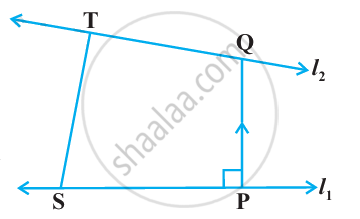
Vector Form:
\[\mathbf{d}=\left|\frac{(\overline{\mathbf{b}}_{1}\times\overline{\mathbf{b}}_{2}).(\overline{\mathbf{a}}_{2}-\overline{\mathbf{a}}_{1})}{\left|\overline{\mathbf{b}}_{1}\times\overline{\mathbf{b}}_{2}\right|}\right|\]
Cartesian Form:
\[\mathbf{d}=\left|\frac{ \begin{vmatrix} x_2-x_1 & y_2-y_1 & z_2-z_1 \\ \mathbf{a}_1 & \mathbf{b}_1 & \mathbf{c}_1 \\ \mathbf{a}_2 & \mathbf{b}_2 & \mathbf{c}_2 \end{vmatrix}}{\sqrt{\left(\mathbf{a}_1\mathbf{b}_2-\mathbf{a}_2\mathbf{b}_1\right)^2+\left(\mathbf{a}_1\mathbf{c}_2-\mathbf{a}_2\mathbf{c}_1\right)^2+\left(\mathbf{b}_1\mathbf{c}_2-\mathbf{b}_2\mathbf{c}_1\right)^2}}\right|\]
\[SD=\left|\frac{\left(a_{2}-a_{1}\right)\times b}{\left|b\right|}\right|\]
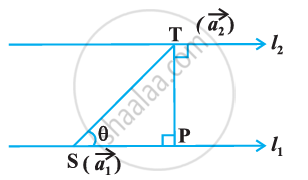
Vector Form:
\[\sin\theta=\left|\frac{\overline{\mathbf{b}}.\overline{\mathbf{n}}}{\left|\overline{\mathbf{b}}\right|.\left|\overline{\mathbf{n}}\right|}\right|\]
Cartesian Form:
\[\mathrm{sin}\theta=\frac{\mathrm{aa}_{1}+\mathrm{bb}_{1}+\mathrm{cc}_{1}}{\sqrt{\mathrm{a}^{2}+\mathrm{b}^{2}+\mathrm{c}^{2}}\sqrt{\mathrm{a}_{1}^{2}+\mathrm{b}_{1}^{2}+\mathrm{c}_{1}^{2}}}\]
Vector Form:
\[\cos\theta=\left|\frac{\overline{\mathbf{n₁}}.\overline{\mathbf{n₂}}}{\left|\overline{\mathbf{n₁}}\right|.\left|\overline{\mathbf{n₂}}\right|}\right|\]
Cartesian Form:
\[\cos\theta=\left|\frac{\mathrm{a}_{1}\mathrm{a}_{2}+\mathrm{b}_{1}\mathrm{b}_{2}+\mathrm{c}_{1}\mathrm{c}_{2}}{\sqrt{\mathrm{a}_{1}^{2}+\mathrm{b}_{1}^{2}+\mathrm{c}_{1}^{2}}\sqrt{\mathrm{a}_{2}^{2}+\mathrm{b}_{2}^{2}+\mathrm{c}_{2}^{2}}}\right|\]
Vector Form:
\[\mathbf{d}=\frac{\left|\left(\overline{\mathbf{a}}.\overline{\mathbf{n}}\right)-\mathbf{p}\right|}{\left|\overline{\mathbf{n}}\right|}\]
Cartesian Form:
\[\mathbf{d}=\left|\frac{\mathbf{a}x_{1}+\mathbf{b}y_{1}+\mathbf{c}z_{1}+\mathbf{d}}{\sqrt{\mathbf{a}^{2}+\mathbf{b}^{2}+\mathbf{c}^{2}}}\right|\]
If a plane at a distance p from the origin and a unit normal \[\hat{n}\]
\[\overline{r}\cdot\hat{n}-p=0\]
Cartesian normal form:
lx + my + nz = p
Normals: n1, n2
\[\cos\theta=\left|\frac{\overline{n}_1\cdot\overline{n}_2}{\left|\overline{n}_1\right|\cdot\left|\overline{n}_2\right|}\right|\]
If line direction vector = b
Plane normal = n
\[\sin\theta=\left|\frac{\overline{b}\cdot\overline{n}}{\left|\overline{b}\right|\cdot\left|\overline{n}\right|}\right|\]
Lines:
\[\overline{r}=\overline{a}_{1}+\lambda_{1}\overline{b}_{1}\]
\[\overline{r}=\overline{a}_2+\lambda_2\overline{b}_2\]
Condition for Coplanarity:
\[\left(\overline{a}_{2}-\overline{a}_{1}\right)\cdot\left(\overline{b}_{1}\times\overline{b}_{2}\right)=0\]
Cartesian Condition:
\[\begin{vmatrix}
x-x_1 & y-y_1 & z-z_1 \\
a_1 & b_1 & c_1 \\
a_2 & b_2 & c_2
\end{vmatrix}=0\]
If line: r = a + λb
Distance of point P(α) from the line:
\[\sqrt{\left|\overline{\alpha}-\overline{a}\right|^2-\left[\frac{\left(\overline{\alpha}-\overline{a}\right)\cdot\overline{b}}{\left|\overline{b}\right|}\right]^2}\]
\[d=\frac{|(a_2-a_1)\cdot(b_1\times b_2)|}{|b_1\times b_2|}\]
\[|(\overline{a_2}-\overline{a_1})\times\hat{b}|\]
Plane:
\[\bar{r}\cdot\hat{n}=p\]
The distance of the origin from the plane = \[\left|p-{\bar{a}}\cdot{\hat{n}}\right|\]
Key Points
| Case | Vector Form | Cartesian Form (Symmetric Form) |
|---|---|---|
| 1. Through a point + parallel to vector | r = a + λb | x = x₁ + lλ y = y₁ + mλ z = z₁ + nλ |
| 2. Through two points | r = a + λ(b − a) | x − x₁ / (x₂ − x₁) = y − y₁ / (y₂ − y₁) = z − z₁ / (z₂ − z₁) |
-
Intersecting lines: SD = 0
-
Parallel lines: \[SD = \frac{|(\vec{a}_2 - \vec{a}_1) \times \vec{b}|}{|\vec{b}|}\]
-
Skew lines: \[SD = \frac{|(\vec{a}_2 - \vec{a}_1) \cdot (\vec{b}_1 \times \vec{b}_2)|}{|\vec{b}_1 \times \vec{b}_2|}\]
| Case | Vector Form | Cartesian Form |
|---|---|---|
| 1. Normal form (given normal vector) | \[\overline{\mathbf{r}}.\hat{\mathbf{n}}=\mathbf{p}\] | ax + by + cz + d = 0 |
| 2. Through a point (x₁, y₁, z₁) | \[\begin{bmatrix} \mathbf{\overline{r}}-\mathbf{\overline{a}} \end{bmatrix}.\mathbf{\overline{n}}=\mathbf{0}\] | a(x−x₁) + b(y−y₁) + c(z−z₁) = 0 |
| 3. Through point + parallel to two vectors | \[\begin{bmatrix} \overline{\mathbf{r}}\overline{\mathbf{b}}\overline{\mathbf{c}} \end{bmatrix}= \begin{bmatrix} \overline{\mathbf{a}}\overline{\mathbf{b}}\overline{\mathbf{c}} \end{bmatrix}\] | \[\begin{vmatrix} x-x_1 & y-y_1 & z-z_1 \\ \mathbf{b}_1 & \mathbf{b}_2 & \mathbf{b}_3 \\ \mathbf{c}_1 & \mathbf{c}_2 & \mathbf{c}_3 \end{vmatrix}=0\] |
| 4. Through three non-collinear points | \[(\mathbf{r-a})\cdot[(\mathbf{b-a})\times(\mathbf{c-a})]=0\] | \[\begin{vmatrix} x-x_1 & y-y_1 & z-z_1 \\ x_2-x_1 & y_2-y_1 & z_2-z_1 \\ x_3-x_1 & y_3-y_1 & z_3-z_1 \end{vmatrix}=0\] |
| 5. Through the intersection of two planes | \[\left(\overline{\mathbf{r}}.\overline{\mathbf{n}}_1-\mathbf{d}_1\right)+\lambda\left(\overline{\mathbf{r}}.\overline{\mathbf{n}}_2-\mathbf{d}_2\right)=0\] | (a₁x + b₁y + c₁z + d₁) + λ(a₂x + b₂y + c₂z + d₂) = 0 |
Equation of a Plane in Intercept form:
\[\frac{x}{a}+\frac{y}{b}+\frac{z}{c}=1\]
Distance of the Plane from Origin is
\[d=\frac{1}{\sqrt{\frac{1}{a^{2}}+\frac{1}{b^{2}}+\frac{1}{c^{2}}}}\]
Condition for Perpendicularity:
\[\overline{\mathbf{b}}=\lambda\overline{\mathbf{n}}\], λ is a parameter
\[\frac{\mathbf{a}_{1}}{\mathbf{a}}=\frac{\mathbf{b}_{1}}{\mathbf{b}}=\frac{\mathbf{c}_{1}}{\mathbf{c}}\]
Condition for Parallelism:
The line is parallel to the plane, if
\[\overline{\mathbf{b}}.\overline{\mathbf{n}}=0\]
aa₁ + bb₁ + cc₁ = 0
Vector Form:
Condition for coplanarity of two lines:
Two lines r = a₁ + λb₁ and r = a₂ + μb₂ are coplanar if
(a₁ − a₂) · (b₁ × b₂) = 0
Equation of the plane containing both lines:
\[\left(\overline{\mathbf{r}}-\overline{\mathbf{a}_1}\right).\left(\overline{\mathbf{b}_1}\times\overline{\mathbf{b}_2}\right)=\mathbf{0}\] or \[\left(\overline{\mathbf{r}}-\overline{\mathbf{a}_2}\right).\left(\overline{\mathbf{b}_1}\times\overline{\mathbf{b}_2}\right)=\mathbf{0}\]
Cartesian Form:
\[\begin{vmatrix} x_2-x_1 & y_2-y_1 & z_2-z_1 \\ \mathbf{a}_1 & \mathbf{b}_1 & \mathbf{c}_1 \\ \mathbf{a}_2 & \mathbf{b}_2 & \mathbf{c}_2 \end{vmatrix}=0\]
1.Line through point \[\mathrm{A}(\overline{a})\] and parallel to vector b
\[\overline{r}=\overline{a}+\lambda\overline{b}\]
2. line passing through two points \[\mathrm{A}(\bar{a})\] and \[\mathrm{B}(\bar{b})\]
\[\overline{r}=\overline{a}+\lambda(\overline{b}-\overline{a})\]
1.Through point \[\mathrm{A}(\overline{a})\] and normal vector n
\[\overline{r}\cdot\overline{n}=\overline{a}\cdot\overline{n}\]
2. Cartesian Form
\[a\left(x-x_{1}\right)+b(y-y_{1})+c(z-z_{1})=0\]
3. Plane Through Three Non-Collinear Points
Vector Form:
\[\left(\overline{r}-\overline{a}\right)\cdot\left(\overline{b}-\overline{a}\right)\times\left(\overline{c}-\overline{a}\right)=0\]
Cartesian form:
\[\begin{vmatrix}
x-x_1 & y-y_1 & z-z_1 \\
x_2-x_1 & y_2-y_1 & z_2-z_1 \\
x_3-x_1 & y_3-y_1 & z_3-z_1
\end{vmatrix}=0\]
1.Through A(x1, y1, z1) with direction ratios a, b, c
\[\frac{x-x_1}{a}=\frac{y-y_1}{b}=\frac{z-z_1}{c}\]
- \[x=x_1+\lambda a\]
- \[y=y_1+\lambda b\]
- \[z=z_1+\lambda c\]
2. Through two points A(x₁,y₁,z₁), B(x₂,y₂,z₂)
\[\frac{x-x_1}{x_2-x_1}=\frac{y-y_1}{y_2-y_1}=\frac{z-z_1}{z_2-z_1}\]
Important Questions [19]
- Find the vector equation of a line passing through the point i^+2j^+3k^ and perpendicular to the vectors i^+j^+k^ and 2i^-j^+k^.
- The foot of the perpendicular drawn from the origin to a plane is M(1, 2, 0). Find the vector equation of the plane.
- Find the cartesian equation of the plane passing through the point A(–1, 2, 3), the direction ratios of whose normal are 0, 2, 5.
- Find the vector equation of the line passing through the point having position vector k4i^-j^+2k^ and parallel to the vector -2i^-j^+k^.
- Find the cartesian equation of the plane passing through A(1, 2, 3) and the direction ratios of whose normal are 3, 2, 5.
- Find the Co-ordinates of the Point, Which Divides the Line Segment Joining the Points A(2, − 6, 8) and B(− 1, 3, − 4) Externally in the Ratio 1 : 3
- If the Lines (x-1)/2=(y+1)/3=(z-1)/4 and (x-3)/1=(y-k)/2=z/1 Intersect Each Other Then Find Value of K
- Find the length of the perpendicular drawn from the point P(3, 2, 1) to the line λr¯=(7i^+7j^+6k^)+λ(-2i^+2j^+3k^)
- If the lines (x-1)/-3=(y-2)/(2k)=(z-3)/2 and (x-1)/(3k)=(y-5)/1=(z-6)/-5 are at right angle then find the value of k
- Find the shortest distance between the lines (x+1)/7=(y+1)/(-6)=(z+1)/1 and (x-3)/1=(y-5)/(-2)=(z-7)/1
- Find the Shortest Distance Between the Lines r=(4i-j)+λ(i+2j-3k) and r=(i-j+2k)+μ(i+4j-5k)
- Find the Angle Between the Planes r(2i+j-k)=3
- The Acute Angle Between the Two Planes 2 3 X Y Z and 3 2 2 7 X
- Show that the lines (x+1)/-3=(y-3)/2=(z+2)/1; are coplanar. Find the equation of the plane containing them.
- Lines λr¯=(i^+j^-k^)+λ(2i^-2j^+k^) and μr¯=(4i^-3j^+2k^)+μ(i^-2j^+2k^) are coplanar. Find the equation of the plane determined by them.
- Show that the points (1, –1, 3) and (3, 4, 3) are equidistant from the plane 5x + 2y – 7z + 8 = 0
- Find the Distance of the Point (1, 2, –1) from the Plane X - 2y + 4z - 10 = 0 .
- Find the equation of the planes parallel to the plane x + 2y+ 2z + 8 =0 which are at the distance of 2 units from the point (1,1, 2)
- How that the Points (1, 1, 1) and (-3, 0, 1) Are Equidistant from the Plane r(3i+4j-12k)+13=0
