Definition: Gravitation
"Every particle of matter in the universe attracts every other particle with a force directly proportional to the product of their masses and inversely proportional to the square of the distance between them. The direction of the force is along the line joining the particles."
or
The force by which the Earth attracts objects towards its centre is called gravitational force.
OR
The force of mutual attraction that any two objects in the universe exert on each other, which is directly proportional to the product of their masses and inversely proportional to the square of the distance between their centres, is called the gravitational force.
Definition: Universal Law of Gravitation
"Every particle of matter attracts every other particle of matter with a force which is directly proportional to the product of their masses and inversely proportional to the square of the distance between them."
Define acceleration due to gravity.
The acceleration produced in a body due to the gravitational force of the earth is called the acceleration due to gravity.
Definition: Acceleration Due to Gravity
The gravitational force due to the earth on a body results in its acceleration. This is called acceleration due to gravity and is denoted by ‘g’.
OR
When a body falls towards the Earth under gravity, then the acceleration produced in the body due to gravity is called acceleration due to gravity, which is denoted by g.
Definition: Mass
Mass is the amount of matter present in the object. The SI unit of mass is kg.
Definition: Weight
The weight of an object is defined as the force with which the earth attracts the object.
Definition: Gauge Pressure
The difference between the hydrostatic pressure (P) and the atmospheric pressure (P₀), measured by a manometer, is called gauge pressure: P − P0 = ρgh
The force which produces compression is called thrust. Its S.I unit is the newton.
Definition: Density
The mass per unit volume of a substance is called density: ρ = M/V
Definition: Specific Weight or Weight Density
The weight per unit volume of a substance is called specific weight or weight density: W = mg/V
Definition: Relative Density
The ratio of the density of a given fluid to the density of pure water at 4°C is called relative density. It is a unitless quantity.
Definition: Pressure
The thrust (Normal Force) exerted by a liquid at rest on unit area of the surface in contact is called pressure.
P = \[\frac {F_⊥}{A}\]
Definition: Gauge Pressure
The difference between the absolute pressure and the atmospheric pressure at a point in a liquid is called gauge pressure.
Definition: Earth's Atmosphere
The gaseous envelope surrounding the earth is called the earth's atmosphere.
Definition: Atmospheric Pressure
The pressure exerted by the atmosphere on the earth's surface is called atmospheric pressure.
Definition: Absolute Pressure
The total pressure exerted by a fluid, which includes both the atmospheric pressure as well as any other additional pressure due to the fluid itself, is called absolute pressure.
Definition: Hydrostatic Paradox
The phenomenon in which the liquid pressure at a point is independent of the quantity of liquid and depends only upon the depth of the point below the liquid surface is called hydrostatic paradox.
What is the unit of relative density?
UNIT OF RELATIVE DENSITY: No units since it is a pure ratio.
Define the term relative density of a substance.
RELATIVE DENSITY: “is the ratio of the density of a substance to the density of water at 4° C.”
Or
RELATIVE DENSITY “is the ratio of the mass of the substance to the mass of an equal volume of water at 4° C.”
Define the term Density of a substance.
Density of a substance is defined as “Mass per Unit volume”.
Density [d]=`"mass of the substance"/"volume of the substance"`
d=`m/v`
Formula: Universal Law of Gravitation
The gravitational force of attraction (F) between two bodies of mass m1 and m2 separated by a distance r is:
\[\mathbf{F} = \mathbf{G}\frac{m_1 m_2}{r^2}\]
- F: Gravitational Force of attraction (in Newtons, N).
- \[m_1, m_2\]: Masses of the two objects (in kilograms, kg).
- r (or d in the first part): Distance between the two objects (in meters, m).
- G: The constant of proportionality, called the Universal gravitational constant.
- Value in SI units: \[G=6.67\times10^{-11}\mathrm{N}\cdot\mathrm{m}^2/\mathrm{kg}^2\]
- Dimensions: \[[G]=[\mathrm{L}^3\mathrm{M}^{-1}\mathrm{T}^{-2}]\]
Formula: Acceleration due to gravity
The value of the acceleration due to gravity (g) on the surface of the Earth is given by the formula:
Where:
- g = Acceleration due to gravity (in m/s²).
- G = Newton's Universal Gravitational Constant (≈ 6.67 × 10⁻¹¹ N · m² / kg²).
- M = Mass of the Earth (≈ 6 × 1024 kg).
- R = Radius of the Earth (≈ 6.4 × 10⁶ m).
Formula: Atmospheric Pressure Value
1 atm = 1.01 × 10⁵ Pa = 1.01 bar = 760 torr
Formula: Gauge Pressure Relation
Pgauge = Pabsolute − Patmospheric
Write the answer of the question with reference to laws of gravitation.
State the universal law of gravitation.
The universal law of gravitation states that every object in the universe attracts every other object with a force called the gravitational force. The force acting between two objects is directly proportional to the product of their masses and inversely proportional to the square of the distance between their centres.
F ∝ m M (masses of two bodies m and M)
F ∝ `1/"d"^2` (d is the distance between the two bodies.)
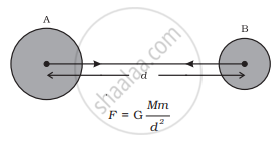
A and B are two bodies, the distance between which is given as d.
F = force with which one body is attracting the other.
G = proportionality constant.
Law: Universal Law of Gravitation
Statement:
The law which states that every particle of matter attracts every other particle in the universe with a force whose magnitude is directly proportional to the product of masses and inversely proportional to the square of the distance between them is called Newton's Law of Gravitation.
Derivation:
Newton's Universal Law of Gravitation states that every particle of matter attracts every other particle of matter with a force which is the following:
- Directly proportional to the product of their masses: F ∝ m₁ ⋅ m₂
- Inversely proportional to the square of the distance between them: F ∝ \[\frac {1}{r^2}\]
Combining both, the gravitational force is expressed as follows:
F = G\[\frac{m_1m_2}{r^2}\]
where G is the universal gravitational constant, measured by Henry Cavendish using the Cavendish balance, with the value:
G = 6.67 × 10⁻¹¹ Nm2/kg2
