English

Revision: Gravitation JEE Main Gravitation

Advertisements

Definitions [7]

Definition: Gravitation

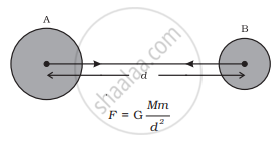
"Every particle of matter in the universe attracts every other particle with a force directly proportional to the product of their masses and inversely proportional to the square of the distance between them. The direction of the force is along the line joining the particles."

or

The force by which the Earth attracts objects towards its centre is called gravitational force.

Definition: Universal Law of Gravitation

"Every particle of matter attracts every other particle of matter with a force which is directly proportional to the product of their masses and inversely proportional to the square of the distance between them."

Answer the following question in detail.

What is a critical velocity?

The exact horizontal velocity of projection that must be given to a satellite at a certain height so that it can revolve in a circular orbit round the Earth is called the critical velocity or orbital velocity (vc).

Answer the following question.

Define the binding energy of a satellite.

The minimum energy required by a satellite to escape from Earth’s gravitational influence is the binding energy of the satellite.

Definition: Satellite

The objects that revolve around the Earth are called Earth satellites.

Definition: Binding Energy of Satellite

"The minimum energy required by a satellite to escape from Earth’s gravitational influence is the binding energy of the satellite."

Definition: Escape velocity

"The minimum velocity with which a body should be thrown vertically upwards from the surface of the Earth so that it escapes the Earth’s gravitational field, is called the escape velocity (ve) of the body."

Formulae [7]

Formula: Gravitation

Newton’s Universal Law of Gravitation:
F = \[G\frac{m_1m_2}{r^2}\]

where:

  • F = Gravitational force between two objects
  • m1,m2 = Masses of the two objects
  • r = Distance between the centers of the two masses
  • G = Universal gravitational constant = 6.67×10⁻¹¹ Nm2/kg2
Formula: Kepler's Law

Kepler’s Third Law relates the time period T of a planet’s revolution to the semi-major axis a of its elliptical orbit:
T2 ∝ a3
where,

  • T = time period of revolution of the planet,
  • a = semi-major axis of the elliptical orbit.
Formula: Universal Law of Gravitation

The gravitational force of attraction (F) between two bodies of mass m1 and m2 separated by a distance r is:

\[\mathbf{F} = \mathbf{G}\frac{m_1 m_2}{r^2}\]
  • F: Gravitational Force of attraction (in Newtons, N).

  • \[m_1, m_2\]: Masses of the two objects (in kilograms, kg).

  • r (or d in the first part): Distance between the two objects (in meters, m).

  • G: The constant of proportionality, called the Universal gravitational constant.

    • Value in SI units: \[G=6.67\times10^{-11}\mathrm{N}\cdot\mathrm{m}^2/\mathrm{kg}^2\]

    • Dimensions: \[[G]=[\mathrm{L}^3\mathrm{M}^{-1}\mathrm{T}^{-2}]\]

Formula: Gravity with Altitude

The formulas for acceleration due to gravity (g) are provided below:

On the Earth's Surface:

\[g = \frac{G M}{R^2}\]

At height $h$ above the Earth's Surface:

\[g_h = g \frac{R^2}{(R+h)^2} \quad \text{or} \quad g_h = g \left(I + \frac{h}{R}\right)^{-2}\]

Simplified Formula for Small Altitudes ($h \ll R$):

\[g_h = g \left(1 - \frac{2h}{R}\right)\]

Definition of Terms:

  • g: Acceleration due to gravity on the Earth's surface.
  • gh: Acceleration due to gravity at height h above the Earth's surface.
  • G: Universal Gravitational Constant.
  • M: Mass of the Earth.
  • R: Radius of the Earth.
  • h: Altitude or height above the Earth's surface.
Formula: Gravitational Potential Energy

U(r) = -\[\frac {GMm}{r}\]

Where:

  • U(r) = Gravitational potential energy at distance r from Earth's center
  • G = Universal gravitational constant (6.67 × 10⁻¹¹ N·m²/kg²)
  • M = Mass of Earth (kg)
  • m = Mass of the object (kg)
  • r = Distance between the centers of mass of Earth and object (m)
  • Negative sign = Shows that potential energy is negative (zero at infinity)
Formula: Binding Energy

Where:

  • G = Universal Gravitational Constant
  • M = Mass of the Earth
  • m = Mass of the satellite
  • r = Radius of the orbit (Distance from the center of the Earth)
Formula: Escape velocity

\[v_e=\sqrt{\frac{2GM}{R}}\]

  • ve = Escape velocity (minimum speed needed to escape Earth’s gravity)
  • G = Universal gravitational constant (6.674 × 10⁻¹¹ Nm2/kg2)
  • M = Mass of the Earth (or celestial body)
  • R = Radius of the Earth (or distance from the centre of the mass to the object)

Key Points

Key Points: Newton's Universal Law of Gravitation
  • Every object attracts every other with a gravitational force.
  • Force increases with mass — more mass means a stronger pull.
  • Force decreases with distance — doubling the distance halves the force.
  • A force acts along the line joining the centres (or centres of mass) of the two bodies.
Advertisements
Advertisements
Advertisements
Share
Notifications

Englishहिंदीमराठी


      Forgot password?
Use app×