Formulae [1]
Area = Amount of space inside a flat shape
Theorems and Laws [2]
Theorem: Parallelograms on the same base and between the same parallels are equal in area.
Proof : Two parallelograms ABCD and EFCD, on the same base DC and between the same parallels AF and DC are given in following fig. 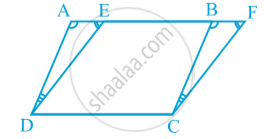
We need to prove that ar (ABCD) = ar (EFCD).
In ∆ ADE and ∆ BCF,
∠ DAE = ∠ CBF (Corresponding angles from AD || BC and transversal AF) (1)
∠ AED = ∠ BFC (Corresponding angles from ED || FC and transversal AF) (2)
Therefore, ∠ ADE = ∠ BCF (Angle sum property of a triangle) (3)
Also, AD = BC (Opposite sides of the parallelogram ABCD) (4)
So, ∆ ADE ≅ ∆ BCF [By ASA rule, using (1), (3), and (4)]
Therefore, ar (ADE) = ar (BCF) (Congruent figures have equal areas) (5)
Now, ar (ABCD) = ar (ADE) + ar (EDCB)
= ar (BCF) + ar (EDCB) [From(5)]
= ar (EFCD)
So, parallelograms ABCD and EFCD are equal in area.
Theorem : Two triangles on the same base (or equal bases) and between the same parallels are equal in area.
Proof: Now, suppose ABCD is a parallelogram whose one of the diagonals is AC (see Fig.).
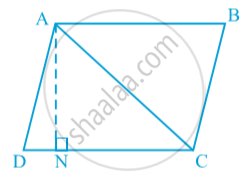
Let AN ⊥ DC. Note that
∆ ADC ≅ ∆ CBA
So, ar (ADC) = ar (CBA)
Therefore, ar (ADC) = `1/2` ar (ABCD)
=`1/2` (DC × AN)
So, area of ∆ ADC = `1/2` × base DC × corresponding altitude AN
In other words, area of a triangle is half the product of its base (or any side) and the corresponding altitude (or height).
The two triangles with same base (or equal bases) and equal areas will have equal corresponding altitudes.
