Definitions [40]
The study of electricity/electric charges at rest is called electrostatics.
The closed surface over which the surface integral of the electric field intensity (i.e. total electric flux) is considered in Gauss' Law is called a Gaussian surface.
The different energy levels with continuous energy variation are called energy bands.
The range of energies possessed by valence electrons is called valence band.
The range of energies possessed by conduction electrons is called conduction band.
The energy difference between the valence band and the conduction band is called forbidden energy gap.
The solids which have very small number of free electrons are called insulators. (e.g. Glass, Wood)
The solids which have a large number of free electrons are called conductors. (e.g. Iron, Aluminium)
The material with electrical conductivity between that of a conductor and an insulator, whose number of charge carriers can be controlled as per requirement, is called a semiconductor. (e.g. Silicon, Germanium)
The process of charging a neutral conductor without any direct contact with a charged object, by redistributing charges within the conductor through electrostatic influence.
A time-dependent combination of electric and magnetic fields that propagates through space and can transport energy is called an electromagnetic field.
Electric Field \[\vec E\] at a point is the electrostatic force \[\vec F\] experienced by a vanishingly small positive test charge q0 placed at that point:
\[\vec E\] = \[\frac {\vec F}{q_0}\]
| Quantity | Symbol | SI Unit |
|---|---|---|
| Electric Field | \[\vec E\] | N C⁻¹ or V m⁻¹ |
| Force | \[\vec F\] | Newton (N) |
| Test Charge | q0 | Coulomb (C) |
The charge per unit area on a surface, is called surface charge density.
A charge distribution in which charge is treated as continuously spread over a line, surface, or volume (ignoring microscopic discreteness), is called continuous charge distribution.
When charge is distributed over the volume of an object, it is called volume charge distribution.
OR
The volume charge density ρρ is the charge per unit volume at any point inside the body.
When charge is distributed over a surface, the charge distribution is called surface charge distribution.
OR
The surface charge density σσ is the charge per unit area at any point on the surface.
The charge per unit length along a line (such as a wire), is called linear charge density.
OR
When charge is distributed along a line, the charge distribution is called linear charge distribution.
The charge per unit volume in a region of space, is called volume charge density.
OR
When charge is distributed over the volume of an object, it is called volume charge distribution.
When charge is distributed along a line, the charge distribution is called a linear charge distribution.
OR
The linear charge density λ is the charge per unit length at any point on the line.
A Gaussian surface is an imaginary, closed mathematical surface chosen to apply Gauss's Law conveniently.
Electrostatic potential at a point is the work done by an external agent in bringing a unit positive test charge slowly from infinity to that point without acceleration.
The potential difference between two points P and R is the work done by an external force in moving a unit positive test charge from one point to the other.
The work done by an external agent in bringing a unit positive test charge slowly from infinity to a point in an electric field, against the electrostatic force, is called the electric potential at that point.
The electrostatic force is a conservative force — the work done in moving a charge between two points is independent of the path and depends only on the initial and final positions. This is why the potential energy is well-defined.
The electrostatic potential energy of a system of charges is defined as the work done by an external agent in assembling the charges at their respective positions, bringing each charge from infinity, without any kinetic energy being imparted.
- Symbol: U
- SI Unit: Joule (J)
- Nature: Scalar quantity
- Reference: U = 0 when all charges are at infinity
The potential energy of a charge q placed at a point with external electric potential V(r) is equal to the work done in bringing the charge from infinity to that point against the external field.
The condition in which charges in a conductor are at rest, and no further motion of charges occurs.
A conductor in electrostatic equilibrium is an equipotential body, meaning all points on it are at the same electric potential.
Surface charge density is the charge per unit area on the surface of a conductor and is denoted by \[\sigma\].
The phenomenon in which the electric field inside a cavity of a conductor is zero, irrespective of external charges or fields, is called electrostatic shielding.
The ability of a conductor to store charge is called the capacity of conductor.
A system consisting of two conductors having equal and opposite charges separated by an insulator or dielectric is called a capacitor.
The maximum electric field that a dielectric medium can withstand without breakdown (of its insulating property) is called its dielectric strength.
The ratio of the charge Q given to one of the conductors of a capacitor to the potential difference V between the conductors is called its capacitance, given by C = Q/V.
A capacitor that consists of two large, parallel, conducting plates separated by a small distance is called a parallel plate capacitor.
The maximum electric field a dielectric can withstand before it breaks down (becomes conducting). Measured in V/m. Example: Air ≈ 3 × 10⁶ V/m.
The process by which the molecules of a dielectric develop induced dipole moments when placed in an external electric field. The induced dipole moments align opposite to the field, creating an opposing induced field EP.
A dielectric is a non-conducting (insulating) material in which charges are bound to their atoms/molecules and cannot move freely. When placed in an external electric field, the molecules of the dielectric get polarised — they develop induced dipole moments that partially oppose the external field.
The product of vacuum permittivity and dielectric constant of the medium.
ε = ε₀K
The ratio of the permittivity of a medium to the permittivity of vacuum.
K = ε / ε₀
OR
Dielectric constant is the factor by which the capacitance of a capacitor increases when a dielectric is completely inserted between its plates.
Formulae [18]
For a system of n point charges q1, q2, q3,…, qn, the total electric field at point P is:
E(r) = \[{\frac{1}{4\pi\varepsilon_0}\sum_{i=1}^n\frac{q_i}{r_{iP}^2}\hat{\mathbf{r}}_{iP}}\]
Symbol Reference
| Symbol | Meaning |
|---|---|
| E(r) | Resultant electric field at point P |
| qi | The i-th source charge in the system |
| riP | Distance from charge qi to point P |
| \[\hat r_i\]P | Unit vector directed from qi toward point P |
| ε0 | Permittivity of free space |
| \[\frac {1}{4πε_0}\] | Coulomb's constant ≈ 9 × 10⁹ Nm²C⁻² |
| Expression | Formula | Condition |
|---|---|---|
| Magnitude of Torque | τ = pE sin θ | θ = angle between \[\vec p\] and \[\vec E\] |
| Vector form | \[\vec τ\] = \[\vec p\] × \[\vec E\] | Cross product |
| Maximum Torque | τmax = pE | When θ = 90° |
| Minimum Torque | τmin = 0 | When θ = 0° or 180° |
ρ = \[\frac {ΔQ}{ΔV}\] ⇒ dq = ρ dV
where ΔQ is the charge distributed over a small volume ΔV of the material.
- SI Unit: C m⁻³ (coulomb per cubic metre)
- Nature: Scalar quantity
\[\vec{E}=\frac{1}{4\pi\varepsilon_0}\sum\frac{\rho\Delta V}{r^{\prime2}}\hat{r}^{\prime}\]
λ = \[\frac {ΔQ}{Δl}\] ⇒ dq = λdl
where ΔQ is the charge distributed over a small length Δl of the wire.
- SI Unit: C m⁻¹ (coulomb per metre)
- Nature: Scalar quantity
σ = \[\frac {ΔQ}{ΔS}\] ⇒ dq = σ dS
where ΔQ is the charge distributed over a small surface area ΔS.
- SI Unit: C m⁻² (coulomb per square metre)
- Nature: Scalar quantity
If the work done in bringing charge q from infinity to point P is W, then
VP = \[\frac {W}{q}\]
If the potential energies at points P and R are UP and UR, then
\[V_P-V_R=\frac{U_P-U_R}{q}\]
\[V(r)=\frac{1}{4\pi\varepsilon_0K}\frac{q}{r}\]
- V(r) = electric potential at distance rr from the charge
- q = source charge
- ε0 = permittivity of free space
- K = dielectric constant of medium
- Reference is taken such that V(∞) = 0.
\[V=\frac{1}{4\pi\varepsilon_{0}}\left[\frac{q_{1}}{r_{1}}+\frac{q_{2}}{r_{2}}+\frac{q_{2}}{r_{3}}+\frac{q_{4}}{r_{4}}+.........+\frac{q_{n}}{r_{n}}\right]\]
\[V=\frac{1}{4\pi\varepsilon_0}\sum_{i=1}^{i=n}\frac{q_i}{r_i}\]
U(r) = qV(r)
where:
- U(r) = Potential energy of the charge at position r (in Joules, J)
- q = Charge of the particle (in Coulombs, C)
- V(r) = External electric potential at position r (in Volts, V)
- r = Position vector of the point from the origin
| Quantity | Symbol | SI Unit | Dimensional Formula |
|---|---|---|---|
| Potential Energy | U | Joule (J) | [ML2T−2] |
| Charge | q | Coulomb (C) | [AT] |
| Electric Potential | V | Volt (V) | [ML2T−3A−1] |
For a dipole making an angle θ with a uniform electric field:
τ = pE sin θ
In vector form: τ = p × E
This torque rotates the dipole toward the field direction.
\[\vec{E}=\frac{\sigma}{\varepsilon_0}\hat{n}\]
where
- σ = surface charge density
- \[\hat n\] = outward normal unit vector
- \[\varepsilon_0\] = permittivity of free space.
Magnitude form:
E = \[\frac{\sigma}{\varepsilon_0}\]
Vector form:
\[\vec{E} = \frac{\sigma}{\varepsilon_0}\hat{n}\]
C = \[\frac {2πkε₀ l}{2.303 log(b/a)}\]
C = 4πkε₀ · [\[\frac {ab}{(b − a)}\]]
C = Q/V
For two plates separated by distance d:
\[C=\frac{\varepsilon_0A}{d}\]
With a dielectric medium:
\[C=\frac{K\varepsilon_0A}{d}\]
| Quantity | Without Dielectric | With Dielectric (Full Slab, (K)) |
|---|---|---|
| Electric Field | E0 = \[\frac {σ}{ε_0}\] | E0 = \[\frac {E_0}{K}\] |
| Potential Difference | V0 = E0d | V = \[\frac {V_0}{K}\] |
| Capacitance | C0 = \[\frac {ε_0A}{d}\] | C = KC0 = \[\frac {ε_0KA}{d}\] |
| Permittivity | ε0 | ε = Kε0 |
| Stored Energy (for constant charge) | U0 = \[\frac {Q^2}{2C_0}\] | U = \[\frac {U_0}{K}\](Q constant) |
Theorems and Laws [3]
"The electric field at any point due to a group of charges is the vector sum of the electric fields at that point due to each individual charge, calculated as if the other charges were not present."
- Each charge in the system contributes its own independent electric field at the point of interest.
- These individual fields are then added vectorially to give the total (resultant) field.
State Gauss’s law on electrostatics and drive expression for the electric field due to a long straight thin uniformly charged wire (linear charge density λ) at a point lying at a distance r from the wire.
Gauss' Law states that the net electric flux through any closed surface is equal to `1/epsilon_0` times the net electric charge within that closed surface.
`oint vec" E".d vec" s" = (q_(enclosed))/epsilon_o`
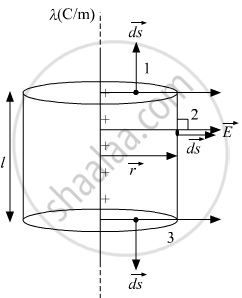
In the diagram, we have taken a cylindrical gaussian surface of radius = r and length = l.
The net charge enclosed inside the gaussian surface `q_(enclosed) = lambdal`
By symmetry, we can say that the Electric field will be in radially outward direction.
According to gauss' law,
`oint vec"E".d vec"s" = q_(enclosed)/epsilon_o`
`int_1 vec"E" .d vec"s" + int_2 vec"E" .d vec"s" + int_3 vec"E". d vec"s" = (lambdal)/epsilon_o`
`int_1 vec"E". d vec"s" & int_3 vec"E". d vec"s" "are zero", "Since" vec"E" "is perpendicular to" d vec"s"`
`int_2 vec"E" . d vec"s" = (lambdal)/epsilon_o`
`"at" 2, vec"E" and d vec"s" "are in the same direction, we can write"`
`E.2pirl = (lambdal)/epsilon_o`
`E = lambda/(2piepsilon_o r)`
"The total electric flux through any closed surface is equal to \[\frac {1}{ε_0}\] times the net charge enclosed by that surface."
Three Forms of the Law
1. Verbal Form:
The net outward electric flux through a closed surface equals the net enclosed charge divided by ε₀.
2. Algebraic Form:
ΦE = \[\frac {Q_enc}{ε_0}\]
3. Integral Form:
\[\oint\vec{E}\cdot d\vec{S}=\frac{Q_{\mathrm{enc}}}{\varepsilon_0}\]
Variable Legend
| Symbol | Meaning | SI Unit |
|---|---|---|
| ∮ | Closed surface integral | — |
| E | Electric field at the surface | N C⁻¹ |
| dS | Area element vector (outward normal) | m² |
| Qenc | Net charge enclosed by the surface | Coulomb (C) |
| ε0 | Permittivity of free space = 8.85 × 10⁻¹² C² N⁻¹ m⁻² | C² N⁻¹ m⁻² |
Key Points
- Conductors → Eg = 0 - bands overlap, electrons flow freely.
- Semiconductors → Eg < 3 eV — small gap, conducts at room temperature.
- Insulators → Eg > 5 eV — large gap, no conduction.
- Ge = 0.72 eV, Si = 1.1 eV — both semiconductors.
- Metal conductivity decreases with temp. Semiconductor conductivity increases with temp.
- Induction charges a conductor without contact, via internal charge redistribution.
- The conductor always acquires a charge opposite in sign to the inducing charge.
- Order of operations matters: ground → disconnect earth → remove charged object.
- Charging by induction is permanent only if grounding is done correctly.
- Distinguish clearly from conduction (contact, same-sign charge) and friction (rubbing, opposite charges on two bodies).
- The resultant field E is the vector sum of all individual fields.
- Each individual field Ei is calculated independently, as if no other charges exist.
- The unit vector \[\hat r_i\]P points from each charge qi toward point P.
- The principle holds for any number of charges in any configuration.
- This is a direct application of the Superposition Principle to electric fields.
- \[\vec E\] = \[\vec F\]/q0 — force per unit positive test charge
- Static case → Coulomb's Law is sufficient; field is a descriptive tool
- Accelerated charges → field becomes a real physical entity (EM waves)
- Time delay = d/c — information travels at the speed of light, not instantaneously
- An electric field carries and transports energy
- Field exists independently of whether any test charge is present
- Gravity is negligible for charged particles in typical electric fields
- Applicable to any closed surface, regardless of shape or size — sphere, cube, irregular shape
- Only enclosed charges contribute to the net flux; external charges do not
- The electric field E at the Gaussian surface is due to all charges (inside and outside), but the net flux depends only on enclosed charge
- Gauss's Law is valid for both stationary and moving charges
- It is one of Maxwell's four equations of electromagnetism
- Gauss's Law can be derived from Coulomb's Law for static charges, and vice versa — both are equivalent
- If net enclosed charge = 0, net flux = 0 (but E ≠ 0 necessarily)
- Electric potential at a point is the work done per unit positive test charge in bringing it slowly from infinity to that point, against the electric field.
- For a point charge q in air/vacuum:
V(r) = \[\frac{1}{4\pi\varepsilon_0}\frac{q}{r}\] - In a medium of dielectric constant K:
V(r) = \[\frac{1}{4\pi\varepsilon_0K}\frac{q}{r}\] - Positive charge produces positive potential; negative charge produces negative potential.
- Potential due to a point charge is spherically symmetric and depends only on distance r.
- Distance dependence:
F ∝ 1/r2, E ∝ 1/r2, V ∝ 1/r. - The potential at infinity is taken as zero; only potential differences are physically significant.
- The electrostatic field is conservative, so the work done in moving a charge between two points is path independent.
- Capacitance depends on the geometry (shape, size, separation) of the conductors and on the dielectric between them.
- In a series, the charge on each capacitor is the same, but the voltage across each is different.
- A series combination divides high voltage — the capacitor with the smallest capacitance gets the largest P.D., and it cannot store much charge.
- In parallel, the voltage across each capacitor is the same, but the charge on each is different, and it handles only low voltage.
- A parallel combination is used when a large capacitance at low potential is needed, as it can store a large amount of charge.
Concepts [23]
- Concept of Electrostatics
- Electrical Conduction in Solids
- Charging by Induction
- Electric Field Due to a System of Charges
- Physical Significance of Electric Field
- Dipole in a Uniform External Field
- Continuous Charge Distribution
- Gauss’s Law
- Uniformly Charged Infinite Plane Sheet and Uniformly Charged Thin Spherical Shell (Field Inside and Outside)
- Electrostatic Potential
- Electric Potential Due to a Point Charge
- Relation Between Electric Field and Electrostatic Potential
- Potential Energy of a System of Charges
- Potential Energy in an External Field
- Potential Energy of a Single Charge
- Potential Energy of a System of Two Charges in an External Field
- Potential Energy of a Dipole in an External Field
- Electrostatics of Conductors
- Capacitors and Capacitance
- The Parallel Plate Capacitor
- Effect of Dielectric on Capacitance
- Work Done in Carrying a Charge
- Grouping of Capacitor
