Definitions [10]
A semiconductor diode is a two-terminal p-n junction device that allows current to pass easily in one direction and offers high resistance in the opposite direction.
With reference to a semiconductor diode, define the potential barrier.
The barrier that the repelling forces use to stop the mobile charge carriers (at the PN junction) is known as the potential barrier.
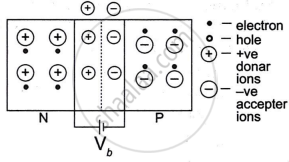
This results from the concentration of immobile charges close to the junction after electrons and holes diffuse across the function.
In semiconductor physics, what is meant by:
(i) rectifier
(ii) an amplifier
(iii) an oscillator
(i) Rectifier: It is a device which converts alternating current into direct current.
(ii) Amplifier: An amplifier is a device which increases the energy of a weak signal by supplying energy from an external source. An amplifier increases the amplitude of a input signal.
(iii) Oscillator: An oscillator is a device which produces electrical oscillations of adjustable frequency and constant amplitude. An oscillator is basically an amplifier. A part of the output energy is fed back into the L-C circuit to produce sustained oscillations.
With reference to a semiconductor diode, define the depletion region.
A semiconductor diode's depletion zone is the area surrounding the p-n junction where there are no mobile charge carriers, this area generates an electric field that allows the diode to conduct in one direction while blocking in another.
- The electronic circuit which rectifies AC voltage is called a Rectifier.
- The device used to convert an alternating current into a direct current is called a rectifier.
A basic semiconductor device that controls the flow of electric current in a circuit, which when forward biased behaves as a closed circuit and when reverse biased behaves as an open circuit, is called a p-n Junction Diode.
- The conversion of AC voltage into a DC voltage is called Rectification.
- The process of converting an alternating current into a direct current is called rectification.
What is a solar cell?
It is a semiconductor device used to convert photons of solar light into electricity. It generates emf when solar radiation falls on the p-n junction. A p-type silicon wafer of about 300 μm is taken over which a thin layer of n-type silicon is grown on one side by the diffusion process.

A special purpose junction diode that converts light energy into electrical current, works on the principle of the photoelectric effect, operates in reverse bias, and generates a current when exposed to light (proportional to the intensity of incident light), is called a Photodiode.
A unique form of a bipolar device which permits the current flow in the reverse direction when the voltage applied is above a certain characteristic value called Zener voltage or breakdown voltage, most commonly used in voltage regulators to protect other semiconductor devices from fluctuations in voltage, is called a Zener Diode.
Formulae [5]
\[R=\frac{V_{IN}-V_{OUT}}{I_Z+I_L}\]
\[I_L=\frac{V_s-V_Z}{R_s}\quad\mathrm{or}\quad I_L=I_S+I_Z\]
\[V_{OUT}=V_{IN}-I_R=V_{IN}-(I_Z+I_L)R\]
\[I_{Z_{max}}=\frac{P_{max}}{V_Z}\]
Where \[P_{max}\] = power dissipation capability of Zener diode.
\[I=I_Z+I_L\]
Key Points
| Aspect | Conductors | Insulators | Semiconductors |
|---|---|---|---|
| Band gap | None (bands overlap) | Large (~10 eV) | Small (~1 eV) |
| Electron transition | Free movement | Not possible easily | Possible with small energy |
| Energy requirement | None | Very high | Low |
| Energy Band Structure | 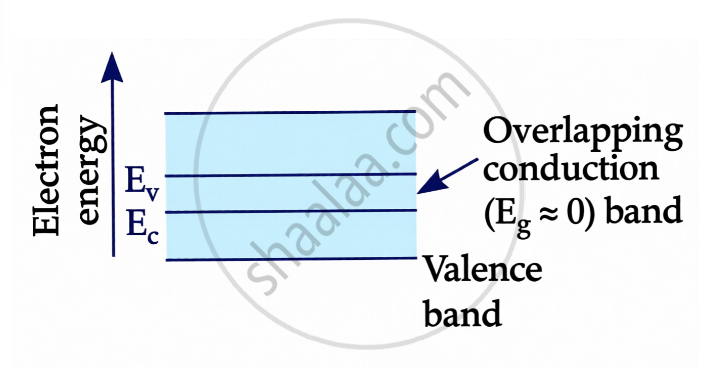 |
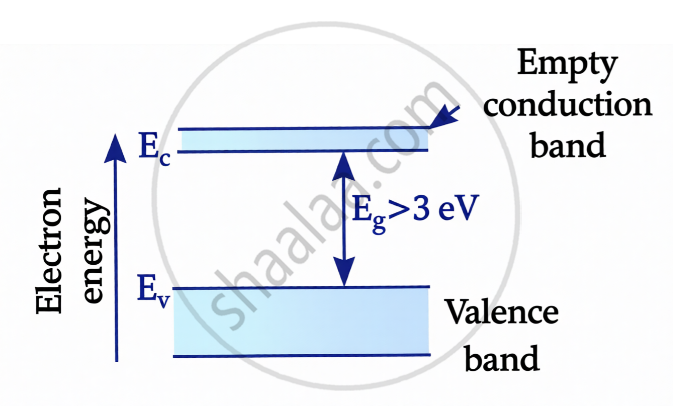 |
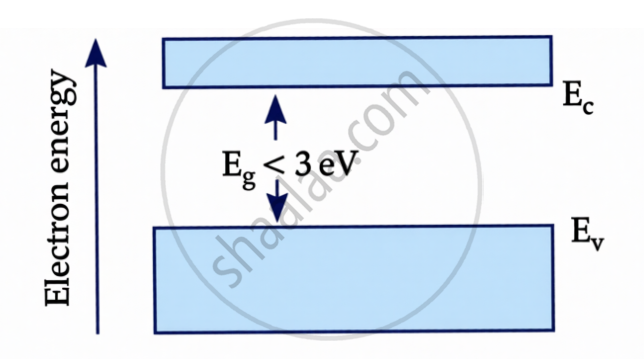 |
- A rectifier is a circuit which converts an AC supply into a unidirectional DC supply.
- A p-n junction diode acts as a rectifier because it allows current to flow in one direction only.
- The bridge rectifier circuit uses semiconductor diodes for converting AC, as it allows current to flow in one direction only.
- Input to the rectifier is AC \[(V_{IN})\]; output is DC \[(V_{OUT})\] — shown as a full-wave rectified signal.
- Rectification is the fundamental principle behind power supply circuits in electronic devices.
- A Zener diode maintains a constant voltage across the load as long as the supply voltage is more than the Zener voltage.
- If the input voltage increases, the current through the Zener diode increases while the voltage drop remains constant.
- In the Zener regulator circuit,\[R_s \] is used to limit reverse current through the diode to a safer value \[V_s\], and \[R_s \] is selected so the diode operates in the breakdown region.
- When IZIZ becomes zero, IZIZ reaches its maximum value - at that case \[R=\frac{V_{IN}-V_{OUT}}{I_{Z_{max}}}\].
- Voltage regulator IC (e.g. LM7805) is a special three-terminal device: Pin 1 = \[V_{IN}\], Pin 2 = GND, Pin 3 = +5V regulated output.
- The voltage regulator has been designed to act as an ideal battery.
Concepts [12]
- Energy Bands in Materials
- Semiconductor Diode
- p-n Junction Diode as a Rectifier
- Special Purpose P-n Junction Diodes
- Voltage Regulator
- Junction Transistor
- Feedback Amplifier and Transistor Oscillator
- Transistor Action
- Transistor and Characteristics of a Transistor
- Transistor as an Amplifier (Ce-configuration)
- Digital Electronics and Logic Gates
- Transistor as a Switch
