Definitions [3]
A secant is a straight line that passes through the circle and intersects it at two distinct points.

line AB cuts the circle at points M and N ⇒ AB is a secant.
A tangent is a straight line that touches a circle at exactly one point only, without cutting through it. This single point where the tangent touches the circle is called the point of contact or point of tangency.
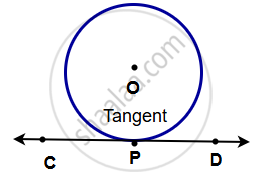
Line CD touches the circle at point P only ⇒ CD is a tangent
Point P is the point of contact.
The locus of the point of intersection of two perpendicular tangents to a given circle is known as the director circle.
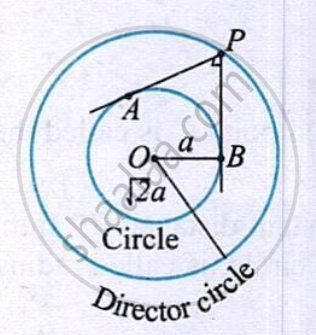
For circle:
x² + y² = a²
Director circle is:
x² + y² = 2a²
Theorems and Laws [2]
Statement: The tangent at any point of a circle is perpendicular to the radius through the point of contact.
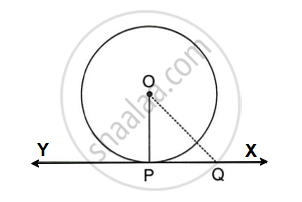
Given: A circle with centre O and a tangent XY touching the circle at P.
To Prove:
Proof:
-
Since XY is a tangent, it touches the circle only at P.
-
Point Q lies on the tangent XY and Q ≠ P, so Q lies outside the circle.
- Therefore, the distance OQ is greater than the radius OP.
OQ > OP -
This is true for every point Q on the line XY except P.
Hence, OP is the shortest distance from O to the line XY. - The shortest distance from a point to a line is perpendicular to the line.
Therefore, OP⊥XY
Statement: The lengths of tangents drawn from an external point to a circle are equal.
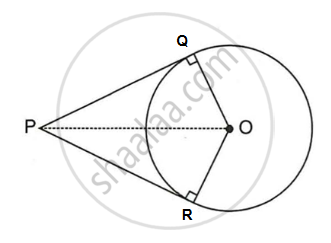
Given: A circle with centre O and two tangents PQ and PR drawn from an external point P.
To Prove: PQ = PR
Proof:
-
Join OP, OQ and OR.
-
Radius is perpendicular to the tangent at the point of contact, so
∠OQP = ∠ORP = 90∘ -
OQ = OR (radii of the same circle).
-
OP = OP (common).
-
Therefore, △OQP ≅ △ORP (RHS).
- Hence, PQ = PR
Key Points
| Case | Condition | Equation |
|---|---|---|
| Touches X-axis | Radius = y-coordinate (k) | (x − h)² + (y − k)² = k² |
| Touches Y-axis | Radius = x-coordinate (h) | (x − h)² + (y − k)² = h² |
| Touches both axes | Centre (±a, ±a), radius = a | (x ± a)² + (y ± a)² = a² |
| Passes through the origin | — | (x − h)² + (y − k)² = h² + k² |
| General form (origin case) | — | x² + y² − 2hx − 2ky = 0 |
| Form | Condition / Description | Equation |
|---|---|---|
| Standard form | Centre (0, 0), radius r | x² + y² = r² |
| Centre-radius form | Centre (h, k), radius r | (x − h)² + (y − k)² = r² |
| General form | General equation of a circle | x² + y² + 2gx + 2fy + c = 0 Centre: (−g, −f) Radius: √(g² + f² − c) |
| Diameter form | Ends of diameter (x₁, y₁), (x₂, y₂) | (x − x₁)(x − x₂) + (y − y₁)(y − y₂) = 0 |
| Parametric (centre at origin) | — | x = r cosθ, y = r sinθ |
| Parametric (centre (h, k)) | — | x = h + r cosθ, y = k + r sinθ |
| Intercepts on Axes |
\[\mathrm{X-axis}=2\sqrt{g^2-c}\]\[\mathrm{Y-axis}=2\sqrt{f^2-c}\] |
Condition for Radius:
| Condition | Result |
|---|---|
| g² + f² − c > 0 | Radius is real → Circle is real |
| g² + f² − c = 0 | Radius = 0 → Point circle |
| g² + f² − c < 0 | Radius imaginary → No real circle |
For Standard Circle: x² + y² = a²
| Sr. No. | Description | Formula |
|---|---|---|
| i. | Tangent at a point (x₁, y₁) | xx₁ + yy₁ = a² |
| ii. | Parametric form of tangent at P(θ) | x cosθ + y sinθ = a |
| iii. | Condition of tangency for the line y = mx + c | \[\mathrm{c=\pm a~\sqrt{1+m^{2}}}\] |
| Point of contact | \[\left(\frac{-\mathrm{a}^{2}\mathrm{m}}{\mathrm{c}},\frac{\mathrm{a}^{2}}{\mathrm{c}}\right)\] | |
| iv. | Equation of tangent in terms of its slope m | \[y=\mathrm{m}x\pm\mathrm{a}\sqrt{1+\mathrm{m}^{2}}\] |
| v. | Length of tangent from the point (x₁, y₁) | \[\sqrt{S_{1}}=\sqrt{x_{1}^{2}+y_{1}^{2}-a^{2}}\] |
| vi. | Equation of the Director circle | x² + y² = 2a² |
For General Circle: x² + y² + 2gx + 2fy + c = 0
| Sr. No. | Description | Formula |
|---|---|---|
| i. | Tangent at a point (x₁, y₁) | xx₁ + yy₁ + g(x + x₁) + f(y + y₁) + c = 0 |
| ii. | Length of tangent from the point (x₁, y₁) | \[\sqrt{S_{1}}=\sqrt{x_{1}^{2}+y_{1}^{2}+2gx_{1}+2fy_{1}+c}\] |
Number of Common Tangents:
| Case | Diagram | No. of Tangents | Condition |
|---|---|---|---|
| Disjoint circles | 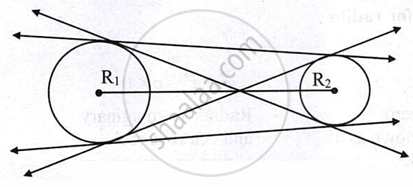 |
4 | d > r₁ + r₂ |
| Touch externally | 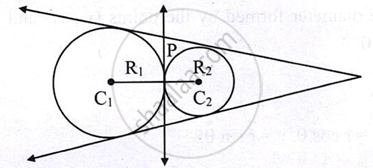 |
3 | d = r₁ + r₂ |
| Intersecting circles | 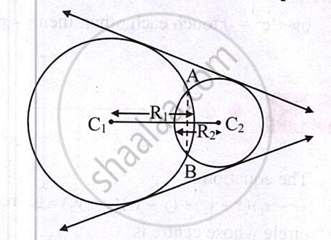 |
2 | d < r₁ + r₂ |
| Touch internally | 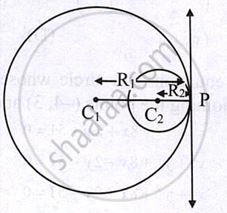 |
1 | d = \[\left|\mathbf{R}_{1}-\mathbf{R}_{2}\right|\] |
| Concentric circles | 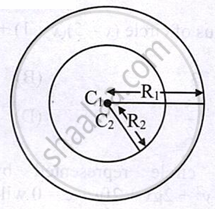 |
0 | d = 0 |
Equation of a pair of tangents:
(x² + y² − a²)(x₁² + y₁² − a²) = (xx₁ + yy₁ − a²)²
-
A tangent touches a circle at only one point (point of contact).
-
The radius through the point of contact is perpendicular to the tangent.
-
A line perpendicular to the radius at its endpoint is a tangent to the circle.
-
No tangent can be drawn to a circle from a point inside the circle.
-
Exactly one tangent can be drawn from a point on the circle.
-
Exactly two tangents can be drawn from a point outside the circle.
-
From an external point, the two tangents drawn to a circle are equal in length.
-
The two tangents from an external point make equal angles at the centre.
-
If two circles touch each other, the point of contact lies on the line joining their centres (external and internal touching).
